

The most expensive abrasive you'll ever buy isn't the one with the highest price tag; it's the cheap retail disc that fails halfway through a porcelain cut and ruins a high-value slab. When your tools can't handle the density of modern masonry or stone, the hidden costs of heat damage and substrate failure start to climb. Using professional grade abrasives for construction is a labor-saving investment that dictates the bond strength of every subsequent layer in your project.
It's frustrating when standard media wears out too quickly on masonry or leaves a jagged edge that requires hours of rework. You need materials that stay cool and sharp, especially when preparing surfaces for critical moisture management systems like the PSC Pro Gen II. This 2026 guide teaches you how to select and apply high-performance abrasives to ensure structural integrity and professional finishes on any job site. We'll cover the technical logic behind longer-lasting media, methods for cleaner cuts on porcelain, and how to accelerate surface preparation for a more efficient workflow.
Key Takeaways
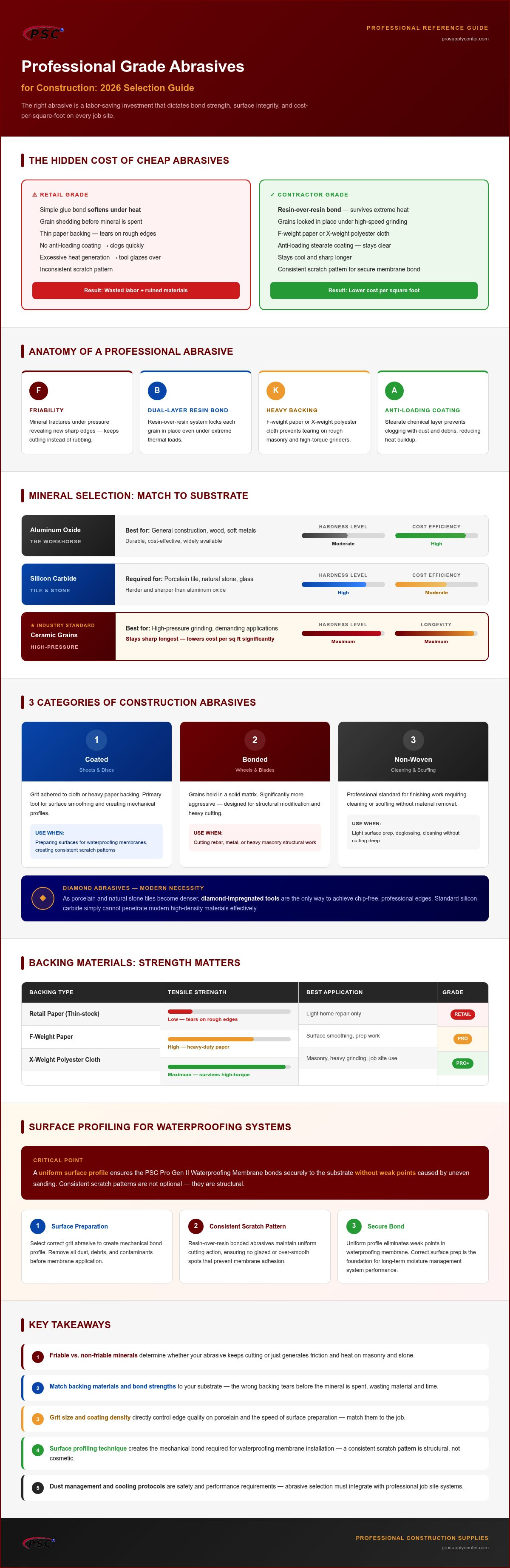
- Understand the technical distinction between friable and non-friable minerals to ensure your abrasive media lasts through heavy-duty masonry and stone applications.
- Identify the correct professional grade abrasives for construction by matching backing materials and bond strengths to the specific physical demands of your substrate.
- Learn to navigate grit sizes and coating densities to achieve cleaner cuts on porcelain and faster surface preparation for high-performance installations.
- Master surface profiling techniques that create the critical mechanical bond required for the PSC Pro Gen II Waterproofing System.
- Improve job site safety and compliance by selecting abrasives that integrate effectively with professional dust management and cooling protocols.
Anatomy of Professional Grade Abrasives: Why Quality Matters in Construction
Professional grade abrasives for construction are engineered for high-stress environments where retail products simply fail. While a standard sanding disc might work for a quick home repair, commercial job sites demand a specific mineral anatomy to handle the heat and friction of masonry, tile, and structural steel. For a comprehensive overview of abrasives and their historical development, industry standards provide a baseline; however, the practical difference lies in the "friability" of the mineral. Friable minerals fracture under pressure to reveal new, sharp edges, which keeps the tool cutting rather than rubbing. Non-friable minerals are tougher and resist breaking, making them ideal for high-pressure grinding where longevity is the priority.
The backing material is the next critical factor in the durability gap. Retail "thin-stock" paper lacks the tensile strength to survive rough masonry edges or high-torque grinders. Professional media uses heavy-weight paper (F-weight) or polyester cloth (X-weight) to prevent premature tearing. Additionally, professional coatings include anti-loading stearates. These chemical layers act as a lubricant to prevent "loading," which is the clogging of the abrasive surface with dust and debris. Without these features, your tool generates excessive heat, glazes over, and stops performing long before the mineral is actually spent.
Retail vs. Contractor Grade: The Durability Gap
Retail sponges and discs often use simple glue bonds that soften as the tool heats up, leading to "grain shedding." Professional grade abrasives for construction utilize resin-over-resin bonding. This dual-layer resin system locks each mineral grain in place, even under the extreme thermal loads generated during high-speed grinding. This ensures a consistent scratch pattern, which is vital when preparing a surface for the PSC Pro Gen II Waterproofing System. A uniform profile ensures the waterproofing membrane bonds securely to the substrate without weak points caused by uneven sanding.
Mineral Selection: Aluminum Oxide vs. Silicon Carbide
Selecting the right mineral is a matter of matching hardness to the substrate. Using the wrong grain results in wasted labor and ruined materials. The standard choices in 2026 include:
- Aluminum Oxide: The workhorse for general construction. It's durable, cost-effective, and ideal for wood or soft metals.
- Silicon Carbide: Harder and sharper than aluminum oxide. This is the requirement for professional grade abrasives for tile, stone, and glass.
- Ceramic Grains: The industry standard for high-pressure applications. It stays sharp longer than any other mineral, significantly lowering your "cost per square foot" by reducing downtime for disc changes.
Categorizing Construction Abrasives: Coated, Bonded, and Non-Woven Media
Professional grade abrasives for construction aren't just about grit size; they're about how that grit is delivered to the surface. These tools fall into three primary categories: coated, bonded, and non-woven. Coated abrasives, including sanding sheets and discs, use a backing material like cloth or heavy paper to hold minerals in place. These are your go-to for surface smoothing and creating the mechanical profile needed for high-performance waterproofing systems. Choosing the right backing determines if the disc will tear on the first rough edge or last through the entire prep phase.
Bonded abrasives are significantly more aggressive. These consist of abrasive grains held within a solid matrix, forming wheels or blades designed for structural modification. For finishing work that requires cleaning or scuffing without material removal, non-woven media is the professional standard. Finally, diamond abrasives have become a necessity for modern tiling. As porcelain and natural stone tiles become denser, diamond-impregnated tools are the only way to achieve chip-free, professional edges on high-density materials that standard silicon carbide simply can't penetrate effectively.
Bonded Abrasives for Heavy Construction
Bonded tools handle the heavy lifting on a construction site. When you're cutting through rebar or metal framing, a high-quality cut-off wheel provides the stability needed to prevent the blade from shattering under lateral pressure. For subfloor preparation, grinding cups are the industry standard for leveling high spots in concrete subfloors. This step is critical before installing any tile leveling system to ensure a flat, professional finish. Always verify the RPM safety rating on the disc matches your grinder's output. Using an under-rated disc is a major safety hazard that can lead to catastrophic tool failure and job site injuries.
Non-Woven Finishing Pads
These pads excel at the final stages of a project where surface integrity is paramount. They're particularly useful for preparing vinyl or rubber cove base for adhesive bonding by scuffing the surface without tearing the material. On tile projects, non-woven pads are the safest way to remove stubborn grout residue from delicate glazes without causing scratches. They also allow contractors to blend finishes on commercial stainless steel fixtures or outdoor decking components. By choosing professional grade abrasives for construction in a non-woven format, you ensure a uniform look across all surfaces without the risk of over-sanding the substrate.
Material-Specific Selection: Matching Abrasives to Your Substrate
Every substrate responds differently to friction and heat. If you use a closed-coat abrasive on drywall, the paper will clog in seconds. Conversely, using a soft mineral on high-density porcelain will simply polish the surface without cutting it. Selecting professional grade abrasives for construction requires an understanding of how your target material sheds dust and absorbs heat. For drywall, open-coat abrasives are the standard. The extra space between mineral grains allows fine dust to escape, which prevents the "loading" that ruins retail-grade paper. When working with plastics or metals, the goal is often adhesion rather than removal. Proper scuffing is essential for the long-term bond of commercial grade cove base, where a light, uniform scratch pattern provides the grip for high-tack adhesives.
Concrete preparation presents a different set of challenges. Before you can install paver leveling spacers or pedestal systems on a balcony, you must level the high spots. This requires aggressive diamond grinding cups that can handle the aggregate without overheating. Failure to profile the concrete correctly leads to rocking pavers and structural instability in the finished deck. By matching the abrasive hardness to the concrete's PSI, you ensure a flat surface that supports the weight of the entire decking system.
Abrasives for Modern Tiling
Modern porcelain is significantly denser than the ceramic tiles of the past. To manage lippage in large-format installations, you need professional grade abrasives for tile that can shave down edges without chipping the glaze. This is especially critical when smoothing mitered edges for integrated shower niches. A rough cut creates a sharp, dangerous edge that grout cannot hide. Many pros still rely on hand-rubbing stones for the final touch. These stones allow for high-precision control that power tools often lack on delicate corners, providing a factory-smooth finish on every cut.
Masonry and Hardscaping Prep
Selecting professional grade abrasives for construction requires a move beyond basic grit numbers to an understanding of how the tool behaves under load. Performance is dictated by three technical pillars: the concentration of the mineral, the strength of the bond, and the ability of the media to shed heat. While retail products focus on a general "all-purpose" feel, contractor-grade supplies are specialized. For instance, the coating density determines how the tool manages waste. Open coat abrasives leave 30% to 50% of the backing exposed, which provides the necessary "valleys" for dust to escape. Closed coat abrasives provide 100% mineral coverage, which is essential for maximum stock removal on hard metals or dense stone where loading isn't a primary concern.
The bond type is equally critical for durability. Most construction-grade discs use resin bonds because they are synthetic and heat-resistant. Unlike glue-based retail alternatives, resin won't soften when the tool reaches high operating temperatures. For specific drywall applications, manufacturers add stearated coatings. This zinc-based lubricant prevents fine gypsum dust from adhering to the grit, effectively extending the life of the disc by three to four times compared to non-stearated versions. To ensure your project stays on schedule with the right technical specs, browse the full selection of professional abrasives at Pro Supply Center.
The Grit Selection Framework
Successful surface preparation follows a logical progression. You can't skip steps without compromising the finish or the bond of your next layer. Use this framework to guide your workflow:
- Aggressive Removal (36-60 grit): Use these for stripping old thin-set, leveling concrete high spots, or heavy stock removal on timber.
- Substrate Smoothing (80-120 grit): This is the intermediate stage. It's used to remove the deep scratches left by aggressive grits and to prep subfloors for leveling systems.
- Final Finishing (180-220+ grit): These are reserved for paint-ready drywall or polishing the mitered edges of natural stone.
Managing Heat and Friction
Heat is the primary enemy of abrasive longevity. When professional grade abrasives for construction are used on high-speed grinders, the friction can cause the mineral grains to "glaze" or dull prematurely. High-quality minerals are designed to be friable, meaning they fracture under pressure to reveal new, sharp edges. However, if the heat is too high, the grain melts rather than fractures. This leads to substrate discoloration, especially on light-colored stones or stainless steel. To prevent this, always match your tool's RPM to the abrasive's rating and use a steady, light pressure rather than forcing the tool into the material.
Integrating Abrasives into the Professional Workflow: From Prep to Finish
The success of a high-end installation often depends on what happens before the first tile is set. Integrating professional grade abrasives for construction into your workflow ensures that every layer of the build has a secure foundation. Surface profiling is the process of creating a "mechanical bond" by increasing the surface area of the substrate. This step is non-negotiable when preparing for the PSC Pro Gen II Waterproofing System. Without the correct profile, liquid-applied membranes or sheet systems may fail to adhere properly, leading to delamination under hydraulic pressure.
Dust management is the next critical link. OSHA compliance isn't just about avoiding fines; it's about maintaining visibility and protecting your health. Choosing abrasives with integrated extraction holes or using vacuum-shrouded grinders significantly reduces airborne silica. Additionally, you must pair your media with the correct tool. Using a high-speed abrasive on a low-oscillation sander leads to "pigtail" scratches that are difficult to hide. Before declaring a job finished, use a raking light held at a low angle across the surface. This technique reveals any abrasive-induced scratches or uneven spots that standard overhead lighting misses.
Prep for Waterproofing and Adhesives
Concrete substrates often have "laitance," a weak, milky layer of cement that rises to the top during curing. You must remove this layer using aggressive grinding to ensure your waterproofing or thin-set bonds to the structural concrete rather than a surface film. For non-porous surfaces, such as existing tile or specialized backer boards in waterproofing shower kits, a light scuffing with a medium-grit abrasive creates the necessary "tooth" for adhesives. This same logic applies to cove base installations; cleaning and profiling the wall base ensures the adhesive doesn't peel over time.
Job Site Efficiency and Safety
Efficiency on a commercial site relies on the "one-pass" philosophy. This means selecting a high-performance abrasive that achieves the desired profile in a single stage rather than requiring multiple grit transitions. Professional grade abrasives for construction are designed for this level of throughput. Finally, consider your storage environment. Abrasives are sensitive to humidity; moisture can weaken the bond between the grain and the backing, causing the disc to "chunk" or fail prematurely. Keep your stock in a climate-controlled area to maintain the integrity of the resin bond and ensure consistent performance on every job.
Future-Proofing Your Build Through Technical Precision
Selecting the right abrasive is a decision that impacts every subsequent stage of your installation. By prioritizing mineral friability and heat-resistant resin bonds, you eliminate the frustration and rework caused by glazed edges or premature substrate loading. We've covered how matching the specific hardness of your media to modern materials like dense porcelain or structural concrete is essential for creating the mechanical bond required for advanced waterproofing and leveling systems. This technical approach transforms surface preparation from a chore into a critical step for long-term structural integrity.
Investing in professional grade abrasives for construction ensures that your tools perform under the pressure of a commercial job site. Pro Supply Center maintains an expert-selected inventory specifically curated for high-performance waterproofing and leveling applications. Our supplies offer contractor-grade durability for national commercial projects, providing the stability and efficiency you need to stay on schedule. When you choose materials based on performance metrics rather than initial price, you guarantee a professional finish that stands up to scrutiny.
Shop Professional Grade Abrasives and Construction Supplies at Pro Supply Center
Take the guesswork out of your next project by using media engineered for the trade. With the right supplies in your kit, you can approach any substrate with the confidence that your finish will meet the highest industry standards.
Frequently Asked Questions
What is the difference between open-coat and closed-coat abrasives?
Open-coat abrasives feature spaces between the mineral grains, typically covering 50% to 70% of the backing. This design creates valleys that allow dust and debris to escape, making them ideal for soft materials like drywall or pine. Closed-coat abrasives provide 100% grain coverage for maximum material removal. You should choose closed-coat options when working on hard metals or dense stone where surface loading is less of a concern.
Which abrasive mineral is best for cutting porcelain tile?
Silicon carbide and diamond are the superior choices for porcelain. Because porcelain is extremely dense, standard aluminum oxide will dull almost instantly without making a clean cut. Silicon carbide is sharper and harder, while diamond-impregnated tools are the professional standard for achieving chip-free edges on large-format tiles. These professional grade abrasives for construction ensure that mitered corners and visible edges remain smooth and structurally sound.
How do I prevent my sanding discs from clogging when working on drywall?
Preventing clogs in drywall requires a combination of open-coat design and stearated coatings. A stearated coating acts as a dry lubricant that prevents fine gypsum dust from adhering to the abrasive grains. Without this layer, the disc "loads" quickly and stops cutting. Pairing these discs with a vacuum-shrouded sander further extends tool life by removing the majority of the waste before it can settle into the grit.
Can I use the same abrasives for both wood and masonry prep?
It's not recommended to use the same abrasive for both materials. Wood prep usually relies on aluminum oxide, which is tough but not hard enough for stone. Masonry requires silicon carbide or ceramic grains to penetrate the surface effectively. Using wood-grade paper on concrete or tile results in immediate grain shedding and excessive heat buildup, which can damage your power tools and leave an inconsistent finish on the substrate.
What grit should I use to prep a floor for a waterproofing membrane?
For floor preparation, you should start with an aggressive 36 to 60 grit abrasive. This coarse range is necessary to remove laitance, old adhesives, or high spots in concrete. Creating this specific surface profile is a critical step before installing the PSC Pro Gen II Waterproofing System. A rougher texture provides the mechanical bond required for the waterproofing membrane to adhere permanently to the subfloor without risk of delamination.
How does heat resistance affect the lifespan of a grinding wheel?
Heat resistance is the primary factor in determining how long a grinding wheel stays sharp. When a wheel lacks proper thermal management, the abrasive grains "glaze" over and lose their cutting edge. Professional grade abrasives for construction use resin bonds that withstand high temperatures without softening. This allows the mineral grains to fracture as intended, which continuously reveals new, sharp edges and prevents the substrate from discoloring during high-speed grinding.
Why are diamond abrasives necessary for modern construction projects?
Diamond abrasives are essential because modern construction materials, such as high-density porcelain and engineered stone, have outpaced the hardness of traditional minerals. Traditional silicon carbide often struggles to produce clean cuts on these surfaces, leading to jagged edges and wasted material. Diamond tools provide the precision needed for complex tasks like mitering shower niches or smoothing paver edges, ensuring the integrity of the build remains high even with dense substrates.
How do I choose between a sanding sponge and a sanding sheet?
Your choice depends on the geometry of the surface you're finishing. Sanding sheets are the professional choice for flat surfaces where you need consistent pressure and a uniform scratch pattern. Sanding sponges are better suited for contoured edges, corners, or irregular profiles like cove base trim. When selecting a sponge, ensure it features resin-over-resin bonding, as retail-grade sponges often tear when they encounter the sharp or rough edges of masonry.


