

What if the best-looking wall base isn’t the best fit for the room? Choose flexible vinyl cove base for more than its color: the profile, dimensions, wall and floor conditions, and corner details all affect the finished result.
It’s easy to focus on appearance, then run into questions about whether the base will suit the room, how to handle curves and seams, or which adhesive matches the surfaces. Comparing the product specifications and installation requirements before buying helps you plan for those details instead of leaving them until installation.
This guide explains how to choose a suitable flexible vinyl profile and size, and how vinyl compares with rubber wall base. It also covers what to check in product specifications and how to plan for surface preparation, adhesive compatibility, corners, seams, and finishing details. Use these factors to make a more informed selection for a cleanable, well-fitted finish.
Key Takeaways
- Match the cove profile and toe design to the wall-floor junction and the room’s geometry.
- Compare height, thickness, and length format using product specifications rather than assumptions.
- Flexible vinyl and rubber each suit different project conditions. Weigh flexibility, traffic, surface needs, and cleaning requirements.
- Plan measurements, cuts, substrate preparation, adhesive compatibility, corners, and seams before installation.
- Build a complete material plan around the room’s requirements, not appearance or price alone.
What Is Flexible Vinyl Cove Base, and Where Does It Fit?
Flexible vinyl cove base is pliable wall trim installed along the bottom of a wall. Unlike a flat wall-base strip, its lower edge curves outward to form a toe that meets the floor, finishing the wall-to-floor joint. The shape can create a neat perimeter, but it isn’t a substitute for a waterproofing system or a seal unless the product documentation specifically supports that use.
How does the cove profile finish the wall-to-floor joint?
The vertical face covers the lower part of the wall, while the curved toe meets the floor. Together, these parts create a continuous-looking perimeter and can conceal minor visual irregularities at the junction. For a general overview of baseboard purpose and materials, see Baseboard (Skirting Board). A consistent result depends on accurate fitting, sound surfaces, and appropriate installation materials.
When is flexible vinyl wall base worth considering?
Flexible vinyl wall base can work well for interior finishing when the trim needs to follow corners or modest changes in wall contour. Its pliability may make fitting room geometry easier than with a rigid strip, but flexibility alone doesn’t make a product suitable for every condition. For areas with specific performance requirements, choose a product whose documentation addresses that application.
Start by considering how the room is used. Frequent foot traffic, regular cleaning, or moisture exposure can place different demands on trim than a lightly used room. The wall and floor substrates matter, too: their condition and compatibility with the intended adhesive affect installation.
Review the product’s stated uses, installation requirements, and cleaning guidance. Pay particular attention to:
- Traffic: Consider how often people, carts, or equipment may contact the base.
- Cleaning routine: Match the product’s care instructions to the cleaners and methods used in the room.
- Substrate: Check that the wall surface is suitable for the product and adhesive system.
- Performance needs: If the space requires specific resistance or safety characteristics, select a product with documentation for those conditions.
Flexible vinyl cove base is one option within a broader wall-and-floor finishing plan. Pro Supply Center carries vinyl and rubber cove base trim. Comparing the room’s demands with each product’s documented properties helps narrow the choice beyond appearance alone.
Which Flexible Vinyl Cove Base Specifications Should You Compare?
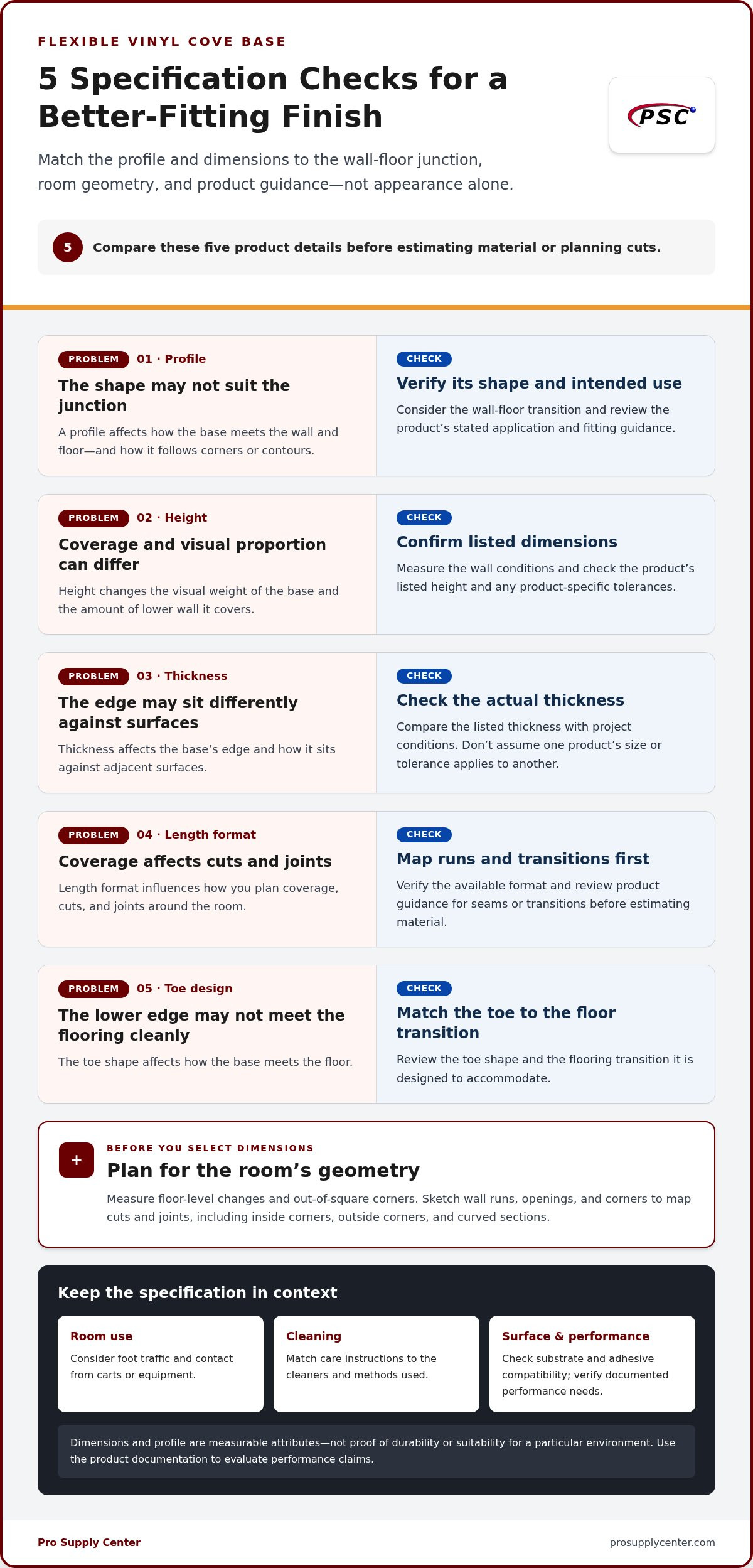
Start with the room, then compare the product details. Profile, height, thickness, length format, and toe design affect how the base fits the wall-floor transition and how much coverage it provides. Treat these as measurable attributes, not proof of durability or suitability for a particular environment. Use product documentation to evaluate performance claims.
| Specification | What it affects | What to verify |
|---|---|---|
| Profile | How the base meets the wall and floor, and how it follows corners or contours. | Profile shape and intended application. |
| Height | Visual proportion and the amount of wall covered. | Listed dimensions and any product-specific tolerances. |
| Thickness | The base’s edge and how it sits against adjacent surfaces. | Actual thickness and compatibility with the project conditions. |
| Length format | How to plan coverage, cuts, and joints around the room. | Available format and guidance for seams or transitions. |
| Toe design | How the lower edge meets the flooring. | Toe shape and the floor transition it is designed to accommodate. |
How do height, thickness, and profile affect the finished edge?
Height changes the visual weight of the base and the amount of lower wall it covers. Thickness and profile affect how the trim sits at the junction, while the toe should meet the flooring without an awkward gap or overlap. Measure the wall and floor conditions, including changes in floor level and out-of-square corners, before selecting dimensions. Don’t assume that a size or tolerance from one product applies to another.
Room geometry matters, too. A profile that works along a straight wall may need careful fitting at inside corners, outside corners, or curved sections. Review the product’s fitting guidance and plan these transitions before estimating material. A room sketch with wall runs, openings, and corners makes it easier to map cuts and joints.
What should you check about material and flexibility?
Flexible vinyl cove base can follow some contours and corners more readily than rigid trim, but the degree of flexibility and suitable applications depend on the product. Vinyl and rubber are distinct material categories. Compare their documented properties with the room’s traffic, cleaning routine, and surface conditions rather than assuming one is always superior.
Color and finish affect appearance, while cleaning compatibility depends on the product instructions. Check both alongside the adhesive guidance: the base, adhesive, wall surface, and floor transition need to work together. Pro Supply Center’s vinyl and rubber cove base selection can be part of your wall-and-floor finishing material plan.
Flexible Vinyl vs. Rubber Cove Base: Which Fits Your Project?
Material preference is only one part of the decision. Compare how each option fits the room’s contours, available profiles, substrate, traffic, and cleaning routine. Flexible vinyl cove base may suit a project where pliability helps the trim follow corners or changes in wall direction, but that alone doesn’t establish its performance in a demanding environment. Let product documentation guide decisions about intended use, cleaning, and environmental suitability.
When might flexible vinyl be the better fit than rubber?
Consider flexible vinyl when its profile and appearance suit the wall-floor transition and the layout includes corners or contours the trim needs to follow. Compare the specific vinyl and rubber options for your project rather than assuming one material bends, cleans, or performs better in every setting. Check the manufacturer’s guidance for cleaning methods and environmental conditions, then match those requirements to how the room will be used.
| Material | May be worth comparing when | Verify in product documentation |
|---|---|---|
| Flexible vinyl | A pliable profile may help accommodate the room’s corners or contours. | Profile, flexibility, approved applications, cleaning guidance, and substrate requirements. |
| Rubber | You want to compare another resilient wall-base material for the same room conditions. | Available profile, intended use, cleaning instructions, and installation requirements. |
| Rigid vinyl | The project calls for a less pliable wall-base option and its profile fits the layout. | Construction, profile, corner and transition details, and product-specific installation guidance. |
When should you compare other wall-base materials?
Look beyond material when the room has frequent foot traffic, a demanding cleaning routine, uneven or challenging substrates, or transitions that require a particular profile. In these situations, product-specific instructions may matter more than a general preference for vinyl or rubber. Rigid vinyl is another option when its construction and profile suit the layout. It isn’t automatically a poor fit because it bends less.
Before settling on a material, compare profile options and confirm that the product and installation system match the wall and floor conditions. For a closer look at material trade-offs, read Rubber vs Vinyl Cove Base: Which Fits Your Project? Pro Supply Center carries vinyl and rubber cove base trim, making its selection a practical place to compare options for your wall-and-floor finishing plan.
How to Plan Flexible Vinyl Cove Base Installation
A clean finish starts with planning, not adhesive. Before installing flexible vinyl cove base, map the wall runs, inspect the surfaces, decide where cuts and joints will fall, and confirm that the base and adhesive suit the substrate. Follow the product instructions throughout, since preparation, application, and finishing details can vary.
What should be measured and prepared before installation?
Measure each wall run and note inside and outside corners, door openings, floor transitions, and other interruptions. Use those measurements to plan material lengths and joint locations, allowing for cuts and reasonable waste. Inspect the wall and floor where the base will meet them. Remove debris and identify loose, damaged, or uneven areas that could interfere with contact.
Confirm that the substrate and its condition meet the requirements of both the base and adhesive. Some systems call for surfaces to be clean, sound, and dry, so follow the applicable product instructions rather than applying a blanket rule. Check adhesive compatibility with the wall surface and base material, along with any stated preparation requirements. Don’t assume an adhesive that works for one substrate or product will suit another.
How can corners, seams, and transitions look consistent?
Plan the cuts and corner treatment before applying adhesive. Decide where seams will land and how the base will meet openings or changes in flooring. A joint at a visible corner or transition may call for a different layout than one along a long, straight wall. The correct method depends on the profile and manufacturer’s guidance, so don’t assume every base should be scored, overlapped, or joined in the same way.
During installation, keep checking alignment along the wall and toe, and confirm contact as directed by the product instructions. Work methodically around corners and across seams. If the base shifts or a joint looks uneven, address it according to the manufacturer’s guidance before moving on. Follow the specified application and finishing steps, including any instructions for handling the adhesive. Avoid guessing at cure times or temperature conditions.
- Measure: Record wall runs, corners, openings, and transitions.
- Inspect: Check substrate condition and compatibility.
- Plan: Lay out cuts, seams, and corner details before application.
- Install and finish: Follow the base and adhesive instructions for application, alignment, and final checks.
For the material side of your project plan, explore vinyl and rubber cove base as part of your wall-and-floor finishing selection.
Choose Flexible Vinyl Cove Base and Build a Complete Material Plan
A complete takeoff connects the trim choice to the room and installation details. Before finalizing flexible vinyl cove base, check that the profile, dimensions, adhesive, and finishing approach work with the actual wall and floor conditions. Choosing by appearance alone can leave important details, such as corner treatments or cleaning compatibility, unaddressed.
What belongs on a flexible-vinyl cove-base takeoff?
Record each wall run and identify inside corners, outside corners, openings, transitions, and termination points. These details help you plan the layout, cuts, and joints rather than estimating from room area alone. Note the selected profile and dimensions as stated in the product documentation, along with the length format needed to plan coverage.
- Room layout: List wall-run measurements, corners, openings, and endpoints.
- Base specifications: Note the product’s documented material, profile, height, thickness, toe design, and length format.
- Installation materials: Include adhesive and accessories identified in the product instructions, checking compatibility with both the base and substrate.
- Finishing needs: Record how corners, seams, and transitions will be handled, along with cleaning requirements for the installed base.
How should you finalize the product selection?
Recheck measurements against the room, then review the conditions at the wall and floor. Confirm that the product documentation addresses the intended application and that its cleaning guidance fits the room’s routine. Compare those requirements with the substrate and adhesive instructions before completing the material plan. If a specification or installation detail isn’t clear in the documentation, don’t substitute an assumption from a different product.
This final review is also a useful point to compare your project with the broader selection and performance considerations in the Commercial Grade Cove Base guide. Use it as context, then base the final choice on the specifications for the actual product and the needs of the room.
A sound plan brings together the profile, dimensions, material, compatible adhesive, corner and seam treatments, and cleaning needs. Match each detail to the project rather than choosing on price or appearance alone. Explore Pro Supply Center’s cove base selection to compare vinyl and rubber options for your flooring and wall-finishing material plan.
Make the Wall-Base Choice That Fits Your Project
The right wall base suits the room, not just the sample. Match flexible vinyl cove base profile and dimensions to the wall-floor transition, then compare vinyl and rubber against the room’s traffic, cleaning routine, and substrate. Before installation, plan measurements, adhesive compatibility, corners, and seams using the product instructions.
Coordinating these decisions can help create a consistent finish and a complete material plan. Pro Supply Center supplies vinyl and rubber cove base trim for flooring and wall-finishing projects.
Ready to compare options for your project? Explore Pro Supply Center’s cove base selection and choose a product that aligns with your room’s requirements.
Frequently Asked Questions
What is flexible vinyl cove base?
Flexible vinyl cove base is wall trim designed to finish the junction between a wall and floor. Its curved toe meets the flooring, while its pliable construction can help it follow some contours. Product composition, profile, and installation requirements vary. Before choosing a base, review the manufacturer’s specifications for dimensions, suitable substrates, compatible adhesives, and cleaning guidance. These details help determine whether a specific product fits the room and its conditions.
Is flexible vinyl cove base suitable for commercial spaces?
Flexible vinyl cove base may suit a commercial interior if its documented specifications match the room’s requirements. Consider traffic levels, routine cleaning methods, substrate condition, and the desired finish. The term “commercial” alone doesn’t establish that a product is right for every space. Compare the product’s intended use and installation requirements with actual site conditions, and verify performance claims in its product literature before specifying or purchasing.
How do I choose the right height for flexible vinyl cove base?
Choose a height by measuring the wall-floor area and considering the room’s proportions, existing flooring, and the coverage needed along the wall. Then compare those measurements with the dimensions offered for the specific product. There isn’t one height that suits every application. Check the selected profile and its documented dimensions against the project’s finish requirements, including how the base will meet flooring transitions and adjacent surfaces.
Can flexible vinyl cove base be installed over uneven walls?
Flexibility may help the base follow some contours, but it won’t correct an unsound or substantially uneven substrate. Inspect the wall and floor junction before installation, then follow the product’s surface-preparation instructions. Check that the substrate condition falls within the product’s stated installation requirements. If it doesn’t, address the surface first. A suitable base and adhesive still depend on the condition and compatibility of the surfaces they’re applied to.
What adhesive should I use for vinyl cove base?
Use an adhesive identified as compatible with the specific cove base and installation substrate. For flexible vinyl cove base, check the adhesive manufacturer’s guidance alongside the trim manufacturer’s instructions. Compatibility, application method, open time, and curing requirements can vary by product and site conditions. Prepare the surface as specified, and don’t choose an adhesive by material name alone. The complete system needs to suit both the base and the wall surface.
How do you cut flexible vinyl cove base around corners?
Measure each wall run and plan the corner treatment before cutting. Inside corners, outside corners, and transitions may call for different cuts or components, depending on the selected profile. Follow the product instructions for fitting and bonding each section. Where practical, test a cut before completing the visible run. As you work, check that joints align and that the base maintains consistent contact as directed by the manufacturer.
How do you clean flexible vinyl cove base?
Clean flexible vinyl cove base according to the care instructions for the specific product. Don’t assume every vinyl base is compatible with the same cleaners or cleaning methods. Check the manufacturer’s guidance before using a product, especially as part of a regular maintenance routine. If instructed, test the cleaner on an inconspicuous area first. Consider the room’s cleaning requirements during selection so the chosen base fits its expected care routine.


