

The toughest trim isn’t always the best fit for the room. Choosing cove base molding means balancing the floor and wall conditions, expected traffic, appearance, and upkeep, rather than simply picking a material that looks durable.
Cove base is a type of wall base with a curved toe that helps cover the floor-to-wall gap. Straight, toeless base has no projecting lip, while traditional baseboards often serve a more decorative role. The right profile depends in part on the flooring and the finish you want.
This guide explains common forms of cove base molding and compares vinyl and rubber using practical project criteria. You’ll learn what to consider before buying, including how to measure the perimeter, account for corners and transitions, and assess the wall surface for installation. With those details in hand, you can narrow your choices to trim that suits the space and is easier to maintain.
Key Takeaways
- Understand how cove base molding finishes the wall-floor junction and how its profile differs from other wall trim.
- Compare rubber and vinyl by flexibility, room use, and project requirements, then use product documentation to assess specific performance.
- Match the trim to room traffic, cleaning needs, flooring, wall condition, and desired finish.
- Measure each wall run and record corners, doorways, and interruptions to plan material quantities and layout.
- Use a clear decision path to narrow your options, including Pro Supply Center’s vinyl and rubber cove base trim category.
What Is Cove Base Molding, and What Does It Do?
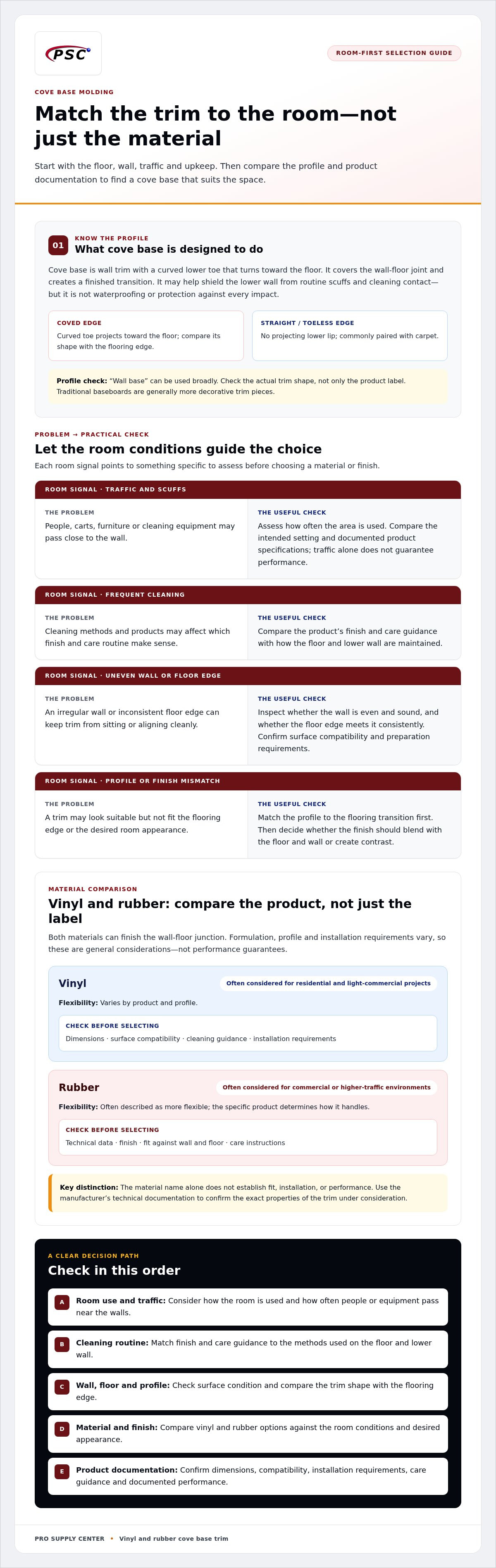
Cove base molding is trim installed along the bottom of a wall where it meets the floor. Its curved lower edge, often called a toe, turns toward the floor to cover the joint and create a neat transition between the two surfaces. It can also help shield the lower wall from routine scuffs and contact during cleaning. It should not be treated as waterproofing or as protection against every impact.
How Cove Base Molding Finishes the Wall-Floor Joint
The floor-to-wall junction can leave a visible gap or an uneven-looking edge. Cove base covers that joint and gives the room a consistent finished line. The toe meets the floor, while the upper portion sits against the wall. The trim may also take some everyday contact from cleaning tools or passing objects, helping keep marks off the wall. The level of protection depends on the product and installation.
Cove Base, Wall Base, and Baseboards: What Is the Difference?
Wall base is a broad term for trim installed at the bottom of a wall. Cove base is a wall-base profile with a curved toe; straight or toeless base has no projecting lower edge and is commonly paired with carpet. Traditional baseboards are generally more decorative trim pieces, often with a shaped face, set along the wall above the floor. The term Cove moldings also describes a curved trim form used to finish transitions between surfaces.
Product names aren’t always used consistently, so check the profile as well as the label. A coved edge and a straight edge serve different floor transitions, even if a catalog uses “wall base” broadly for both. Compare the trim’s shape with the flooring edge to avoid a terminology mismatch that leads to a fit problem.
Appearance matters, but it shouldn’t be the only selection factor. Consider the flooring material and its edge, how the room is used, how often the floor and lower wall are cleaned, and whether the wall is even enough for the trim to sit properly. A profile that looks suitable may not fit cleanly over an irregular surface or align well with the flooring. Start with the site conditions, then compare finish and color. This order helps you choose trim that works for the space as well as its appearance.
Rubber or Vinyl Cove Base Molding: How the Materials Differ
Vinyl and rubber are distinct material categories for cove base molding. Both can finish the wall-floor junction, but the material name alone doesn’t tell you how a specific trim will fit, install, or perform. A legal definition of cove base describes it as a vinyl or rubber base that forms a junction between a wall and floor. For a project decision, compare the product’s profile and technical documentation with the room’s conditions.
| Material | Flexibility | Common setting consideration | What to check |
|---|---|---|---|
| Vinyl | Flexibility varies by product and profile. | Often considered for residential and light-commercial projects. | Confirm dimensions, surface compatibility, cleaning guidance, and installation requirements. |
| Rubber | Often described as more flexible, but the specific product determines how it handles. | Often considered for commercial or higher-traffic environments. | Review the product’s technical data, finish, fit, and care instructions. |
These are general selection considerations, not performance guarantees. Formulation, profile, and installation requirements vary. Use the manufacturer’s technical documentation to confirm the exact properties of the trim you’re considering instead of assuming every vinyl or rubber option behaves the same way.
When to Consider Vinyl Cove Base
Consider vinyl as one material option, then assess the room’s use, wall surface, and flooring edge. Think about routine cleaning, too: the finish and care guidance should suit the maintenance routine. Before buying, check the product documentation for exact dimensions and installation requirements, including any surface-preparation guidance.
When to Consider Rubber Cove Base
Evaluate rubber using the same criteria. A busy room may make it a material worth comparing, but traffic level alone doesn’t establish how a product will perform. Check the intended setting, finish, fit against the wall and floor, and documented specifications. Comparing these details is more useful than choosing by material label or appearance alone.
Pro Supply Center offers vinyl and rubber cove base trim. Compare the room conditions first, then narrow the material and profile to what fits the floor and wall. Use the product documentation to confirm installation and performance details.
How to Choose Cove Base Molding for Your Room
Selecting cove base molding starts with the conditions at the floor and wall, then moves to material and finish. A trim choice that suits a lightly used room may not be the best fit for a busy space with frequent cleaning. Define the job before comparing options with this checklist:
- Room use: Is the space residential, commercial, or used for a mix of activities?
- Traffic and scuffs: How often do people, carts, furniture, or cleaning equipment pass near the walls?
- Cleaning routine: What methods and products are used on the floor and lower wall?
- Surface condition: Is the wall even and sound where the trim will sit? Does the floor edge meet it consistently?
- Finish: Should the trim blend with the floor and wall, or provide a deliberate visual contrast?
Match the Trim to Room Use and Maintenance
Everyday residential use may involve different traffic and cleaning demands than a commercial setting, so assess the actual room rather than relying on the category alone. A hallway, for example, may receive more frequent contact than a seldom-used room. Consider how often the lower wall is cleaned and what it may encounter. Then compare product guidance for the intended setting. Don’t assume a material label guarantees a particular performance level.
Check the Floor, Wall, and Desired Finish
The floor material and edge affect how the base profile meets the surface, while an uneven or damaged wall can interrupt fit and appearance. Inspect the junction along the full run, not just in one spot. Color coordination is a design decision: matching trim can create a quieter transition, while contrast can make the edge more defined. Before ordering, verify product dimensions and installation guidance against the project conditions.
Separate functional requirements from visual preferences. A preferred color won’t resolve a fit issue, and a suitable profile still needs to work with the room’s maintenance routine. For more context on commercial selection criteria, read the commercial-grade cove base selection and performance guide. Use your checklist to compare options with the room, then carry those requirements into measurement and purchasing.
How to Measure and Plan a Cove Base Molding Project
Good planning starts with a room sketch and a consistent set of measurements. Before estimating material, note the wall layout, floor-to-wall conditions, and any places where the trim will stop or change direction. These details help you compare the project with the selected cove base molding’s product format and installation documentation.
Measure Wall Runs and Record Project Details
Measure each continuous wall run separately, using the same unit throughout. Don’t rely on a single room dimension if the walls include recesses, returns, or other interruptions. Record each measurement on a simple sketch so the quantities and layout can be reviewed together.
- Draw the room outline. Mark each wall and label the runs in sequence.
- Measure each run. Note the length of every continuous section, including short returns.
- Mark corners and openings. Identify inside and outside corners, doorways, thresholds, and transitions to other flooring.
- Record interruptions. Note built-ins, wall openings, or other areas where the trim may stop and resume.
- Document site conditions. Add observations about the floor edge, wall surface, and any changes in level or material.
Keep your marks clear. A doorway is different from a corner, and a short interrupted section may affect how the trim is laid out. Final material quantities depend on the product format and project layout, so use the selected product’s documentation for coverage details instead of relying on a rough perimeter estimate alone.
Prepare for Fit, Adhesive, and Installation
Check that the wall surface is clean and sound enough to support a consistent fit. Loose material, residue, or uneven areas can affect how the trim sits and may need attention before installation. Record these conditions, and don’t assume the same preparation method applies to every surface or product.
Adhesive compatibility and application instructions are product-specific. Review the selected trim’s documentation for adhesive guidance, surface requirements, and installation details. This planning check does not replace those instructions. Reviewing them before purchasing helps align the material choice with the actual wall and floor conditions.
Use your sketch and notes to compare the project layout with Pro Supply Center’s vinyl and rubber cove base trim. Review the product documentation before finalizing quantities and installation plans.
Where to Find Vinyl and Rubber Cove Base Molding
Make the final choice in sequence: identify the room’s conditions, compare material options, check how the profile meets the floor and wall, then review the product documentation. This keeps cove base molding selection grounded in project fit instead of appearance alone. A color or finish can help complete the room, but it won’t resolve a mismatch with the flooring edge or an unsuitable wall surface.
Use a Final Selection Checklist
Before choosing a product, review the project details together. A short checklist can catch gaps between the room plan and trim specifications:
- Room requirements: Note how the space is used, expected traffic, cleaning routine, and preferred finish.
- Floor and wall fit: Check the floor edge, wall condition, and trim profile for a consistent junction.
- Product details: Verify dimensions, compatibility, and installation instructions in the product documentation.
- Project quantities: Revisit wall-run measurements and account for corners, doorways, transitions, and interrupted sections.
Keep the measurement notes with the product information. This makes it easier to compare options against the actual layout and spot details that could affect planned coverage or installation.
Explore Cove Base Molding Options
Pro Supply Center offers vinyl and rubber cove base trim. Treat these as material categories, not as a guarantee of a particular profile or performance level. Specific dimensions, features, and installation requirements depend on the individual product, so use its documentation to confirm the details relevant to your project.
Once the functional requirements are settled, consider finish and color as part of the room’s overall design. The right selection is the one that fits the space, flooring, wall condition, maintenance routine, and desired appearance as a complete set of requirements. Explore Pro Supply Center’s vinyl and rubber cove base molding selection to compare options for your project.
Make Your Cove Base Choice With Confidence
The right cove base molding fits the project, not simply the one that looks best on a sample. Match the material and profile to the room’s use, flooring, wall condition, and cleaning routine. Then check the product documentation for dimensions and installation requirements, and use careful measurements to plan wall runs, corners, and openings.
Vinyl and rubber each offer options to consider, but specific product details matter more than broad assumptions about either material. Pro Supply Center offers vinyl and rubber cove base trim, giving you options to explore as you narrow your project requirements.
Use your measurements and selection notes to compare options with a clear purpose. Explore vinyl and rubber cove base molding to find trim options for your flooring project.
Frequently Asked Questions
What is cove base molding used for?
Cove base molding finishes the junction where a wall meets the floor. Its curved lower edge, or toe, covers the joint and creates a cleaner transition. The trim can also help protect the lower wall from routine scuffs and contact during cleaning, depending on the product and installation. It isn’t a substitute for waterproofing, and its specific performance should be confirmed in the product documentation.
What is the difference between cove base and baseboard?
Cove base is a type of wall base with a curved lower edge that meets the floor. “Wall base” is a broader term for trim installed along the bottom of a wall, and some wall-base profiles have a straight, toeless edge. Traditional baseboards are often more decorative in profile. Since product terminology can vary, compare the trim’s shape and intended floor transition, not just its label.
Is rubber or vinyl cove base molding better?
Neither material is automatically better for every project. Rubber and vinyl are different material categories, and the right choice depends on room use, traffic, cleaning needs, desired finish, and fit with the wall and floor. Compare the specific product’s intended setting, dimensions, and installation guidance. Material names alone don’t establish a product’s performance, so use its technical documentation to assess suitability.
How do you measure for cove base molding?
Measure each continuous wall run separately and record the lengths on a room sketch. Mark inside and outside corners, doorways, transitions, and sections where trim will stop and resume. Keep the units consistent and note uneven walls or changes in the floor edge. Use the selected product’s format and coverage details to estimate quantities, then review the layout before finalizing the order.
Can cove base molding be installed over existing flooring?
It may be possible, but the answer depends on the trim profile, the existing floor’s edge and condition, and the product’s installation requirements. The cove toe should meet the floor as intended, and the wall surface must support the selected attachment method. Check the product documentation for compatibility and preparation guidance before proceeding. Don’t assume every trim can be fitted over every flooring type.
Does cove base molding need adhesive?
Some cove base products are installed with adhesive, while other products may use a different attachment method. The correct approach depends on the specific trim and the wall surface. Check the manufacturer’s instructions for adhesive compatibility, surface preparation, and application details. Avoid choosing an adhesive based only on the material name, since requirements can vary between products.
What size cove base molding should I choose?
Choose a height and profile that suit the room’s proportions, floor-to-wall junction, and practical requirements. Common cove-base heights include 2.5, 4, and 6 inches, but not every size is appropriate or available for every product. Compare the intended coverage and finish, then verify the selected trim’s dimensions and installation details in its documentation before ordering.


