

A hardscaping project's failure isn't usually the fault of the stone; it's the failure of the joint management system beneath it. Professional contractors know that even the most premium natural stone can shift or pool water if the spacing isn't engineered for the specific load. You've likely seen joint lines migrate over time or watched standard spacers crush under the weight of large format porcelain. When you're working with high-performance materials, using standard consumer-grade plastic isn't an option. You need heavy duty paver spacers that are built to withstand the compressive forces of commercial installations while maintaining perfect alignment.
It's frustrating when a high-end build loses its precision because of poor drainage or structural shifting. We understand that your reputation relies on the long-term stability of your work. This guide provides a deep dive into the technical standards and installation protocols for professional spacing systems. You'll learn how to achieve uniform 1/8 inch or 3/16 inch joint lines that remain stable under heavy porcelain or natural stone. We'll cover everything from ASTM C936 compliance and load distribution to efficient water management strategies that prevent surface pooling. By the end of this reference, you'll have the knowledge to select and install spacing systems that guarantee both structural integrity and aesthetic precision.
Key Takeaways
- Identify the technical requirements for high-density components designed to handle heavy compressive loads without shifting.
- Learn why UV-stabilized HDPE is the required material standard for heavy duty paver spacers to ensure long-term durability.
- Evaluate the mechanics of adjustable pedestal systems versus fixed spacers for on-grade and elevated decking applications.
- Master professional installation protocols, from sub-base preparation to establishing master joint lines for aesthetic precision.
- Understand how a system-based approach to hardscaping prevents common failures like surface pooling and spacer breakage.
Beyond Standard Plastic: Defining Heavy Duty Paver Spacers
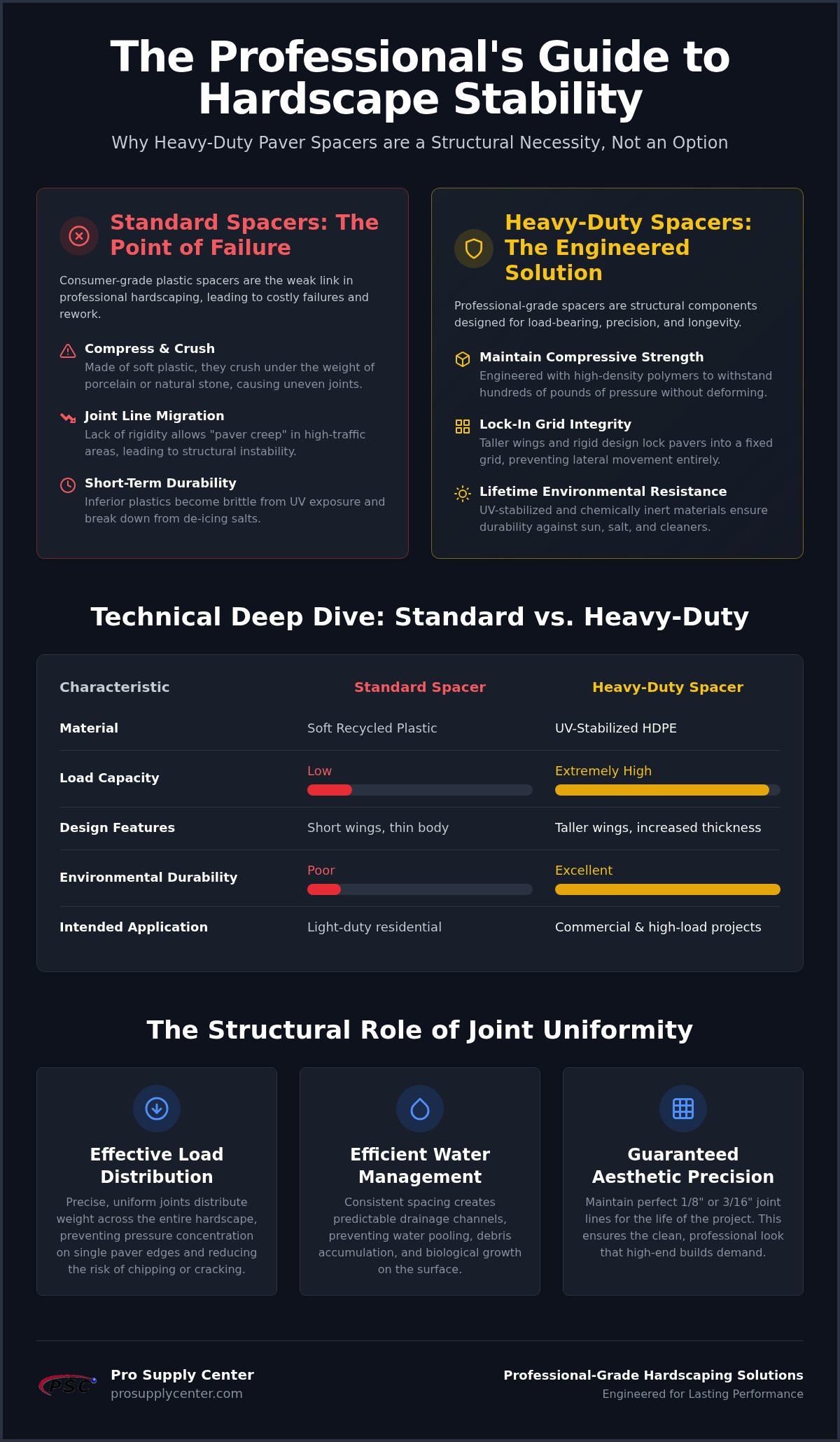
Heavy duty paver spacers are high-density, rigid components engineered to maintain specific joint widths under significant compressive loads. Unlike the flimsy, flexible spacers often found in residential kits, these professional-grade supports are designed to integrate into the structural assembly of a hardscape. They don't just create a gap; they function as a stabilizer that preserves the integrity of the entire surface. In a professional application, a spacer must resist crushing even when supporting large-format porcelain or heavy natural stone slabs that weigh hundreds of pounds.
The primary difference between standard and professional-grade supports lies in material density and structural rigidity. Residential spacers are frequently made of soft plastics that compress under weight. This compression leads to uneven joint lines and surface instability. Professional systems utilize high-density polypropylene or similar reinforced polymers. These materials ensure that a 1/8 inch joint remains exactly 1/8 inch for the life of the project. This precision is vital for the interlocking concrete paver system to function correctly, as it relies on uniform friction and load-sharing between units.
Spacers also serve as the first line of defense against lateral movement, commonly known as paver creep. In high-traffic zones, the constant force of foot traffic or light machinery can push units out of alignment. High-performance spacers lock the units into a fixed grid, preventing the "migration" that eventually leads to structural failure and costly rework.
The Structural Role of Joint Uniformity
Joint uniformity is a structural necessity for load distribution. When pavers are spaced correctly, the weight of a load is distributed across the entire hardscape surface rather than being concentrated on a single edge. This is especially critical for large format porcelain pavers, which are prone to edge chipping if they make direct contact with one another. Beyond protection, uniform joints are essential for effective water management. Consistent spacing allows for predictable drainage rates and prevents the accumulation of debris that can cause surface pooling and biological growth. For projects where water management extends to the surrounding landscape, utilizing automated irrigation components from gardenwatering.co.uk can help maintain the balance between hardscape drainage and plant health.
Commercial vs. Residential Specifications
Selecting the right specification depends entirely on the intended use of the area. Pedestrian walkways have different requirements than vehicular zones or commercial plazas. Standard 1/8 inch spacers often fail under heavy porcelain loads because the "wings" are too short or the material is too soft. Professional-grade heavy duty paver spacers feature increased material thickness and taller wing heights. These design elements ensure the spacer engages with the full depth of the paver, providing a secure grip that prevents the units from "riding up" over the spacer during the vibration and settling process.
Engineering and Material Science: What Makes a Spacer Durable?
The durability of a hardscaping system is directly linked to the chemical and physical properties of its smallest components. Professional systems utilize high-density polypropylene (HDPE) because it offers a superior strength-to-density ratio compared to standard recycled plastics. The material doesn't just hold space. It resists force. High-performance heavy duty paver spacers must maintain their structural profile under the constant weight of large format stone slabs, which can exert hundreds of pounds of pressure on a single joint point. If the material is too soft, the spacer compresses, leading to joint failure and uneven surfaces.
Environmental resistance is equally critical for longevity. Outdoor components face constant UV exposure, which can make inferior plastics brittle and prone to cracking within a few seasons. UV-stabilized polymers prevent this degradation, ensuring the spacer remains flexible enough to handle movement without snapping. These components must also withstand harsh chemical environments. De-icing salts, acidic cleaners, and fertilizers frequently come into contact with joint lines. A professional-grade spacer is chemically inert, meaning it won't break down or leach when exposed to common maintenance agents. The Concrete Masonry & Hardscapes Association (CMHA) highlights the importance of using heavy duty paver spacers to ensure proper joint stabilization and load transfer in interlocking systems.
Polypropylene vs. Standard Recycled Plastics
Lifecycle costs favor high-density polypropylene over budget alternatives. Standard recycled plastics often lack the molecular consistency required for extreme temperature stability. In climates with intense freeze-thaw cycles, inferior spacers can expand or contract at different rates than the surrounding stone, creating voids in the joint sand. The tensile strength of HDPE in hardscaping applications typically falls between 3,100 and 4,400 psi, providing the necessary resistance to deformation when pavers expand or shift. This stability ensures the structural grid remains intact year-round.
Design Variations: T-Shapes, Cross-Spacers, and Stackable Options
The geometry of a spacer should match the specific laying pattern of the project. Cross-spacers are the standard for traditional stack bond patterns, while T-shaped designs are required for staggered or running bond layouts to provide support at the intersection of three units. For projects with uneven sub-bases or varying stone thicknesses, stackable spacers allow for micro-adjustments to achieve a perfectly level surface. Some installers prefer integrated spacers that remain in the joint, while others use removable versions for a cleaner finish before applying jointing sand. Contractors looking for reliable performance often source from the professional-grade hardscaping inventory at Pro Supply Center to ensure material consistency across their projects.
Fixed Spacers vs. Adjustable Pedestal Systems
Choosing between fixed supports and adjustable systems is a matter of site conditions rather than preference. For traditional on-grade projects where a compactable base is established, fixed heavy duty paver spacers provide the most cost-effective solution. These are typically used in sand-set or aggregate-based installations where the grade is already established by the sub-base. In contrast, a pedestal decking system is the industry standard for elevated applications like balconies, terraces, or rooftops. These systems allow for a perfectly level surface while the underlying substrate remains sloped for drainage. It's a reliable way to turn unusable space into a functional area.
Hybrid approaches are common in professional hardscaping. When you're working with minor grade irregularities on a concrete pad, you don't always need a full pedestal. Installers often use fixed spacers combined with leveling shims. This allows for precise micro-adjustments without the expense of a full assembly. Understanding the economics of each choice helps contractors maintain margins without compromising the structural integrity of the build.
Elevated Applications and Drainage
Pedestal systems are engineered to manage water runoff on non-porous surfaces by creating a dry-laid deck. The spacer head on these pedestals maintains open joints, allowing water to pass through to the drainage layer below. This prevents surface pooling and protects the underlying structure from moisture damage. For rooftop projects, these systems are frequently paired with the PSC Pro Gen II Waterproofing System. The synergy between the waterproofing membrane and the elevated spacers ensures the building envelope remains secure while providing a functional, high-traffic surface.
Installation Speed and Labor Efficiency
Labor is the most significant cost in any commercial hardscape project. While a pedestal system has a higher material cost than standard heavy duty paver spacers, it significantly reduces labor hours spent on base preparation. Traditional sand-set installations require meticulous screeding and compaction. Pedestals allow for rapid leveling over uneven or sloped substrates. This efficiency extends to long-term maintenance. Because the pavers aren't permanently bonded or grouted, they can be lifted easily for repairs or utility access. This accessibility reduces lifecycle costs for commercial property owners and simplifies future renovations.
Professional Installation Protocols for Commercial Hardscaping
Professional installation begins long before the first unit is laid. The performance of heavy duty paver spacers is entirely dependent on the quality of the sub-base. If the foundation is unstable, even the strongest spacers cannot prevent joint migration or surface failure. In commercial settings, this means following a rigorous protocol for base preparation, alignment, and edge containment to handle the high compressive forces of pedestrian and light vehicular traffic.
Base Compaction and Leveling
Installations should adhere to ASTM C936 standards, which require paving units to meet a minimum compressive strength of 8,000 psi. To support these units, the sub-base must be compacted to industry-standard density levels to prevent settling. Without proper compaction, the bedding sand layer can shift, causing spacers to tilt or sink. This movement compromises the uniform joint lines you've worked to establish. When working with natural stone or large format porcelain, the precision of the cut is just as important as the base. Using professional grade abrasives allows installers to clean up factory edges or field cuts. Clean, square edges are essential for the spacers to sit flush against the material, preventing the gaps that lead to debris accumulation.
Edge Restraint and Lateral Stability
Spacers provide the internal grid, but a rigid edge restraint provides the external force required to keep that grid tight. In heavy-duty applications, the perimeter must be secured with concrete curbing or industrial-grade steel or aluminum edging. This prevents lateral movement when the surface is subjected to constant use. During the installation of the first few courses, establishing a master joint line is critical. Any deviation at the start will multiply across the project, leading to "joint drift." Regular verification with a string line or laser level ensures that the heavy duty paver spacers are maintaining the intended 1/8 inch or 3/16 inch gap consistently.
A final inspection should be conducted before the units are vibrated into the bedding sand. This process includes:
- Checking for joint drift against the master line to ensure geometric precision.
- Ensuring spacers are fully seated and not "riding up" between units.
- Confirming edge restraints are pinned or haunched securely to resist lateral pressure.
For contractors who need reliable materials that meet these rigorous standards, you can browse our full inventory of professional hardscaping supplies at Pro Supply Center.
Selecting Professional-Grade Hardscaping Solutions at Pro Supply Center
Success in commercial hardscaping depends on the reliability of your supply chain. Pro Supply Center serves as a technical partner for the trade, curating an inventory that prioritizes functional reliability over generic retail options. Every component we stock, from heavy duty paver spacers to advanced decking systems, is selected based on its performance in high-pressure environments. When you source from a technical supplier, you gain access to materials engineered for the specific compressive loads and environmental stresses of professional job sites. You don't have to worry about material failure when your components are built for the trade.
Integrated Systems for High-Performance Builds
A professional build is only as strong as its weakest component. We view paver spacers as a critical part of a broader construction ecosystem. This is why our inventory is designed for compatibility across multiple systems. Whether you're installing a rooftop terrace using our pedestal supports or an on-grade plaza, our components work in synergy with our waterproofing and floor prep products. For projects requiring transitions between exterior hardscapes and interior wet areas, our PSC Pro Gen II Waterproofing System provides a reliable foundation. Sourcing matching components like drains, niches, and spacers from a single technical source ensures quality consistency; it also reduces the logistical complexity of the project.
Procurement for National Commercial Projects
Managing large-scale commercial hardscaping requires a supplier that can handle bulk procurement without sacrificing technical support. We maintain significant inventory levels of heavy duty paver spacers and decking systems to support national projects with tight deadlines. Our team understands that contractors need more than just products. They need documentation and specifications for project submittals. We provide the technical data required to verify that our materials meet the necessary load-bearing and durability standards for high-traffic zones. This no-nonsense approach to supply allows you to focus on the execution of the build while we handle the material integrity. It's about providing the stability your reputation is built on. Browse our professional paver spacers and decking systems here.
Building for Long-Term Structural Integrity
A successful hardscape is defined by its ability to maintain precision under pressure. Achieving this requires moving beyond residential-grade plastics and utilizing heavy duty paver spacers engineered for commercial compressive loads. By prioritizing high-density materials like UV-stabilized HDPE and selecting the correct support system for your grade, you ensure that joint lines remain uniform and surfaces stay level. Professional-grade results are the product of combining these technical materials with rigorous installation protocols, from proper base compaction to secure edge restraints.
Pro Supply Center provides the specialized inventory needed for these high-performance builds. We offer contractor-grade durability and expert technical support for commercial hardscaping projects of any scale. With national shipping on all professional supplies, we're a reliable partner for your procurement needs. It's about providing the stability your reputation is built on. Shop Professional Hardscaping and Paver Spacers at Pro Supply Center and ensure your next project stands the test of time.
Frequently Asked Questions
What is the difference between standard and heavy duty paver spacers?
Heavy duty versions are manufactured from high-density polypropylene (HDPE) to withstand significant compressive loads. Unlike standard residential spacers that often crush or deform under weight, these professional components maintain their structural profile. They ensure that your joint lines remain perfectly aligned even when supporting large-format stone or porcelain. This rigidity is essential for the long-term stability of commercial hardscaping projects where load distribution is a primary engineering requirement.
Do I need to remove paver spacers after the installation is complete?
Most professional-grade spacers are designed to remain in the joint permanently. They are buried beneath the jointing sand or gravel to provide ongoing lateral stabilization for the units. Leaving them in place ensures that the pavers don't shift or migrate over time due to traffic or environmental changes. While some specific removable models exist for temporary alignment, the standard protocol for heavy duty paver spacers is permanent integration into the hardscape assembly.
Are plastic paver spacers UV resistant for long-term outdoor use?
Professional hardscaping spacers are treated with UV stabilizers during the manufacturing process to prevent material degradation. Outdoor environments expose these components to intense solar radiation, which can make untreated plastics brittle and prone to cracking. By using UV-stabilized polymers, manufacturers ensure the spacers remain flexible and durable for the life of the installation. This chemical resistance is a mandatory specification for any component used in exposed joints or elevated decking systems.
How many paver spacers do I need per square foot of hardscaping?
The number of spacers required depends entirely on the dimensions of your paving units and the laying pattern. For a standard 24x24 inch paver, you typically need one spacer per square foot of coverage. If you're using smaller 12x12 inch units, the requirement increases to approximately one spacer per unit. You should calculate based on the total number of paver intersections plus the perimeter edges to ensure you have adequate inventory for the job.
Can heavy duty spacers be used with both porcelain and natural stone pavers?
These spacers are fully compatible with both large-format porcelain and natural stone pavers. Porcelain units are often thinner and require the precise support of a rigid spacer to prevent edge chipping. Natural stone slabs are significantly heavier and need the high compressive strength of heavy duty paver spacers to avoid crushing. Regardless of the material, the spacer provides the necessary gap for drainage and joint stabilization across various material thicknesses.
What joint width is recommended for large format commercial pavers?
A joint width of 1/8 inch or 3/16 inch is recommended for most large-format commercial pavers. This spacing provides enough room for jointing sand or aggregate to lock the units together while allowing for effective water drainage. It also accommodates minor manufacturing variances in the pavers themselves. Using a width smaller than 1/8 inch can lead to edge-to-edge contact, which increases the risk of spalling and structural failure under heavy load.
How do spacers prevent pavers from shifting in high-traffic areas?
Spacers prevent shifting by locking the paving units into a consistent geometric grid. This arrangement distributes lateral forces across the entire surface rather than allowing a single unit to move independently. In high-traffic areas, this resistance to "paver creep" is vital for maintaining the integrity of the design. The rigid wings of the spacer act as a physical barrier that keeps the units from migrating toward the edges of the installation during use.
Can I use paver spacers with a sand-set base?
You should use spacers with a sand-set base to maintain uniform jointing throughout the installation. During the compaction process, pavers have a tendency to shift as the bedding sand settles. Spacers keep the units aligned during this critical phase, ensuring the finished surface is both aesthetically precise and structurally sound. They are especially useful in sand-set applications to prevent "running" joints where the alignment drifts over long distances.


