

Most shower failures don't happen because of the tile choice, but because the underlying waterproofing system wasn't designed as a single, cohesive unit. It's common to feel a sense of dread regarding hidden leaks that lead to mold and structural rot. You shouldn't have to guess whether your drain assembly will actually bond with your pan. Selecting a high-quality waterproof shower base kit is the most effective way to eliminate these variables and ensure your project meets the rigorous 2026 ANSI A118.10 standards for bonded membranes.
This guide will help you master the technical specifications and selection criteria required for a 100% leak-proof installation. We'll show you how to achieve professional-grade results with faster installation times, even when working with modern styles like linear drains. You'll learn the specific advantages of the PSC Pro Gen II Waterproofing System and how to create a hydrophobic shell that protects your home for decades. We'll examine the critical relationship between slope requirements and membrane thickness to ensure your next build is both efficient and indestructible.
Key Takeaways
- Understand why bonded membrane technology has replaced traditional pan liners to create a more reliable, subsurface moisture barrier.
- Identify the vapor permeance ratings and ANSI A118.10 standards required to ensure your installation remains compliant with 2026 building codes.
- Learn how the PSC Pro Gen II Waterproofing System integrates the drain and base into a single unit, simplifying the assembly of a waterproof shower base kit.
- Master the "thin-set sandwich" technique to ensure a permanent, leak-proof bond between your subfloor and the waterproofing layers.
- Evaluate the technical requirements for both curbed and curbless configurations to select the best drainage style for your project's layout.
Understanding the Anatomy of a Waterproof Shower Base Kit
A modern waterproof shower base kit represents a fundamental shift from component-based assembly to a fully engineered system. In the past, contractors sourced pans, liners, and drains separately, which often led to compatibility failures at critical junctions. Today, a professional-grade kit ensures that every element, from the bonding flange to the perimeter tape, works together to create a hermetic seal. This "system" approach is the only way to guarantee long-term performance in high-moisture environments. It's about more than just convenience. It's about eliminating the failure points that occur when mixing different manufacturers' products. When you use a complete kit, you ensure that the thin-set mortar bonds correctly to both the membrane and the drain flange, creating a single hydrophobic shell.
Bonded Membranes vs. Traditional Pan Liners
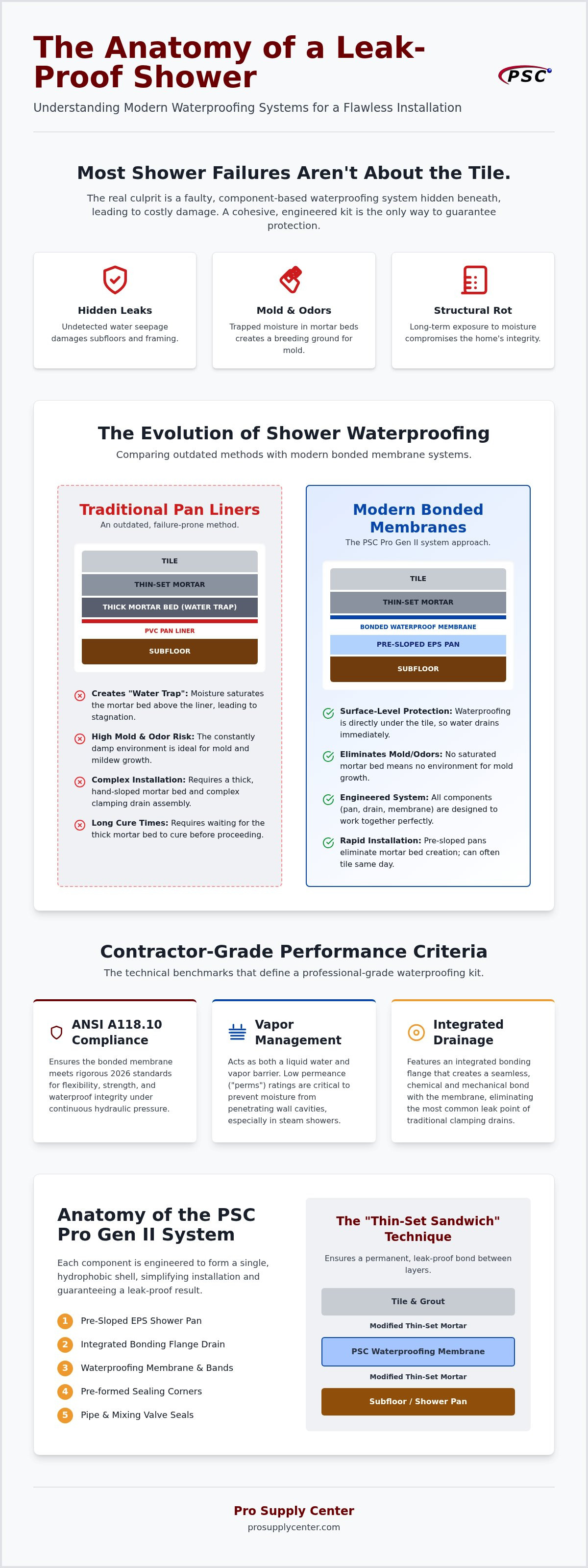
Traditional shower construction relied on thick mortar beds and PVC pan liners buried deep beneath the surface. This method created a "water trap" where moisture would saturate the mortar between the tile and the liner. This often led to stagnant water, mold growth, and white mineral deposits known as efflorescence. The PSC Pro Gen II Waterproofing System solves this by moving the waterproof layer directly beneath the tile. Water stays on the surface and flows into the drain immediately. This surface-level protection eliminates the damp mortar bed entirely. It significantly reduces the risk of structural rot and foul odors that plague older bathrooms. Modern systems are designed to meet ANSI A118.10 standards, ensuring the membrane is both flexible and strong enough to bridge small cracks in the subfloor.
The Role of Pre-Sloped Shower Pans
Achieving a consistent 1/4-inch per foot slope toward the drain is difficult with hand-troweled dry-pack mortar. Pre-sloped pans included in a waterproof shower base kit remove the guesswork by providing a factory-calibrated pitch. This ensures perfect drainage and prevents the "birdbaths" or standing water that can lead to tile failure. These pans are typically made from high-density expanded polystyrene (EPS). This material offers the high compressive strength necessary to support large format porcelain tiles without deflection. Using a pre-fabricated pan also cuts installation time by hours. There's no need to wait for a thick mortar bed to cure before applying the waterproofing membrane. You can often move from subfloor to tile in a single day, which is a significant advantage for tight project timelines.
Key Performance Criteria for Contractor-Grade Shower Kits
Selecting a waterproof shower base kit requires more than checking a box for moisture resistance. Professionals look for specific technical benchmarks that ensure the assembly won't degrade over time. Compliance with the International Plumbing Code is the baseline requirement for any North American installation. However, high-performance builds often demand specs that exceed these minimums, particularly regarding vapor management and drain connection integrity. You must verify that your chosen system carries the ANSI A118.10 certification for bonded waterproof membranes to ensure it can withstand the hydraulic pressure of daily use.
Vapor Management and Permeability
Permeance ratings, often measured in "perms," determine how well a material resists water vapor. This is critical for steam showers or high-use residential stalls where moisture is constant. While a standard liner might stop liquid water, it may still allow vapor to pass through, leading to moisture accumulation in the wall cavities. The PSC Pro Gen II Waterproofing System is engineered to act as both a liquid water and vapor barrier. This dual-purpose design is essential for maintaining the structural integrity of the home. It's vital to maintain a continuous seal from the floor up the walls to prevent vapor from bypassing the system at the seams.
Drainage Integration and Flange Design
The connection between the drain and the membrane is the most common leak point in custom showers. Traditional clamping ring drains rely on mechanical pressure and bolts, which can fail if the membrane shifts or the mortar settles. Integrated bonding flanges are the professional standard because they provide a large, flat surface area for the membrane to adhere to directly. This creates a chemical and mechanical bond that eliminates the risk of capillary action, where water "wicks" between layers. These systems are also fully compatible with linear shower drains for tile. Linear options allow for a single-slope floor, which is the preferred method for creating curb-less, ADA-compliant transitions. Using a matched system ensures the drain height and the pan slope are perfectly aligned from the start. You can explore these integrated configurations within our selection of PSC Waterproofing Shower Kits to find the right fit for your layout.
PSC Pro Gen II: Advancing Beyond Standard Waterproofing Membranes
Professionals often look beyond simple water resistance to the actual chemistry of the membrane bond. The PSC Pro Gen II Waterproofing System is engineered with an enhanced surface texture that maximizes the mechanical bond with modified thin-set mortars. This represents a significant technical leap over standard polyethylene sheets that can suffer from delamination if the mortar isn't perfectly mixed. By utilizing a high-performance waterproof shower base kit, you ensure that the primary barrier remains permanently fused to the substrate, even under the extreme thermal stress of daily hot water cycles. This level of reliability is why the Gen II system is the preferred choice for high-stakes commercial projects where failure is not an option. Similarly, professional firms like Swiss Build Ltd prioritize these high standards to ensure longevity and quality in every residential or commercial build.
Wood-framed subfloors are dynamic environments that expand and contract with seasonal humidity shifts. This movement is a primary cause of cracked grout lines and "tented" tiles in traditional installations. The PSC Pro Gen II membrane functions as a high-performance crack isolation layer, effectively decoupling the tile assembly from the underlying subfloor. It's designed to absorb lateral movement without transferring those stresses to the finished tile surface. This capability is essential for meeting International Plumbing Code standards while providing the long-term durability required for modern residential builds. By isolating the tile from structural shifts, the system prevents the microscopic leaks that often lead to rot in the joists below.
Integrated Shower Components
Efficiency on the job site is achieved through components that are engineered to fit together without field modification. Modern waterproofing shower kits provide a comprehensive ecosystem where every accessory is sealed into the primary membrane. This includes everything from the pre-sloped pan and curb to recessed ceramic soap dishes and pre-fabricated niches. Sealing these elements into a monolithic hydrophobic layer eliminates the risk of water bypassing the system at accessory transitions. This integrated approach ensures that the entire waterproof shower base kit functions as a single, impenetrable unit. It protects the wall cavities just as effectively as the floor, ensuring that the most vulnerable parts of the shower—the corners and penetrations—remain completely watertight for the life of the installation.
Site Preparation and Installation: Ensuring a Leak-Proof Seal
Installation success is decided long before the first bag of mortar is opened. Even the most advanced waterproof shower base kit cannot compensate for a compromised foundation. A professional-grade installation requires a subfloor that is structurally sound, level, and free of debris. Any deflection in the floor joists will eventually lead to tile delamination or grout failure, regardless of the membrane's quality. You must ensure the substrate meets the industry standard deflection limit of L/360 for ceramic tile or L/720 for natural stone. If the subfloor is uneven, use a high-quality self-leveling underlayment to create a flat plane. A flat surface is the only way to prevent lippage and ensure the pre-sloped pan sits perfectly flush against the substrate.
Critical Subfloor Preparation
Checking for deflection and cleanliness is the first step in any high-stakes build. Dust, oil, and drywall compound act as bond breakers that prevent the thin-set from adhering to the subfloor. Vacuum the entire area and wipe it down with a damp sponge before beginning. This preparation phase is where professional shower installation components prove their value. They are designed to integrate with a clean substrate to provide a permanent bond. If you're working with a wood subfloor, ensure the plywood or OSB is properly gapped to allow for natural expansion without stressing the waterproofing layer.
Applying the Membrane and Seals
Once the subfloor is ready, the installation of the waterproof shower base kit moves to the bonding phase. This is often called the "thin-set sandwich." You apply a layer of mortar to the pan, embed the membrane, and then apply more mortar on top for the tile. Use a 1/4" x 3/16" V-notched trowel or an 1/8" x 1/8" square-notched trowel to ensure even coverage without excessive buildup. It's vital to "key" the mortar into the substrate using the flat side of the trowel first. When embedding the membrane, use a flat trowel or a grout float to push out any air pockets. Work from the center toward the edges to ensure a 100% bond. All seams must overlap by at least two inches to maintain the integrity of the hydrophobic shell.
The most critical failure points are the corners and the drain interface. Don't rely on folding the flat membrane into these areas. Use pre-formed inside and outside corners to ensure a seamless transition. These components are specifically engineered to eliminate the bulk that occurs with folded sheets, making your tile work much easier. Before you even think about laying tile, perform a mandatory 24-hour flood test. Plug the drain, fill the base with water, and mark the waterline. If the level drops, you have a leak that must be addressed immediately. It's much cheaper to fix a seal now than to tear out finished tile later. View our full range of PSC Waterproofing Shower Kits to find the right configuration for your specific subfloor type.
Selecting Your Professional Waterproofing Solution at Pro Supply Center
Choosing the right waterproof shower base kit depends on the architectural goals and accessibility requirements of your project. For a traditional installation, a standard curbed kit provides a clear boundary and simplified water containment. If your design calls for a modern, open aesthetic, a curb-less configuration is necessary. This requires either a recessed subfloor or a specific ramped pan to ensure the transition is flush with the rest of the bathroom floor. You must also match your drain style to your floor's pitch. A point drain requires a four-way slope, while a linear drain allows for a single-plane slope, which is often preferred for large format tiles.
Before finalizing your order, verify that you have all the necessary components for a complete PSC Pro Gen II Waterproofing System installation. A professional-grade setup should include:
- A factory-sloped PSC Pro Gen II shower pan.
- The PSC Pro Gen II waterproofing membrane for the walls and floor.
- An integrated bonding flange drain (standard or linear).
- Waterproofing bands for all horizontal and vertical seams.
- Pre-formed inside and outside corners to seal critical junctions.
- A shower curb or curb-less transition ramp.
Customizing Your Waterproofing Kit
A truly professional build often includes integrated features that enhance the utility of the space. You can customize your kit by adding pre-fabricated niches and corner seats that are designed to be sealed directly into the primary membrane. These components eliminate the need for complex framing and ensure that the soap dish or bench is as watertight as the floor itself. It's also important to select a drain finish that matches your other bathroom hardware, such as brushed nickel, matte black, or oil-rubbed bronze. Always calculate your perimeter measurements carefully to ensure you have enough waterproofing band and sealant to maintain a continuous, monolithic barrier across every surface.
The Pro Supply Center Advantage
The Pro Supply Center Advantage
Sourcing your materials from a specialized professional supplier ensures you receive contractor-grade inventory that isn't available at standard big-box retailers. We focus on the PSC Pro Gen II system because it provides the reliability and performance that seasoned trade professionals demand. You gain access to technical expertise and a complete support ecosystem that understands the nuances of a job site. We offer national shipping across the US to keep your renovation projects on schedule. For broader home protection, you can also explore Direct-to-consumer e-commerce sales of water treatment hardware and maintenance supplies to address water quality and plumbing longevity. By choosing a curated system, you can move forward with the confidence that every component is engineered for compatibility, ensuring a successful, leak-proof result for years to come.
Building for Long-Term Structural Integrity
Achieving a leak-proof shower floor requires a fundamental shift from piecemeal components to a pre-engineered system. By prioritizing bonded membrane technology and verifying technical benchmarks like vapor permeance, you effectively eliminate the traditional failure points that lead to mold and structural rot. The success of your build rests on the foundation of the subfloor and the chemical bond of the mortar. Utilizing a high-quality waterproof shower base kit ensures that every element, from the pre-sloped pan to the integrated drain, functions as a single hydrophobic shell. This methodical approach is what separates a professional-grade installation from a standard renovation effort.
You now have the technical roadmap to master the specifications and installation nuances required for a 2026-compliant build. It's about combining precise site preparation with materials that are engineered to perform under the constant pressure of moisture and vapor. Ready to start your next project with industry-leading materials? Shop PSC Pro Gen II Waterproofing Shower Kits at Pro Supply Center to access contractor-grade PSC Pro Gen II technology with comprehensive system compatibility and national US shipping. You have the expertise to build a shower that performs under pressure and lasts for decades.
Frequently Asked Questions
What is included in a standard waterproof shower base kit?
A standard waterproof shower base kit provides all the essential components for a subsurface moisture barrier. Most kits feature a pre-sloped high-density foam pan, a roll of waterproof membrane for the floor and walls, and an integrated bonding flange drain. You'll also find specialized sealing bands and pre-formed inside and outside corners. These elements are engineered to work together, ensuring that moisture never reaches the structural subfloor or wall cavities during daily use.
Can I use a waterproof shower base kit on a wood subfloor?
You can install a waterproof shower base kit on a wood subfloor provided the structure meets specific deflection limits. The subfloor should be clean, level, and securely fastened to prevent shifting. Industry standards typically require a deflection limit of L/360 for ceramic tile or L/720 for natural stone. If your wood subfloor is uneven or unstable, you must address these issues with extra bracing or self-leveling underlayment before the installation begins.
Do I need to flood test a shower kit before tiling?
Performing a flood test is a mandatory step that must occur before you start any tile work. Once the membrane and all seals are installed and the thin-set has cured, you should plug the drain and fill the base with water. Mark the waterline and wait for 24 hours. This process verifies the integrity of every seam and corner. It's the only way to catch potential leaks before they are buried under finished tile and grout.
How long does it take for a waterproofing membrane to cure?
The curing time for a waterproofing membrane typically depends on the type of thin-set mortar used and the job site's ambient conditions. In most professional environments, you should wait at least 24 hours after embedding the membrane before performing a flood test or installing tile. This allows the mortar to achieve sufficient strength to handle the weight of the water or the foot traffic associated with setting tile without compromising the critical bond.
Is a waterproof shower base kit compatible with a linear drain?
Yes, many kits are specifically engineered for compatibility with modern linear drainage systems. A linear drain requires a single-plane slope toward one side of the shower rather than a traditional four-way pitch. When selecting your kit, you must choose a pan configuration that matches the linear drain's placement. This setup is particularly popular for curb-less designs and large format tile installations because it eliminates the need for complex envelope cuts.
What is the difference between the PSC Pro Gen II and standard membranes?
The PSC Pro Gen II system offers several technical advantages over standard polyethylene membranes. It features an enhanced surface texture designed to maximize the mechanical bond with modified thin-set mortars. This advanced chemistry reduces the risk of delamination in high-use environments. Additionally, the Gen II system provides superior vapor permeance ratings, making it suitable for steam showers and residential stalls where moisture control is a primary concern for long-term structural protection.
Can I install a curb-less shower using these kits?
You can achieve a curb-less or low-threshold entry by using specialized kit configurations. This often involves either recessing the subfloor or using a ramped pan that transitions smoothly to the rest of the bathroom floor. Curb-less designs are a key part of universal design principles for 2026. They provide better accessibility and a cleaner aesthetic. It's vital to ensure the waterproofing membrane extends at least two inches beyond the threshold to prevent water migration.
Do I need specialized tools to install the PSC Pro Gen II system?
You don't need highly specialized machinery to install the PSC Pro Gen II system. The process relies on standard professional tiling tools such as a 1/4" x 3/16" V-notched trowel for the membrane and a flat trowel or grout float to embed the material. A utility knife is needed for trimming the membrane and bands. The most important tool is a thorough understanding of the installation sequence, ensuring that every overlap and corner is sealed with the correct mortar coverage.


