

A high-end tile finish won't save your reputation if the substrate fails within the first year. Most contractors realize that the true value of a bathroom remodel lies beneath the surface, yet many still treat hardware as an aesthetic afterthought. When you prioritize the right professional shower installation components, you aren't just buying parts; you're investing in a structural insurance policy against floor leaks and moisture damage. With 16% of renovated bathrooms in 2025 now including wet rooms, the demand for integrated, high-performance hardware has never been higher.
You already know that complicated installation processes and lippage issues with large format tiles eat into your profit margins and frustrate your crew. This guide provides the technical roadmap you need to select hardware that ensures a leak-proof result that stands the test of time. We'll examine how to integrate advanced waterproofing systems, precision drains, and prefabricated niches to achieve a high-end finish while significantly reducing your time on the job site. From meeting 2026 drainage size requirements to ensuring a perfectly level floor, we cover the essentials for a successful, professional build.
Key Takeaways
- Understand why treating shower hardware as an extension of the waterproofing system is essential for preventing long-term structural failure and leaks.
- Learn how to evaluate the technical differences between linear and point drains to ensure proper drainage and compatibility with large-format tiles.
- Discover how to reduce labor costs and improve finish quality by replacing field-fabricated wall cubbies with integrated, prefabricated shower niches.
- Master the selection of professional shower installation components to create a continuous, high-performance barrier using the PSC Pro Gen II Waterproofing System.
- Gain insights into material grades and bonding flange technology to ensure your hardware selections meet the highest standards for durability and installation efficiency.
The Role of Professional Shower Hardware in the Wet Area Ecosystem
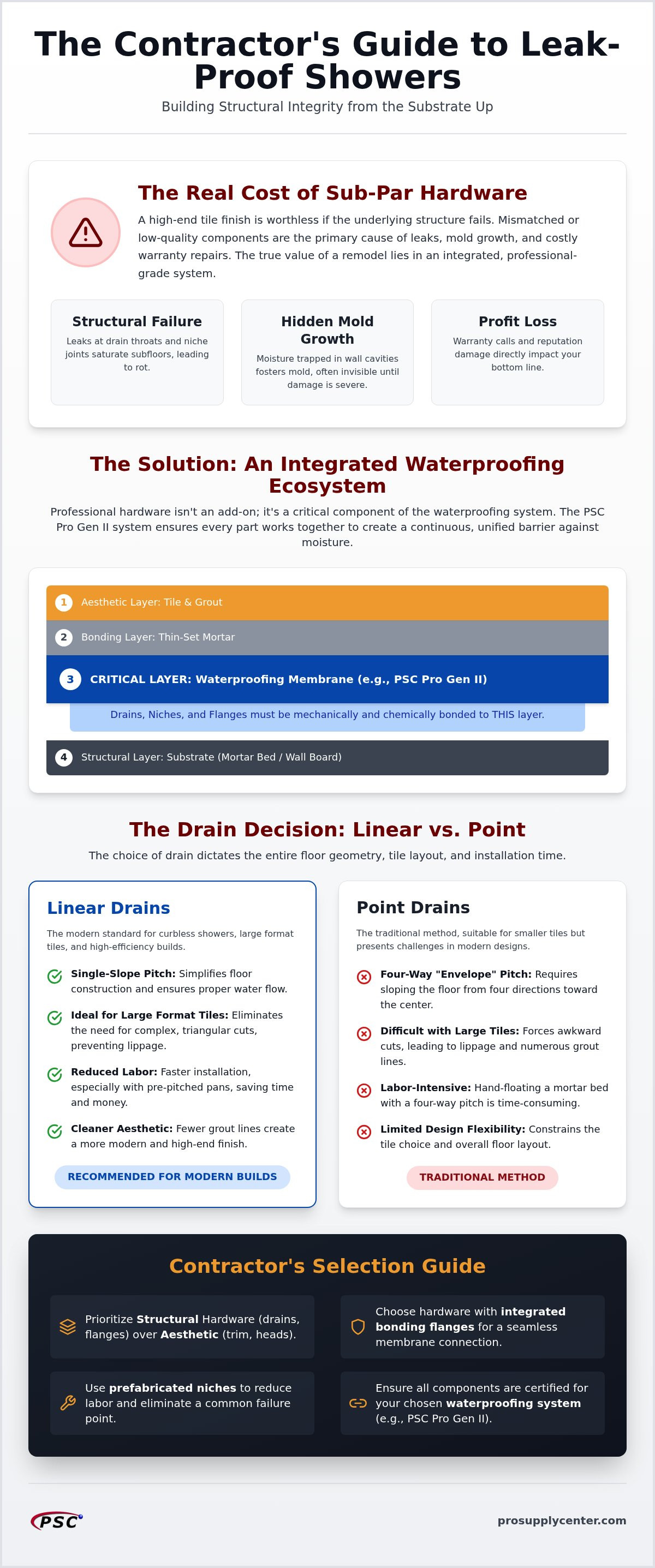
Professional shower installation components serve as the critical intersection between a building’s structural integrity and its daily user interface. In a high-performance wet area, hardware isn't a decorative add-on; it's a functional requirement of the drainage and moisture management system. When contractors treat waterproofing and hardware as separate categories, the ecosystem often fails at the transition points. A leak-proof assembly requires that every component, from the bonding flange to the niche, works in total compatibility with the primary membrane.
Standard consumer-grade finishes focus on surface aesthetics, but professional-grade supplies prioritize the hidden mechanics that prevent structural rot. By utilizing an integrated system like the PSC Pro Gen II Waterproofing System, you ensure that the physical hardware bonds chemically and mechanically with the waterproofing layer. This creates a continuous, unified barrier that protects the home's framing while providing a stable foundation for high-end tile work.
Structural vs. Aesthetic Hardware
Understanding the hierarchy of hardware is vital for project planning. Structural hardware includes the drain bodies, bonding flanges, and integrated niches that manage water flow and containment. Conversely, aesthetic hardware consists of the visible trim kits, showerheads, and handles that define the room's style. While clients often focus on the latter, the structural components dictate the longevity of the build.
Contractors must select structural components before the first tile is laid. You can easily swap a showerhead later, but a poorly chosen drain body is permanent. Proper shower construction and waterproofing starts with professional shower installation components that are designed to be embedded within the substrate, ensuring that moisture is directed into the plumbing rather than into the wall cavity.
The Consequences of Sub-Par Hardware Selection
Using mismatched or low-quality hardware leads to predictable failure points. Common issues include membrane delamination at the drain throat and joint failure where niches meet the wall studs. These gaps allow moisture to seep into the substrate, fostering mold growth that is often invisible until the damage is extensive. Professional-grade hardware mitigates this risk through precision-engineered bonding surfaces and integrated flanges.
Capillary action occurs when water is pulled into narrow gaps, such as micro-cracks in grout or unsealed hardware joints, allowing moisture to bypass the primary drainage path and saturate the subfloor. By choosing hardware designed for the PSC Pro Gen II system, you eliminate the guesswork and ensure the installation remains dry and structurally sound for decades. This proactive approach saves on future warranty calls and protects your profit margins.
Evaluating Shower Floor Drain Systems: Linear vs. Point Drains
The technical evolution of the shower floor drain has transformed it from a basic utility pipe into a primary design feature. In modern contracting, the drain selection dictates the entire floor geometry and tile layout. Choosing between a traditional point drain and a modern linear system isn't just about the look; it’s about managing water volume while maintaining the structural integrity of the pan. Professional shower installation components must be rated for high-output systems, especially as luxury multi-head showers become the standard in high-end builds.
Linear Shower Drains for Modern Curbless Designs
Linear drains have revolutionized barrier-free and curbless shower construction. Unlike traditional drains that require a four-way "envelope" pitch, a linear shower drain for tile allows for a single-slope floor pitch. This geometry is essential when working with large format tiles. By sloping the floor in one direction toward a wall-to-wall or entry-placed drain, you eliminate the need to cut large tiles into small triangles, which significantly reduces grout lines and prevents lippage issues. This creates a cleaner, safer walking surface that satisfies the most demanding clients.
Efficiency on the job site is another major advantage of the linear format. Pre-pitched pans designed for linear systems cut down on the labor-intensive process of hand-floating a mortar bed. When integrated with the PSC Pro Gen II system, these drains provide a flush, high-performance finish that handles high water volumes without the risk of pooling or overflow at the curb.
Point Drains and Traditional Four-Way Slopes
Point drains remain a reliable choice for central placement, particularly in smaller footprints or when using mosaic tiles. Because mosaics are flexible, they easily conform to the four-way slope required to direct water to a central square or circular grate. When installing these systems, the most critical step is ensuring a permanent, waterproof bond between the drain flange and the waterproofing membrane. Any compromise here leads to sub-floor saturation and eventual rot.
Adherence to the International Building Code shower requirements is mandatory for professional compliance, specifically regarding the minimum 2-inch drain and trap size for showers. Modern point drains often feature integrated hair strainers and removable grates, which are vital for long-term maintenance. These small details prevent clogs deep in the plumbing and reduce the need for invasive service calls later. For projects requiring traditional geometry, you can browse our selection of professional-grade point drains to find the right fit for your waterproofing method.
Flow rate remains a non-negotiable metric. High-output shower valves can easily overwhelm a standard drain if the grate free-area is insufficient. Always verify that your chosen drain can handle the cumulative GPM of all active fixtures. Properly matched professional shower installation components ensure that the wet area ecosystem remains balanced, safe, and entirely leak-proof under maximum load.
Professional Niches and Recessed Ceramic Hardware
Traditional field-fabricated niches are often the weakest link in a wet area's defense. Cutting and waterproofing a custom wall cubby from scratch involves multiple joints and transitions; each one increases the risk of water intrusion. Professional shower installation components have evolved to solve this by offering prefabricated, integrated shower niches that drop directly into the wall framing. These units eliminate the complexity of manual waterproofing while providing a consistent, square surface for tile application. They're a structural necessity for modern builds.
When selecting niche materials, contractors must weigh longevity against installation speed. Stainless steel and high-density plastic niches offer exceptional durability, but ceramic options provide a classic look that integrates seamlessly with traditional tile. The National Tile Contractors Association emphasizes the importance of maintaining membrane continuity, a task made significantly easier with factory-sealed components. These units ensure that the transition between the wall membrane and the recessed storage remains 100% watertight, even in high-moisture environments.
Integrated Shower Niches: Speed and Security
The hand-built niche is the primary failure point in many older shower walls. Joint separation and poor pitch often lead to standing water and mold growth behind the tile. Prefabricated niches solve this by coming out of the box with a pre-pitched bottom shelf and a factory-integrated bonding flange. This design ensures a flush, professional finish that bonds perfectly with the PSC Pro Gen II Waterproofing System.
Sizing is also critical. Most professional niches are designed to fit between standard 16-inch on-center studs, usually measuring 12 inches in width. This prevents the need for invasive structural modifications. For larger storage needs, vertical niches or stacked configurations offer ample space without compromising the wall's integrity. It's a faster, more secure way to build.
Ceramic Soap Dishes and Functional Accents
Recessed ceramic soap dishes remain a staple in high-traffic environments and rental properties. Unlike surface-mounted accessories that rely on problematic adhesives or mechanical fasteners, a recessed ceramic soap dish is embedded directly into the tile assembly. This makes it nearly impossible to knock loose, providing a permanent solution for soap and accessory storage. It's a practical choice that prioritizes utility over fleeting trends.
Installation requires precision to ensure a flush finish with the surrounding tile. Professionals use a thin-set mortar that is compatible with both the ceramic body and the waterproofing membrane. Because ceramic is non-porous and chemically resistant, it won't stain or degrade from soap scum or harsh cleaning agents. This durability ensures the hardware looks as good in year ten as it did on day one. For contractors, these components offer a reliable way to add value while minimizing future maintenance calls.
Waterproofing Integration: The PSC Pro Gen II Advantage
Hardware selection is the final mechanical connection in the PSC Pro Gen II Waterproofing System. It's the point where structural moisture management meets the plumbing stack. This system relies on a precise bond between the membrane and the hardware's integrated bonding flange. When these elements are matched, they create a continuous, non-porous barrier that extends from the wall studs to the center of the drain. This unified approach is what separates a high-performance professional build from a standard renovation.
Mixing different professional shower installation components from various manufacturers is a high-risk gamble that often voids product warranties. Most manufacturers require a single-source system to guarantee long-term performance. Adhesion failures frequently occur when the chemical composition of one brand's membrane doesn't bond correctly with another's flange material. Sticking to a curated ecosystem ensures the build remains intact and moisture-tight for the life of the shower, preventing the capillary action that leads to subfloor rot.
Bonding Hardware to the Membrane
The Gen II system utilizes fleece-backed hardware components designed specifically for modified thin-set mortar adhesion. This fleece layer provides a massive increase in surface area, allowing the mortar to lock the hardware into the waterproofing layer mechanically. This is vital for the drain-to-floor interface, which is the most common failure point in traditional pans. By ensuring the membrane overlaps the bonding flange by a minimum of two inches, you eliminate the possibility of water bypassing the drain and saturating the substrate.
This system also offers a PERM rating of 0.07, making it suitable even for high-moisture environments like residential steam showers. The transition from the floor membrane to the drain body is seamless. It provides a flat surface that prevents water from pooling around the grate, which simplifies the tile setter's job and ensures a flush finish. It's a technical advantage that saves time and reduces the risk of call-backs.
Complete Shower Installation Kits
Using PSC Waterproofing Shower Kits is the most effective way to manage job site efficiency. These kits ensure every piece is pre-engineered for compatibility, reducing common errors like using the wrong corner seal or an incompatible drain flange. It eliminates the need to source individual professional shower installation components from multiple vendors, which saves time and lowers shipping costs. Most kits include the following essentials:
- Integrated shower drains with bonding flanges
- Waterproofing curbs and pans
- Pre-formed membrane corners for a full seal
Pre-engineered hardware components ensure that every transition is tight and secure. This level of integration allows for faster installation times without sacrificing the quality of the finish. You can view our complete PSC Waterproofing Shower Kits to find the right configuration for your next project and ensure a leak-proof result.
Contractor Selection Guide: Durability and Installation Efficiency
Establishing a professional framework for hardware procurement involves looking past the initial sticker price to evaluate the total cost of ownership. For a seasoned contractor, the ROI of professional shower installation components is measured in reduced labor hours and the total absence of warranty calls. Choosing materials that are engineered to work together eliminates the troubleshooting phase of a project. While cheaper, off-brand alternatives might seem attractive for the budget, they often lead to site delays or material failures that cost significantly more in the long run.
Long-term client satisfaction depends on how the shower performs five years after the final inspection. High-performance drainage and storage solutions are the "user interface" of the wet area. If a niche collects standing water or a drain grate begins to pit, the quality of your tile work won't matter. You must prioritize components that offer both structural reliability and functional longevity to maintain your reputation in a competitive market. To further distinguish your projects with high-end natural finishes, you can learn more about Scandistone and their selection of unique stone sinks that complement professional bathroom installations.
The grade of metal used in shower hardware dictates its resistance to the harsh chemicals found in modern cleaning agents. While 304 stainless steel is the industry standard for most residential applications, 316 stainless steel provides superior corrosion resistance for high-salinity environments or heavy-duty commercial use. Selecting the right metal is only half the battle; the finish must also be executed with precision. Using professional grade abrasives is necessary to ensure that cuts on linear drain covers or stainless niches are clean and free of burrs. This prevents oxidation at the cut site and maintains the hardware's integrity over time.
Installation Speed and Job Site Efficiency
Speed on the job site shouldn't compromise the final finish. Integrating a Ceramic Tile Leveling System alongside your professional hardware ensures that the transition between the tile surface and the drain or niche is perfectly flush. This eliminates lippage, which is the most common complaint from demanding clients. A one-and-done installation approach, where hardware fits perfectly into pre-pitched pans and membrane systems, keeps the project moving without the need for field modifications. To find high-quality products that facilitate this efficiency, check out Mr T for professional-grade hardware and installation supplies. When procuring professional shower installation components, use this final checklist to ensure a high-performance result:
- Verify the material grade (304 vs. 316 stainless steel) based on the environment.
- Confirm 100% compatibility with the PSC Pro Gen II Waterproofing System to protect the warranty.
- Ensure the drain flow rate exceeds the cumulative GPM of all shower fixtures.
- Select prefabricated niches that fit standard 16-inch on-center stud spacing to avoid structural framing changes.
- Use a dedicated tile leveling system to ensure a lippage-free transition at all hardware interfaces.
By following this procurement framework, you ensure that every component contributes to a leak-proof, high-end finish. This systematic approach to selection reduces job site errors and maximizes your profit margins by getting the job done right the first time.
Building for Performance and Longevity
Successful shower construction depends on treating every drain, niche, and bonding flange as a critical part of a unified waterproofing ecosystem. By moving away from field-fabricated solutions toward integrated professional shower installation components, you eliminate the primary failure points that lead to moisture damage and costly repairs. Whether you're transitioning to curbless designs with linear drains or optimizing storage with prefabricated niches, the focus remains on selecting hardware that matches the technical requirements of the PSC Pro Gen II Waterproofing System.
Investing in high-performance materials like 304 or 316 stainless steel ensures your work stands the test of time while satisfying even the most demanding clients. As an authorized supplier of the PSC Pro Gen II system, we specialize in providing contractor-grade supplies that prioritize job site efficiency and structural reliability. Don't leave your reputation to chance on your next project. Browse Professional Shower Hardware at Pro Supply Center and benefit from national shipping across the United States. Your commitment to quality starts with the right substrate hardware.
Frequently Asked Questions
What is the difference between a point drain and a linear shower drain?
A point drain requires a four-way floor pitch to direct water to a central grate, which usually necessitates smaller mosaic tiles. In contrast, a linear shower drain allows for a single-slope pitch toward a wall or entry. This geometry is essential for curbless designs and allows for the use of large format tiles without complex cuts. Both options represent critical professional shower installation components that dictate the overall floor geometry and drainage efficiency.
Can I use PSC Pro Gen II hardware with other waterproofing membranes?
While technical compatibility exists, mixing hardware and membranes from different manufacturers is a high-risk practice that often voids warranties. The PSC Pro Gen II hardware is specifically designed to bond with the fleece-backed Gen II membrane using modified thin-set. This ensures a unified, leak-proof barrier. Sticking to a single-source system eliminates the chemical rejection issues that can lead to delamination and moisture intrusion at the drain interface.
Why should I use a prefabricated integrated shower niche instead of building one?
Prefabricated niches remove the human error inherent in field-fabricating wall cubbies. Hand-built niches require complex framing and multiple waterproofing joints, which are prone to failure. Integrated niches feature a factory-sealed bonding flange and a pre-pitched bottom shelf to ensure proper drainage. This design provides a square, stable surface for tile application while guaranteeing a 100% watertight connection to the primary wall membrane.
Is a recessed ceramic soap dish still relevant in modern shower design?
Recessed ceramic soap dishes remain highly relevant for projects prioritizing utility and long-term durability. Unlike surface-mounted hardware that relies on adhesives, a recessed dish is embedded directly into the substrate and tile assembly. This creates a permanent, non-porous storage solution that cannot be knocked loose or damaged in high-traffic environments. It's a practical choice for transitional designs where functional reliability is more important than fleeting aesthetic trends.
What material is best for professional shower floor drains?
Stainless steel is the industry standard for professional-grade drains due to its exceptional durability and chemical resistance. Grade 304 stainless steel handles most residential needs, while grade 316 offers superior protection in commercial or high-salinity settings. These materials resist the pitting and corrosion caused by modern cleaning agents. Choosing high-quality metals for your professional shower installation components ensures the drain remains structurally sound and visually clean for the life of the installation.
How does a bonding flange drain differ from a traditional clamping ring drain?
Traditional clamping ring drains utilize a mechanical clamp to secure a thick vinyl liner beneath a mortar bed. Bonding flange drains, however, are designed for topical waterproofing membranes. The membrane is adhered directly to the large, flat surface of the flange using thin-set mortar. This creates a much thinner, flush transition that is ideal for modern tile-in applications and ensures that moisture is managed at the surface level.
Do I need a specific waterproofing kit for a steam shower installation?
Steam showers require specialized components with a low vapor permeance rating to prevent moisture from reaching the wall studs. The PSC Pro Gen II Waterproofing System features a PERM rating of 0.07, making it an excellent choice for these environments. When installing a steam shower, using a complete PSC Waterproofing Shower Kit ensures that every joint and corner seal is rated to withstand the constant vapor pressure without failing.
What is the most common mistake when installing professional shower hardware?
The most common error is failing to achieve 100% mortar coverage at the bonding flange interface. If the thin-set doesn't fully transfer between the membrane and the hardware, the assembly won't be watertight. Contractors must also maintain a minimum two-inch overlap between the waterproofing membrane and the drain flange. Neglecting these small technical details often results in capillary action, where water is pulled into the subfloor, leading to eventual structural rot.


