
The fastest installation on the job site often leads to the most expensive callbacks three years later. While rigid foam boards like GoBoard promise record-breaking speed, the long-term integrity of your shower depends on more than just how quickly you can screw a panel to a stud. Choosing between GoBoard vs PSC Pro Gen II requires a deep look at how different materials handle joint movement and vapor drive. You want a system that is easy to handle but won't fail at the seams when the house settles or moisture levels peak.
This technical comparison helps contractors and DIYers navigate the critical differences between lightweight foam boards and advanced bonded membrane systems. You will learn how to achieve a leak-proof shower that meets 2026 building codes while ensuring compatibility with modern large format tiles. We examine vapor permeance ratings, thinset requirements, and installation workflows to determine which system provides the most reliable waterproof envelope for your project. By the end, you will understand why a monolithic membrane often provides the technical edge needed for high-moisture environments like steam showers.
Key Takeaways
- Identify the structural differences between polyisocyanurate foam boards and high-density polyethylene membranes to ensure your substrate matches the project's moisture demands.
- Evaluate the trade-off between a rapid board-and-sealant workflow and the superior tensile strength provided by a bonded membrane system during house settling.
- Discover why the GoBoard vs PSC Pro Gen II decision depends heavily on vapor permeance ratings, specifically for high-performance environments like steam showers.
- Learn how integrated bonding flanges and engineered shower kits eliminate the most common failure points at the drain-to-waterproofing connection.
- Determine which system best supports large format tiles while maintaining a leak-proof envelope that complies with 2026 building codes.
Understanding the Core Differences: GoBoard and PSC Pro Gen II
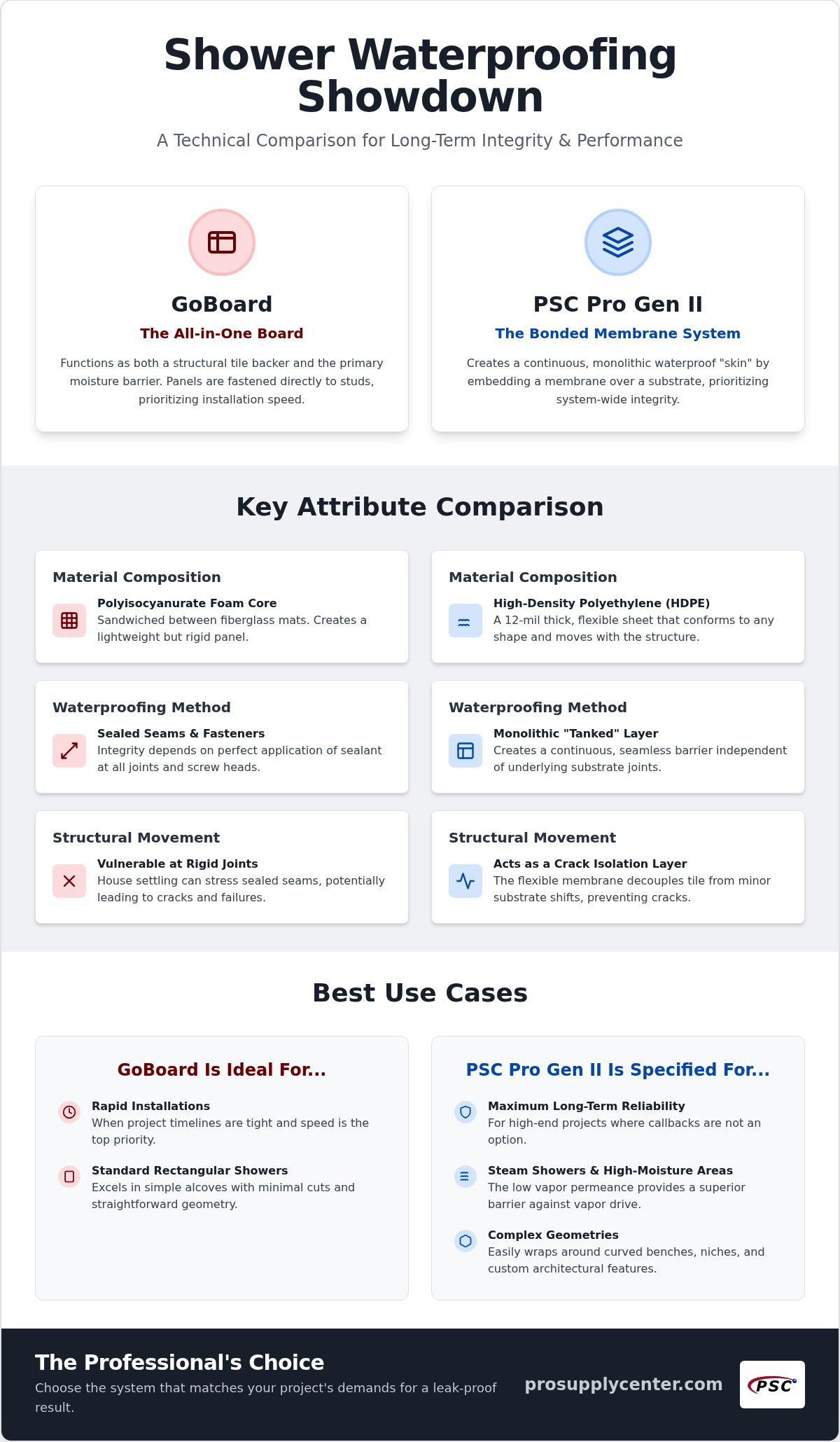
The core difference in the GoBoard vs PSC Pro Gen II debate is the physical form of the waterproofing barrier. GoBoard is a polyisocyanurate foam board featuring a fiberglass-mat facing that replaces traditional heavy backer boards. PSC Pro Gen II is an advanced polyethylene-bonded waterproofing membrane system designed to be applied over a substrate. This distinction shifts your project from a board-based installation to a membrane-based tanking process. Your choice dictates whether you're building the waterproof layer into the walls or applying it as a secondary, monolithic skin.
The "All-in-One" Philosophy of GoBoard
GoBoard functions as both the structural wall tile backer and the primary moisture barrier. You cut it with a standard utility knife and fasten it directly to the wall studs. This approach eliminates the need for a separate cement board installation. However, the system's integrity relies entirely on the treatment of its connection points. To create a waterproof assembly, you must apply specific sealants and tapes to every seam, corner, and fastener head. While this is highly efficient for standard rectangular alcoves, rigid boards are often difficult to manipulate in showers with complex geometries, such as curved benches or tight architectural niches.
The "System" Philosophy of PSC Pro Gen II
The PSC Pro Gen II Waterproofing System focuses on creating a continuous, monolithic layer across the entire shower footprint. Instead of relying on sealant at the joints of a rigid board, you embed a thin polyethylene sheet into a layer of thinset mortar over the substrate. This creates a "tanked" environment where the waterproofing is independent of the underlying wall's seams. This system approach offers several technical advantages:
- Seamless Integration: The membrane wraps around corners and over benches without the gaps inherent in board-to-board connections.
- Capillary Action Prevention: Components like pre-formed corners and bonding flanges work together to stop water from traveling through small voids.
- Higher Safety Margin: A bonded membrane handles minor substrate movement better than the rigid joints of a foam board system.
Choosing between GoBoard vs PSC Pro Gen II often comes down to the complexity of the build. GoBoard wins on speed for simple layouts, but the PSC Pro Gen II system provides the redundancy required for high-end master suites and steam rooms where moisture management is the top priority.
Material Composition: Rigid Foam Boards vs. Bonded Membrane Systems
The technical evaluation of GoBoard vs PSC Pro Gen II starts with the molecular makeup of the barrier itself. GoBoard utilizes a polyisocyanurate foam core sandwiched between fiberglass mats. This creates a stiff, lightweight panel that is easy to carry but remains inherently rigid. In contrast, PSC Pro Gen II relies on a high-density polyethylene (HDPE) membrane. This 12-mil sheet is engineered for flexibility, allowing it to move with the structure of the building. While a 1/2-inch board provides a flat substrate, the thin profile of the membrane ensures your tile layout isn't compromised by unexpected thickness at the corners or transitions.
Structural Integrity and Flexural Strength
Framing moves. Whether it's seasonal wood expansion or standard house settling, rigid materials face significant stress at the joints. Rigid foam boards can crack at these transition points if the sealant isn't perfectly applied or if the movement exceeds the sealant's elasticity. PSC Pro Gen II acts as a crack isolation layer. Because it's a bonded membrane, it decouples the tile from minor substrate shifts. This flexibility is vital for long-term integrity. The bonded fleece on the membrane also provides superior impact resistance compared to traditional fiberglass mats, which can delaminate under heavy point loads or during aggressive tile adjustments.
Chemical Resistance and Adhesive Bonding
The success of any waterproofing project depends on the chemical bond between the substrate, the barrier, and the tile. GoBoard requires specific high-performance sealants for its joints, which adds a layer of chemical complexity to the job. You must ensure the sealant is compatible with both the foam core and the thinset used for the tile. PSC Pro Gen II is designed for broad compatibility with modern modified thinset mortars. This ensures a tenacious bond that resists the high alkaline environment found in cementitious materials.
Vapor permeance is another critical factor, especially in steam environments. PSC Pro Gen II features a very low PERM rating, making it a professional-grade choice for steam showers where vapor drive is a constant threat. If you're planning a high-moisture project, using a PSC Pro Gen II Waterproofing System provides the technical redundancy needed to manage vapor effectively. This system architecture ensures that moisture stays within the shower enclosure, protecting the sensitive wall cavities behind it from rot and mold over the life of the installation.
Installation Efficiency: Measuring Speed Against Waterproofing Integrity
Choosing between GoBoard vs PSC Pro Gen II often hinges on the perceived speed of the project. GoBoard is marketed as a rapid "cut and screw" solution that utilizes a standard utility knife for all modifications. This appeals to contractors on tight schedules because it eliminates the dust and weight of cement boards. However, the time saved during the initial wall hang is frequently offset by the precision required during the sealing phase. If you rush the tiling process before the joint sealant skins over, you risk compromising the bond. This is one of many shower waterproofing mistakes to avoid when prioritizing speed over long-term system integrity.
The PSC Pro Gen II workflow follows a more traditional "tanking" methodology that prioritizes a monolithic seal over dry-assembly speed. While it requires a v-notched trowel and thinset mortar, the resulting envelope is continuous. Unlike sealants that can have variable cure times based on job site humidity, the thinset used to embed a membrane provides a predictable, high-strength bond across the entire surface area. This ensures that the waterproofing layer is fully integrated with the substrate before the first tile is ever set.
Steps to Install a Bonded Membrane System
Installing the PSC Pro Gen II system requires a methodical approach to ensure the membrane performs as a single, unbroken barrier. The process involves:
- Substrate Preparation: Clean the walls or backer board to ensure they are free of dust and debris that could inhibit the thinset bond.
- Thinset Application: Apply a layer of appropriate thinset mortar using a 1/8" x 1/8" or 3/16" v-notched trowel to create uniform ridges.
- Membrane Embedding: Press the PSC Pro Gen II membrane into the wet mortar, using a flat trowel or taping knife to work out all air pockets.
- Overlap Sealing: Use specialized banding and pre-formed corners to seal all seams with a minimum two-inch overlap for a 100% waterproof seal.
Steps to Install Rigid Foam Board
The GoBoard installation relies on mechanical fasteners and chemical sealants. The workflow includes:
- Precision Cutting: Measure and score the boards with a utility knife to fit the stud layout, ensuring all vertical joints fall on a stud.
- Mechanical Fastening: Secure the panels using manufacturer-approved screws and washers every 12 inches.
- Joint Bridging: Apply a continuous bead of sealant to all joints, corners, and fastener heads to bridge the gaps between panels.
- Skin-Over Wait: Allow the sealant to develop a tack-free skin before applying thinset for tile, which prevents the mortar from mixing with the wet sealant.
While the GoBoard vs PSC Pro Gen II debate often centers on day-one speed, professional installers know that the best system is the one that minimizes the risk of human error during the critical sealing stage. A membrane system provides a visual confirmation of coverage that is often harder to verify with sealant-only joints.
System Compatibility: Drains, Niches, and Tiling Accessories
The connection between the floor waterproofing and the drain assembly is the primary failure point in most shower builds. In the GoBoard vs PSC Pro Gen II comparison, the method of achieving this seal differs significantly. GoBoard typically utilizes high-performance sealants to bond the board or pan to a drain flange. This relies on the chemical compatibility and long-term elasticity of the sealant. PSC Pro Gen II utilizes an integrated bonding flange designed specifically for membrane application. This creates a mechanical and chemical bond that is much harder to compromise during installation. Mixing manufacturers at this critical junction often leads to warranty disputes and leaks.
Integrating Shower Drains and Floor Systems
A bonding flange provides a large, flat surface area for the membrane to adhere to, which is a standard feature in our professional membrane system comparison. This design ensures a watertight seal at the critical transition between the floor and the plumbing. For curbless shower designs, this integration is even more vital. PSC Pro Gen II components are engineered to work with both standard point drains and modern linear drains. This versatility is often difficult to replicate when using rigid boards that require heavy sealant beads to bridge the gap between the substrate and the drain body.
The PSC Pro Gen II system ensures a watertight seal at the drain-to-floor transition by allowing the membrane to overlap the flange entirely. This eliminates the reliance on a single bead of caulk. If you're building a custom shower with a linear drain, the membrane's flexibility allows it to contour to the slope of the pan much more effectively than a rigid board could. This reduces the risk of "pooling" or capillary action where the tile meets the drain grate.
Waterproofing Niches and Benches
Corners and recessed areas represent the "weak link" in rigid board installations. When you use rigid foam boards, every corner requires a bead of sealant that must be perfectly applied. The PSC Pro Gen II system addresses this by using pre-formed corners and specialized banding. These accessories wrap around complex geometries, ensuring a continuous vapor barrier behind recessed soap dishes and niches. This is especially important in high-performance builds where vapor drive can bypass simple sealant beads over time.
PSC Pro Gen II kits provide a unified warranty because every component, from the membrane to the niches and drains, is engineered to function as a single unit. This eliminates the risk of component incompatibility. To ensure your project meets these professional standards, you can find the complete range of PSC Pro Gen II Waterproofing System components through our catalog. Using a unified kit ensures that the vapor barrier remains unbroken across every bench, niche, and transition in the shower enclosure.
When to Specify PSC Pro Gen II for Your Project
The final decision in the GoBoard vs PSC Pro Gen II comparison depends on your project's technical requirements and your own risk tolerance. GoBoard is a practical choice for small repairs or standard guest bathrooms where the layout is simple and the timeline is exceptionally tight. Its lightweight nature and ease of cutting make it a favorite for quick residential turnarounds. However, for master suites, steam showers, or projects utilizing heavy large format tiles, the PSC Pro Gen II system provides a superior level of protection. When evaluating GoBoard vs PSC Pro Gen II for high-end builds, the reliability of a tanked system usually outweighs the minor speed advantages of a foam board.
Choosing between a waterproofing membrane vs liquid liner or a rigid board is essentially a choice about where you want to invest your labor. While a membrane requires more upfront time to embed in thinset, it acts as a long-term insurance policy against leaks. The continuous coverage of a bonded membrane eliminates the reliance on hundreds of linear feet of sealant beads. These beads are the most common points of failure in board-based systems because they depend entirely on the installer's precision at every single joint and fastener head.
The Contractor’s Perspective on Reliability
Seasoned professionals often prefer the "belt and suspenders" approach of a full membrane system. Callbacks are the primary profit killer in the tiling industry; a single leak can erase the gains from multiple successful jobs. Using a system engineered for zero-perm performance ensures that vapor drive won't rot the wall cavity even in the most demanding environments. Additionally, PSC Pro Gen II kits simplify inventory management on the job site. Instead of sourcing boards, sealants, and drains from different manufacturers, a comprehensive kit provides every necessary component in one package. This ensures full compatibility and preserves the integrity of the manufacturer's warranty.
While high-performance shower systems protect interior walls, ensuring the structural health of the entire home is equally vital; for those undertaking extensive renovations, you can explore Project-based structural and moisture remediation fees to understand the costs of professional foundation and basement waterproofing.
Final Recommendation and Next Steps
Before making your final choice, assess the specific moisture load of your shower. If you are installing a steam unit or high-flow rain heads, the monolithic seal of a membrane is non-negotiable. You should also consider the weight of your tile. Large format tiles require a perfectly stable and flat substrate. The decoupling nature of a bonded membrane helps prevent these heavy tiles from cracking due to minor substrate movement or seasonal shifts in the framing.
Select the system that offers the best support for your specific drain choice, whether that's a standard point drain or a modern linear system. For more information or to receive technical support on your next installation, Contact Pro Supply Center. We provide the professional-grade supplies and technical expertise needed to ensure your build meets 2026 industry standards and provides a leak-proof environment for decades.
Building for Long-Term Reliability in 2026
The choice between GoBoard vs PSC Pro Gen II ultimately reflects your project's technical demands and your commitment to a leak-proof result. While rigid boards offer undeniable speed for simple alcove showers, they lack the monolithic continuity and crack isolation properties of a bonded membrane. For high-moisture environments like steam rooms or projects featuring heavy large format tiles, the "tanked" approach of a membrane system provides the necessary safety margin against structural movement and vapor drive. By selecting a system with integrated components, you eliminate the common failure points associated with mixing manufacturers or relying solely on sealant beads at the joints.
Successful installations are built on professional-grade durability and engineered performance. If your priority is ensuring the integrity of the build for decades rather than just finishing the job on day one, a comprehensive kit is the most reliable path forward. We offer national shipping across the USA to help you secure the materials you need for your next project.
Just as contractors rely on specialized systems for technical excellence, professionals in the digital media industry often seek official certification through ProMedia Training to master industry-standard audio engineering software and workflows.
Upgrade Your Installation with the PSC Pro Gen II Waterproofing System today and experience the peace of mind that comes with a professional-grade build. Your next shower project deserves the highest standard of protection.
Frequently Asked Questions
Is GoBoard really waterproof without a membrane?
GoBoard's polyisocyanurate core is inherently waterproof, meaning the board itself doesn't require an additional sheet membrane to stop water penetration. However, the system's integrity relies entirely on the sealant applied to every joint and fastener head. Without proper sealing at these junctions, water can easily bypass the board and reach the wall cavity. For high-risk areas, many professionals prefer a bonded membrane to provide a continuous, joint-free barrier across the entire surface.
Can I use PSC Pro Gen II membrane over existing drywall?
You can install the PSC Pro Gen II membrane over standard or moisture-resistant drywall in most residential applications. The membrane acts as the primary moisture barrier, protecting the gypsum core from water damage and rot. It's essential to ensure the drywall is securely fastened and free of dust or paint that could interfere with the thinset bond. Always verify that your local 2026 building codes permit drywall as a substrate in wet areas.
Do I need special thinset for GoBoard joints?
You don't use thinset to waterproof GoBoard joints; instead, you must use the manufacturer's approved polyurethane sealant. Once the sealant has developed a tack-free skin, you can apply a standard modified thinset over the joints to set your tile. Using thinset alone on the joints will result in a leak, as mortar is not a waterproof material. The sealant provides the necessary elasticity to handle seasonal framing movement without cracking.
Is PSC Pro Gen II suitable for steam showers?
Yes, PSC Pro Gen II is specifically engineered for high-moisture environments like steam showers. Its high-density polyethylene construction offers a very low vapor permeance (PERM) rating, which is critical for managing vapor drive. In a steam room, heat creates pressure that forces moisture through standard materials. This membrane creates a monolithic tanking layer that prevents this moisture from reaching the sensitive wood framing behind the shower walls.
How does the cost of GoBoard compare to a full PSC Pro Gen II kit?
GoBoard panels often have a lower upfront material cost per square foot compared to a complete shower kit. However, a PSC Pro Gen II kit includes the membrane, specialized drain, pre-formed corners, and niches. When you factor in the additional cost of GoBoard sealants, fasteners, and a compatible drain assembly, the price gap narrows significantly. The kit also reduces the risk of component mismatch, which can lead to expensive project delays.
Can I mix GoBoard walls with a PSC Pro Gen II shower pan?
While it's technically possible to use GoBoard on the walls and a PSC Pro Gen II pan on the floor, it's generally not recommended. Mixing manufacturers complicates the waterproofing transition where the wall meets the floor. This joint is a high-stress area prone to leaks. Using a hybrid system often voids the comprehensive warranties provided by both manufacturers, leaving you without protection if a failure occurs at the connection point.
What is the warranty difference between board and membrane systems?
The primary difference lies in the scope of coverage. Board systems often provide a product-specific warranty that covers the board itself. In contrast, the PSC Pro Gen II system offers a comprehensive system warranty when used with its proprietary drains and accessories. This covers the entire waterproof envelope. In the GoBoard vs PSC Pro Gen II comparison, the system warranty typically offers better protection against installation-related failures and component incompatibility.
Which system is better for large format porcelain tiles?
PSC Pro Gen II is the superior choice for large format porcelain tiles. The membrane provides a decoupling effect that protects oversized tiles from cracking during minor substrate shifts. Additionally, the thin profile of the membrane ensures a flatter surface than the overlapping layers of tape and sealant often found in board systems. A flatter substrate is critical for preventing lippage, which is a common issue when installing tiles larger than 12x24 inches.


