
A visually perfect shower is a liability if the waterproofing system fails to manage moisture at the molecular level. Many builders assume a few coats of roll-on product provide total protection, but the choice between a waterproofing membrane vs liquid liner often determines whether a high-use shower survives its first five years without structural decay. You already know that hidden leaks lead to rot and mold; you're looking for a professional-grade solution that eliminates that risk entirely.
This article provides a technical breakdown of sheet membranes and liquid-applied barriers so you can select the right system for your specific installation. You'll learn how to meet the strict 0.5 perm rating required by ANSI A118.10 standards for steam rooms and why factory-controlled thickness often outperforms manual application. We'll compare application speeds, drain compatibility, and the performance metrics found in the 2026 TCNA Handbook to ensure your next project is both leak-proof and vapor-tight. Whether you're navigating complex drain geometries or seeking the fastest path to tile, this guide helps you choose with confidence.
Key Takeaways
- Identify the core differences between a waterproofing membrane vs liquid liner to avoid common failure points like uneven thickness and vapor bypass.
- Learn why factory-manufactured sheet membranes are the industry standard for high-moisture environments like steam showers due to their superior perm ratings.
- Understand the specific scenarios where liquid-applied barriers offer a practical advantage for waterproofing complex niches and irregular shower benches.
- Evaluate how using a complete kit, such as the PSC Pro Gen II Waterproofing System, ensures component compatibility and faster project completion.
- Discover a logical framework for balancing material costs against long-term reliability and 2026 TCNA Handbook compliance.
Understanding the Basics: Waterproofing Membrane vs. Liquid Liner
Every professional shower installation relies on a barrier to protect the underlying structure from water damage. Whether you are working with moisture-resistant drywall or a traditional mortar bed, the primary goal is to prevent liquid and vapor from reaching the substrate. If water penetrates these layers, it leads to structural rot, mold growth, and eventual tile failure. Understanding Waterproofing basics is the first step toward a successful build. It isn't just about stopping a leak; it's about managing the environment behind the tile to ensure long-term stability.
The choice between a waterproofing membrane vs liquid liner significantly impacts both your project timeline and the long-term durability of the installation. Sheet membranes offer immediate results and factory-calibrated reliability. Liquid liners provide a custom, seamless fit for non-standard layouts. Selecting the right one requires a technical understanding of how these materials interact with the shower environment and the specific demands of your job site.
The principles of moisture management are universal across a building's structure; for example, Pro Torch Roofing applies similar high-standard roofing solutions to protect residential and commercial properties from water damage and structural decay.
What is a Bonded Sheet Membrane?
Bonded sheet membranes are factory-manufactured rolls of material designed for consistent performance. These membranes are usually composed of polyethylene or similar high-performance polymers, reinforced with a fleece webbing on both sides. This fleece is critical because it allows the membrane to form a mechanical bond with the thin-set mortar used during installation. You don't have to worry about chemical compatibility; the system relies on the physical strength of the mortar bed to stay in place.
Installation involves applying a layer of thin-set to the wall or floor, pressing the membrane into the wet mortar, and smoothing it out with a flat trowel to eliminate air pockets. Because the thickness is set during manufacturing, the risk of "thin spots" is eliminated. Bonded membranes are the industry standard for vapor management in high-moisture environments.
What is a Liquid-Applied Waterproofing Liner?
A liquid liner is a fluid-applied coating that you spread across the shower area using a brush, roller, or heavy-nap trowel. As the liquid cures, it transforms into a flexible, rubberized barrier that adheres directly to the substrate. This process creates a monolithic, seamless membrane that is particularly effective in tight corners or around complex plumbing fixtures where sheets might be difficult to fold.
Liquid systems are common for small repairs or when the shower design features extremely irregular geometries, such as curved benches or custom soap niches. However, they require a methodical approach. You must apply multiple coats to achieve the dry film thickness specified by the manufacturer. If the coating is too thin, the barrier won't hold up against the constant hydrostatic pressure of a daily shower, leading to failure over time.
The Case for Sheet Membranes: Precision and Vapor Control
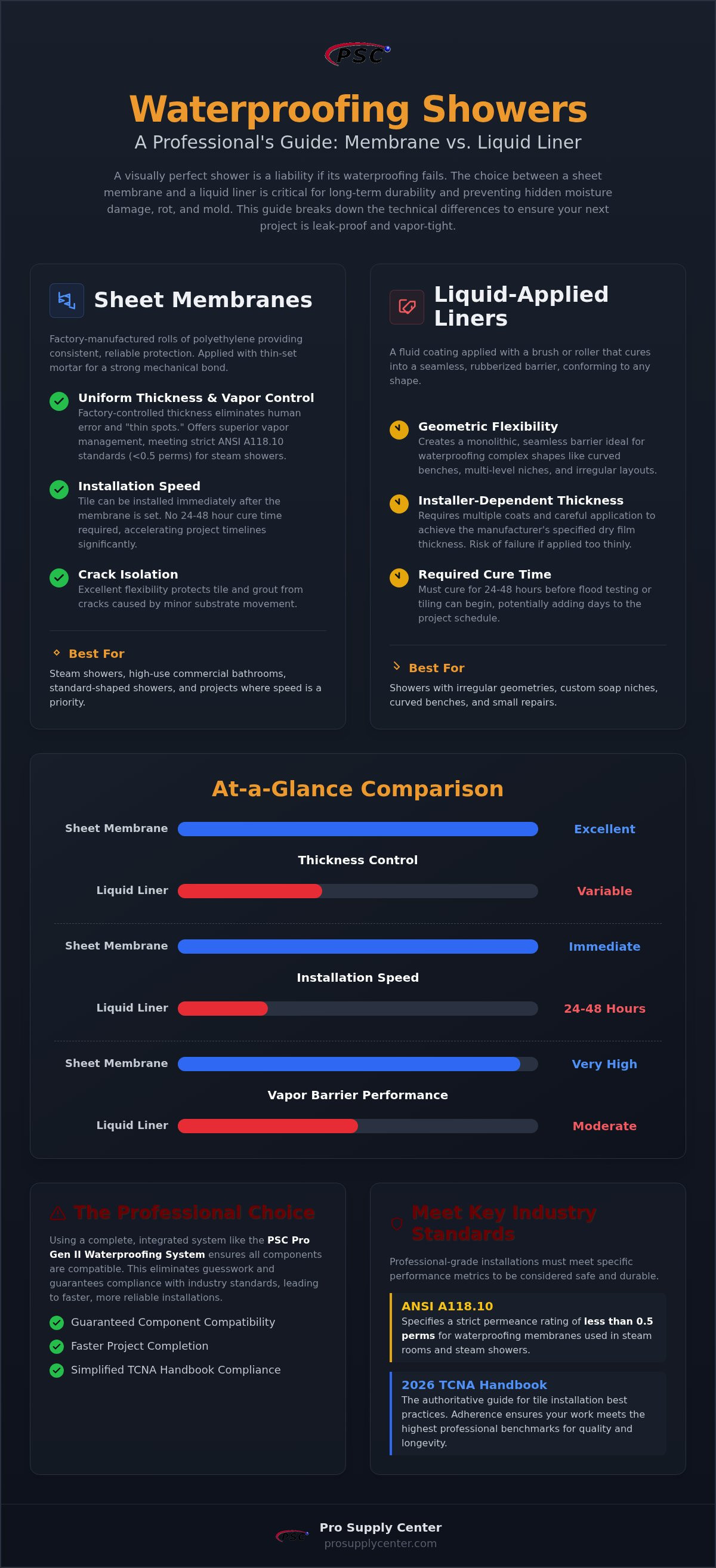
For many professionals, the debate between a waterproofing membrane vs liquid liner ends with factory reliability. A sheet membrane is manufactured under controlled conditions, ensuring a uniform thickness across every square inch of the roll. Unlike liquid-applied products that depend on the installer's technique and the number of coats applied, a factory-set mil thickness eliminates human error during installation. You don't have to worry about thin spots that might pass a flood test today but fail under constant hydrostatic pressure later.
Efficiency on the job site is another significant advantage. Once you embed a sheet membrane into the thin-set, you can begin tiling immediately. There's no need to wait 24 to 48 hours for a chemical cure. This speed doesn't come at the expense of protection. High-performance sheets offer excellent crack isolation properties. If the subfloor or wall studs experience minor movement or settling, the membrane acts as a flexible buffer. This prevents stress from transferring directly to the tile, which reduces the risk of grout cracking or stone failure. For property owners facing more significant settling issues on exterior surfaces, Foundation Werks offers specialized concrete leveling to restore safety and structural integrity to areas like pool decks and foundations.
Vapor Barriers vs. Waterproofing
The distinction between a waterproof surface and a vapor-proof barrier is critical for modern bathroom design. Standard liquid liners are often effective at stopping liquid water, but they frequently fail as vapor barriers in high-heat environments like steam showers. Adhering to building code requirements ensures your project meets safety and performance benchmarks regarding moisture migration.
The role of the ASTM E96 standard is to evaluate how much water vapor can pass through a material. For steam rooms, industry standards mandate a perm rating of 0.5 or less. The PSC Pro Gen II Waterproofing System is engineered to manage moisture at the molecular level, providing the vapor-tight seal necessary for these demanding applications. It ensures that steam stays in the shower rather than condensing inside your wall cavities.
Durability on the Job Site
Sheet membranes are built to survive the realities of a construction zone. They offer high resistance to punctures and tears during the tiling process, even when working with heavy natural stone or sharp-edged mosaics. Most modern sheets feature a fleece webbing that is highly compatible with modified thin-set mortars, creating a permanent mechanical bond. Consider these factors when choosing your system:
- Consistency: Zero risk of applying the product too thin.
- Speed: Zero cure time means faster project completion.
- Protection: Superior vapor management for steam and high-use areas.
Choosing a professional-grade sheet membrane like the PSC Pro Gen II provides the steady, dependable performance required for high-end residential and commercial builds.
Liquid Liners: When Flexibility Outweighs Uniformity
Liquid liners have gained popularity due to their seamless application and perceived ease of use. For many DIYers, the low entry cost of a roll-on bucket is an attractive alternative to purchasing specialized tools and rolls of material. However, when evaluating a waterproofing membrane vs liquid liner, the primary advantage of a liquid system is its ability to conform to irregular geometries. If your design includes complex niches, curved shower benches, or non-standard floor slopes, a brush-on barrier fills the gaps that a flat sheet cannot easily reach.
Despite this flexibility, liquid application introduces a significant variable: human error. Achieving the correct "wet mil" thickness is the most difficult part of the process. Without a mil gauge, it's nearly impossible to tell if the coating is thick enough to meet the manufacturer's performance specs. Over-spreading the material often leads to pinholes, which are tiny air bubbles that form during application. These microscopic gaps create direct leak paths to the substrate, compromising the entire installation. Following Water management best practices involves understanding that a barrier is only as strong as its thinnest point.
The Hidden Risks of Liquid Application
Environmental factors play a massive role in the success of a liquid-applied liner. Humidity levels can delay cure times by days, effectively stalling your project. If you apply tile too early, the moisture trapped behind the stone prevents the liner from fully rubberizing. You should also account for shrinkage. As liquid liners dry, they lose volume and moisture. If the initial application was already borderline, this shrinkage can pull the material away from corners or create hairline fractures in the barrier that are invisible to the naked eye.
- Inconsistent Coverage: Roller pressure and nap size can lead to uneven protection across the substrate.
- Extended Timelines: Multi-coat requirements and drying intervals can take 48 hours or more before tiling can begin.
- Pinholes: Rapid application or overly thick coats often trap air, resulting in eventual leaks.
Best Use Cases for Liquid Liners
While sheet membranes are superior for the main shower enclosure, liquid liners serve well in secondary roles. They're excellent for waterproofing areas outside the immediate splash zone, such as the bathroom floor surrounding the shower. Many professionals also use a hybrid approach. They install a sheet membrane for the walls and floor but use a liquid liner to seal complex penetrations or small niches. This strategy utilizes the speed of sheets for large surfaces while leveraging the adaptability of liquids for intricate details. For small-scale residential repairs where logistics make sheet rolls impractical, a high-quality liquid liner remains a functional choice.
Comparison Framework: Which System Fits Your Project?
Deciding on a waterproofing membrane vs liquid liner involves more than just a preference for application methods. You must weigh the project's environmental conditions against your required turnaround time. In high-humidity environments, a liquid liner can take 72 hours or more to cure between coats. This stalls the project and increases the risk of dust or debris contaminating the wet surface before it sets. Conversely, a sheet membrane is a dry installation. It allows you to move from waterproofing to tile setting in a single afternoon, regardless of the local weather or job site humidity.
Skill level also dictates the choice. A liquid liner is often marketed as DIY-friendly because it applies like paint, but the technical requirement of achieving a consistent dry film thickness is high. Professional-grade results with a sheet membrane require more precision during the initial layout and thin-set application, but the factory-controlled thickness removes the risk of "thin spots." When you consider the long-term risk of structural rot, the precision of a sheet system often outweighs the perceived ease of a roll-on product. Contractors who prioritize speed without sacrificing reliability generally find that the higher upfront material cost of a sheet system is offset by the reduction in labor hours.
Standard Shower vs. Steam Shower Requirements
The technical demands of a steam shower are significantly higher than those of a standard residential unit. If you use a liquid liner that lacks a sufficient vapor rating, you risk creating a "mold sandwich." This happens when steam penetrates the barrier, condenses inside the wall cavity, and cannot escape. Polyethylene sheet membranes are specifically engineered to block moisture at the molecular level. Meeting the 0.5 perm rating is essential for any high-heat environment. For commercial showers or luxury steam rooms, the structural integrity of the building depends on this vapor-tight seal.
The Hybrid Solution: Using Both Effectively
Some builders try to save time by using sheet membranes on large walls and liquid liners for complex corners or soap niches. While this hybrid method can work, it often leads to a "franken-system" where different manufacturers' products are mixed. Chemical compatibility is not always guaranteed, and a failure at the transition point can be difficult to diagnose. Using a PSC Waterproofing Shower Kit provides a safer, more reliable alternative. These kits are designed as integrated systems, ensuring that the membrane, drain, and pre-formed niches are all chemically and physically compatible for a 100% waterproof result.
The Professional Choice: PSC Pro Gen II Waterproofing System
Choosing between a waterproofing membrane vs liquid liner is only the first step; the second is ensuring that every component of your shower pan works in unison. Piecemeal systems often fail at the connection points between the drain, the walls, and the floor. The PSC Pro Gen II Waterproofing System is a high-performance bonded membrane designed to eliminate these weak links. By using a factory-manufactured sheet, you ensure that the vapor protection and liquid barrier are uniform across the entire installation, providing a level of reliability that manual liquid application cannot match.
Installation efficiency is a primary driver for trade professionals. The Pro Gen II allows for immediate tiling, but its real value lies in the reduction of variables. When you use a PSC Waterproofing Shower Kit, you receive a curated set of components including the membrane, specialized shower drains, and pre-formed niches. This integrated approach saves time on the job site because every part is engineered to bond perfectly with the next. You don't have to guess if your thin-set will adhere to a third-party niche or if your drain flange is compatible with your chosen liner. The debate of waterproofing membrane vs liquid liner becomes clear when you prioritize long-term structural integrity over initial material costs.
Why Pro Supply Center Curates the Gen II System
We focus on materials that exceed industry standards, specifically ANSI A118.10 for bonded waterproof membranes. The Gen II system provides a high-performance barrier that manages moisture and vapor effectively, even in demanding residential and commercial environments. One of the most significant advantages is the single-source warranty. When you install a complete PSC system, you have the confidence that the entire shower pan is protected under a unified standard of quality. This integration extends to our ceramic soap dishes and shower niches, which are designed to be wrapped or bonded seamlessly with the Pro Gen II membrane.
Next Steps for Your Remodel
To begin your project, start by calculating the total square footage of your shower walls and floor. Add approximately 10% to your total to account for overlaps at the seams and corners. Selecting the right components is simpler when you move away from a "franken-system" and toward a unified kit. Ensure your chosen niche and drain match the technical specifications of your waterproofing layer to maintain the integrity of the build. You can View our complete PSC Waterproofing Shower Kits to find the right configuration for your specific layout. Whether you're a seasoned contractor or a serious DIYer, choosing an integrated system is the most pragmatic way to ensure a leak-proof, professional result.
Building a Leak-Proof Future for Your Bathroom
Selecting between a waterproofing membrane vs liquid liner is a decision that dictates the lifespan of your build. While liquid products offer convenience for irregular shapes, they cannot match the factory-controlled precision and immediate tiling readiness of a bonded sheet system. Reliability on the job site comes down to managing moisture at the molecular level and ensuring every component, from the drain to the niche, works together as a unified barrier.
You don't have to risk structural rot or mold by using piecemeal supplies. The PSC Pro Gen II system provides contractor-grade vapor protection and exceeds ANSI A118.10 standards for total confidence. By choosing a complete kit, you eliminate compatibility errors and ensure a professional-grade result that stands up to daily use. Upgrade to the PSC Pro Gen II Waterproofing System for your next project and secure your build with a system designed for performance. Your commitment to quality materials today prevents costly failures tomorrow.
Frequently Asked Questions
Can I use a liquid liner over a sheet membrane for extra protection?
In the debate of waterproofing membrane vs liquid liner, mixing the two is rarely the answer. You should not apply a liquid liner over a sheet membrane unless specifically directed by the manufacturer for a detail repair. Sheet membranes rely on their fleece webbing to create a mechanical bond with mortar. Coating this fleece in liquid rubber can fill the fibers and prevent the mortar from grabbing the surface.
Is a sheet membrane required for a walk-in shower floor?
A sheet membrane isn't strictly required by all building codes, but it is the superior choice for walk-in and curbless showers. These layouts require a perfectly consistent barrier across the transition from the shower pan to the bathroom floor. Using a sheet ensures that movement at the transition point doesn't cause the barrier to crack. It provides significantly better puncture resistance than a thin liquid coating.
How long does a liquid waterproofing liner take to dry before tiling?
When evaluating a waterproofing membrane vs liquid liner, cure time is a major differentiator. Most liquid liners require 24 to 48 hours of cure time before you can safely begin tiling. This window depends on humidity and temperature. You must apply at least two coats, allowing the first to dry completely. If the material feels tacky or hasn't changed color, it isn't ready to support tile.
Do I need a vapor barrier if I am using a waterproofing membrane?
You don't need a separate plastic vapor barrier behind your backer board if you're using a bonded waterproofing membrane. Installing both can trap moisture between the layers, creating a "mold sandwich" that rots your wall studs. High-performance sheet membranes are designed to manage both liquid water and vapor migration at the surface level, keeping the substrate dry and the structure protected.
What is the best waterproofing for a steam shower?
The best solution for a steam shower is a bonded sheet membrane that meets the 0.5 perm rating requirement of ANSI A118.10. Steam molecules are smaller than water droplets and easily penetrate standard liquid liners. The PSC Pro Gen II system provides the necessary vapor-tight seal to prevent condensation from forming inside your wall cavities. This is essential for protecting the wood or steel framing in high-heat environments.
Can I install a sheet membrane over existing tile?
You can't install a sheet membrane directly over existing tile. For a successful bond, the substrate must be clean, stable, and flat; this usually means moisture-resistant drywall or a fresh mortar bed. Tiling over old tile is a high-risk practice. Any failure in the original bond will cause your new waterproofing and tile layer to delaminate from the wall, leading to a total failure.
Does the PSC Pro Gen II system require special thin-set?
The PSC Pro Gen II system is designed to work with high-quality modified thin-set mortars. Using a mortar that meets ANSI A118.11 or A118.15 standards ensures the best mechanical bond to the membrane's fleece webbing. Always follow the mortar manufacturer's instructions regarding trowel size and coverage. This ensures the membrane is fully embedded without air pockets or dry spots that could compromise the build.
How do I test if my shower waterproofing is successful before tiling?
You should perform a 24-hour flood test to verify the integrity of your waterproofing before setting any tile. Plug the shower drain using a test ball or plug and fill the basin with water. Mark the water level on the wall or membrane. If the level remains the same after 24 hours, your installation is successful. This is the only way to catch hidden leaks before they cause structural damage.


