
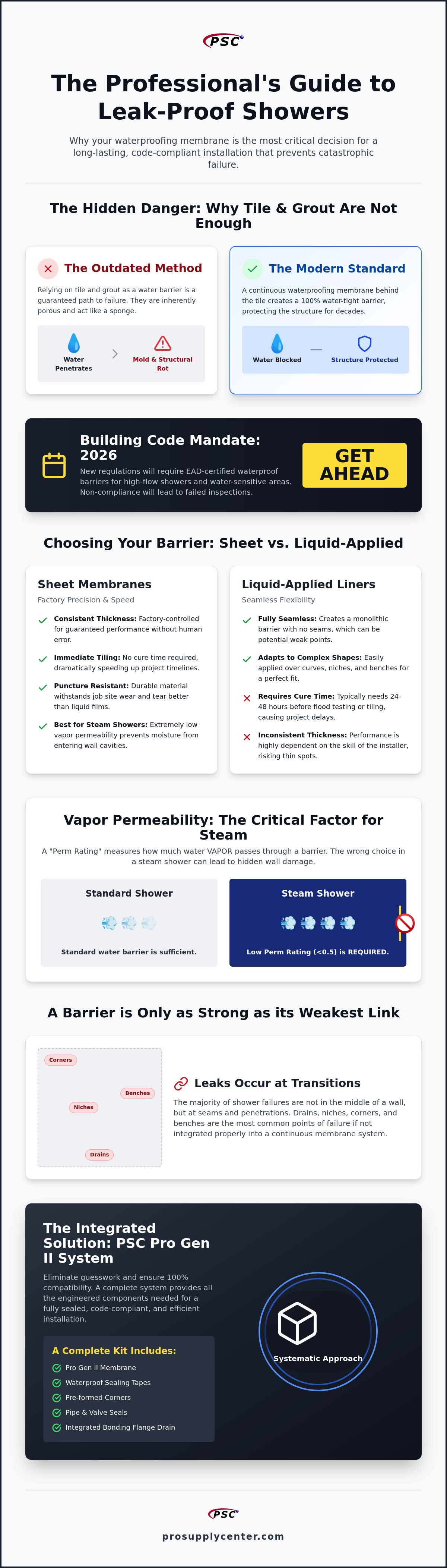
Relying on tile and grout as your primary water barrier isn't just a technical error; it's a violation of modern building standards that leads to catastrophic structural rot. You understand that a single pinhole leak can compromise an entire subfloor, yet the confusion over vapor ratings and choosing the correct waterproofing membrane for shower installations makes the process feel like a gamble. It's a high-stakes decision where "good enough" eventually leads to a costly tear-out. You need a solution that performs under pressure without the guesswork.
This guide helps you select the right materials to ensure a professional-grade, 100% leak-proof installation that lasts for decades. We'll examine the mandatory 2026 regulations requiring EAD-certified barriers and explain why a systematic approach is superior to piecemeal methods. You'll learn how to navigate vapor permeability requirements and see how integrated options like the PSC Pro Gen II Waterproofing System streamline your workflow. By the end, you'll have a clear framework for achieving a code-compliant, high-performance wet room that stands the test of time and satisfies the most rigorous technical standards.
Key Takeaways
- Understand the 2026 mandatory regulations that require EAD-certified barriers for high-flow showers and water-sensitive substrates.
- Compare the structural advantages of factory-controlled sheet membranes against the seamless flexibility of liquid-applied liners to find your best fit.
- Learn how to evaluate vapor perm ratings to select the correct waterproofing membrane for shower projects involving steam or standard humidity levels.
- Identify the "Weak Link" theory to prevent common transition leaks by properly integrating drains and niches into a continuous moisture barrier.
- Discover how using a complete PSC Waterproofing Shower Kit with the PSC Pro Gen II system ensures code compliance and maximum installation efficiency.
Why Waterproofing Membranes are Non-Negotiable in Modern Showers
Traditional shower construction once relied on the "water-managed" theory. This approach assumed that water would inevitably penetrate tile and grout, so it focused on directing that moisture to a sub-pan. It's an outdated model that often fails. Modern installations prioritize a "water-tight" design. Because grout and mortar are inherently porous, they act more like a sponge than a shield. Without a dedicated waterproofing membrane for shower surfaces, moisture migrates into the wall cavity. This creates a breeding ground for mold and compromises the structural integrity of the home.
It's vital to distinguish between a water barrier and a vapor retarder. A water barrier stops liquid moisture from passing through, while a vapor retarder slows the movement of water in its gaseous state. In a standard shower, a liquid or sheet membrane acts as the primary defense against rot. In steam showers, the vapor perm rating becomes the critical metric to prevent moisture from driven into the framing. You can find a deeper look at these technical distinctions in this comprehensive guide to waterproofing.
The Evolution of Shower Waterproofing
Traditional PVC pan liners have significant limitations that lead to failure. They are often difficult to install correctly at the corners, where the material must be folded or cut. These "weak points" are where most leaks begin. In 2026, bonded membranes have become the industry standard. These systems are applied directly to the substrate, which prevents water from ever reaching the mortar bed or backer board. This shift is a matter of practical economics. A professional-grade waterproofing membrane for shower projects is a minor investment compared to the massive costs associated with mold remediation and structural repairs. It's the difference between a project that lasts five years and one that lasts fifty.
Building Code Compliance and Industry Standards
The Tile Council of North America (TCNA) provides the clear guidelines that professional contractors follow for wet area installations. Modern inspectors increasingly require continuous membrane systems that "tank" the entire shower area. This isn't just about checking a box for a permit; it's about protecting long-term property value. A failed shower is a major liability during a home sale. Following TCNA standards ensures the installation remains code-compliant and durable. Using a high-performance system confirms that you're building to the highest professional standards, ensuring the shower remains leak-free under the most demanding daily use.
Sheet Membranes vs. Liquid Liners: A Professional Comparison
Choosing the best waterproofing membrane for shower construction often comes down to a trade-off between factory precision and field flexibility. Sheet membranes are manufactured with a consistent thickness, ensuring that every square inch of your shower meets the required specifications without human error. Liquid liners, by contrast, offer a seamless application that conforms to any shape. Both systems must comply with the International Plumbing Code shower lining requirements, but their performance on the job site varies significantly depending on the project scope.
Cure times are a major factor in project scheduling. Time is money. Sheet membranes allow you to begin tiling immediately after the thin-set has grabbed the substrate. Liquid membranes usually require 24 to 48 hours to fully cure before they can be flood tested or tiled. This delay can stall a project, making sheet systems the preferred choice when speed is a priority. Also, sheet membranes provide superior puncture resistance. While a dropped trowel might tear a thin liquid film, high-quality sheet products are designed to withstand the rigors of a busy job site.
When to Choose a Sheet Membrane
Sheet systems are the gold standard for steam showers. Their low vapor permeability prevents moisture from driving into the wall assembly under high pressure. They're also the fastest option for large, flat surfaces. If your layout consists mostly of standard walls and floors, a sheet membrane will save hours of labor. For a more detailed breakdown of these two categories, read our guide on Waterproofing Membrane vs Liquid Liner: Which is Better? to see which fits your specific installation style.
The Case for Liquid Waterproofing
Liquid membranes excel in showers with complex geometries. If your design includes built-in benches, intricate niches, or curved walls, a paint-on solution is often easier to manage than cutting and folding fabric. However, success depends entirely on achieving the correct mil thickness. Most manufacturers mandate at least two heavy coats to prevent pinhole leaks. These tiny voids are almost invisible to the naked eye but lead to catastrophic failure over time. You must ensure the product is completely cured and dry to the touch before proceeding. If you prefer a more reliable, all-in-one approach, consider browsing the professional-grade waterproofing systems available today.
Critical Selection Factors: Vapor Permeability and Substrate Compatibility
Selecting a waterproofing membrane for shower installations requires looking beyond simple water resistance. You must evaluate how the material interacts with the specific environment and the underlying structure. Two of the most overlooked factors are vapor permeability and crack isolation. While a standard shower only needs to stop liquid water; a high-performance installation must also manage vapor drive and minor subfloor shifts. High-quality membranes provide crack isolation properties, acting as a flexible bridge that prevents small cracks in the subfloor from telegraphing through to your tile and grout lines.
Substrate compatibility is equally vital. Whether you're working with traditional cement board, green-board drywall, or modern high-density foam panels, the membrane must achieve a permanent mechanical bond. Not every product sticks to every surface. Using an incompatible pairing leads to delamination, which causes tiles to pop or grout to crack. You must verify that your chosen waterproofing membrane for shower projects is rated for the specific substrate in your build to ensure the assembly stays put for decades.
Vapor Management for Steam Showers
Standard waterproofing often fails in steam environments because it doesn't account for vapor pressure. In a steam shower, high temperatures turn water into a gas that can penetrate materials liquid water cannot. To protect your wall cavity from rot, you need a membrane with a "Perm Rating" of 0.5 or lower. This low rating indicates the material is an effective vapor barrier. The PSC Pro Gen II Waterproofing System is engineered to handle these high vapor loads, providing a level of protection that standard market options often lack. Don't risk a steam room build with a membrane only rated for standard humidity.
Evaluating Substrate Adhesion
The bond between your membrane and the substrate depends heavily on the type of thin-set mortar you use. Manufacturer requirements vary; some demand unmodified thin-set to allow for proper drying, while others require modified versions for increased grab. Always follow the specific instructions for your membrane to avoid a bond failure. Surface preparation is the "dust-free" rule of the job site. Even the best adhesive won't stick to a layer of drywall dust or sawdust. Wipe down all surfaces with a damp sponge before application. If you're unsure about the bond, perform a "pull test" on a small scrap piece. It's a simple step that provides professional peace of mind before you commit to the entire installation.
Integrating Drains and Niches for a Continuous Moisture Barrier
Most catastrophic failures don't occur in the center of a wall or floor. They happen at the transitions. This is the "Weak Link" theory of shower construction; 90% of leaks originate where the horizontal and vertical surfaces meet or where hardware penetrates the barrier. Successfully integrating your waterproofing membrane for shower installations with the drainage system and wall accessories is the only way to ensure a truly "tanked" environment. Without a seamless connection at these points, moisture will eventually find a path behind the tile through capillary action or structural settling.
Corner treatments are another critical area where standard applications fail. Folding thick membrane material into a 90-degree corner often creates a bulky buildup that makes tiling difficult. More importantly, cutting the material to fit a corner creates a seam that must be perfectly sealed. Using pre-formed inside and outside corners eliminates this risk. These components are engineered to provide a flush, watertight fit that maintains the integrity of the barrier without the guesswork of field fabrication.
Connecting to the Shower Floor Drain
The connection between the floor and the drain is the most vulnerable point in any wet room. Achieving a permanent seal requires a methodical approach to ensure the waterproofing membrane for shower floors functions as intended. Follow these three steps for a professional-grade connection:
- Step 1: Flange Preparation. Clean the bonding flange of the drain thoroughly. Any construction dust, thin-set splatter, or oils will prevent a proper bond.
- Step 2: Membrane Overlap. Apply the appropriate thin-set to the flange and embed the membrane. Ensure the material overlaps the bonding surface completely without wrinkles or air pockets.
- Step 3: Secure the Bond. Use a flat trowel or roller to press the membrane into the adhesive. This creates the combined mechanical and chemical bond necessary to resist constant water pressure at the lowest point of the shower.
Waterproofing Shower Niches and Benches
Building your own niche from scrap backer board is a high-risk strategy that often leads to leaks at the internal corners. Every seam you create in a recessed area is a potential failure point. We recommend using an integrated shower niche to maintain a continuous barrier. These pre-manufactured units are already waterproofed and feature a wide bonding flange that integrates directly with your wall membrane. This ensures that the most frequent site of soap and water accumulation remains completely sealed.
Proper flashing is also required for benches and soap dishes. You must treat these as extensions of the wall, ensuring the membrane laps over the top of the bench and down the face to direct water toward the drain. If you're ready to upgrade your installation hardware, browse our selection of professional-grade shower drains and hardware to find the right components for your next project.
The PSC Pro Gen II System: A Professional-Grade Solution
The PSC Pro Gen II Waterproofing System represents the next generation of moisture management for high-stakes residential and commercial projects. While individual components can be sourced separately, the real power of this system lies in its integrated engineering. Every part of the system is designed to work together, ensuring that the waterproofing membrane for shower walls creates a continuous, unbreakable bond with the floor and drain assembly. This eliminates the compatibility issues that often lead to bond failure when mixing brands on the job site. System consistency matters.
Using a complete waterproofing shower kit provides a significant advantage in workflow efficiency. Instead of measuring and cutting generic rolls, you work with a curated set of components that are pre-sized for professional installations. This streamlining allows for faster project completion without sacrificing the quality of the moisture barrier. In an industry where labor costs are rising, reducing the time spent on membrane application directly improves the profitability of the build. When you're installing a high-performance waterproofing membrane for shower floors, the PSC Pro Gen II system ensures that every transition is secure.
What's Inside a PSC Waterproofing Shower Kit?
The synergy between the membrane, waterproofing band, and pre-formed corners is what makes the PSC system reliable. By using a single-source system, you significantly reduce warranty and liability concerns. If a failure occurs in a mixed-brand setup, manufacturers often point fingers at each other; with a PSC kit, you have a unified solution backed by a single standard of quality. For those working on modern walk-in designs, the Curbless Shower Waterproofing Kit offers the specific components needed to handle the complex drainage requirements of a zero-entry floor.
Why Contractors Trust PSC Pro Gen II
Contractors choose the PSC Pro Gen II system because of its superior handling characteristics. The membrane features an enhanced fleece surface that provides an aggressive thin-set "grab," which is critical for vertical applications where heavy tiles might otherwise slip. This tactile performance is matched by a consistency in material quality that professionals depend on for large-scale national projects. When you're responsible for the integrity of a high-end build, you don't want to gamble on unproven materials. The PSC Pro Gen II system is a stable, contractor-grade solution that delivers professional results every time. It's a pragmatic choice for those who value functional reliability and long-term performance over aesthetic trends or marketing hype.
Build for Decades of Leak-Proof Performance
Protecting your home from moisture damage requires moving beyond outdated construction methods. By selecting a high-performance waterproofing membrane for shower projects, you're investing in the structural longevity of your property. You've learned that success depends on more than just material choice; it's about managing vapor drive, ensuring substrate compatibility, and eliminating the weak links at drains and niches. Relying on a systematic approach is the only way to meet the rigorous building codes of 2026 and avoid the catastrophic costs of structural rot.
Achieving a professional-grade, leak-proof result is significantly more efficient when you use a coordinated system. Pro Supply Center provides the PSC Pro Gen II Waterproofing System, which offers complete system compatibility to streamline your entire installation workflow. We provide national shipping across the USA to deliver these professional-grade materials directly to your job site. Don't settle for a piecemeal approach that risks future failure and costly remediation.
Shop the PSC Pro Gen II Waterproofing System for your next project and build with the confidence of an industry expert. You're now equipped to complete a code-compliant, high-performance installation that stands the test of time.
Frequently Asked Questions
Is a waterproofing membrane really necessary if I use waterproof grout?
Yes. Grout is a cosmetic filler and not a structural water barrier. Even high-performance epoxy grouts can develop hairline cracks due to natural building movement or settling. Without a dedicated waterproofing membrane for shower walls and floors, moisture will eventually seep through these gaps and saturate the substrate. A membrane provides the primary, continuous defense that protects your home's framing from rot, mold growth, and catastrophic structural damage.
Can I apply a waterproofing membrane over existing tile?
Applying a membrane over existing tile is generally not recommended and often leads to bond failure. The new membrane requires a stable, porous surface to achieve a proper mechanical bond. Tiling over old tile also adds significant weight and thickness, which may exceed the load-bearing capacity of the wall or misalign your plumbing fixtures. For a professional-grade result, you should strip the area back to the studs or a clean substrate.
What is the difference between a moisture barrier and a vapor retarder?
A moisture barrier stops liquid water, while a vapor retarder limits the passage of water in its gaseous state. Most membranes serve both roles to some degree, but their effectiveness varies. In a standard shower, stopping liquid water is the main priority. However, in high-temperature environments like steam rooms, you need a membrane with a very low perm rating to prevent steam from driving moisture through the walls and into the framing.
How long does it take for a liquid waterproofing membrane to cure before tiling?
Most liquid membranes require 24 to 48 hours to cure completely before they are ready for tiling. Environmental factors like high humidity or low temperatures can extend this timeline. You must wait until the material has changed color and is dry to the touch across the entire surface. Tiling too early traps moisture behind the tile; this prevents the thin-set from curing properly and compromises the integrity of the entire installation.
Do I need a special thin-set to install a sheet membrane like PSC Pro Gen II?
You must use the specific thin-set type recommended by the manufacturer to ensure a permanent bond. For the PSC Pro Gen II system, this typically involves a modified thin-set that provides an aggressive grab to the fleece webbing. Always verify the technical data sheet for your specific waterproofing membrane for shower projects. Using an incompatible adhesive can lead to delamination, causing tiles to pop or grout lines to crack over time.
Can I mix different brands of waterproofing membranes and drains?
Mixing brands is technically possible but significantly increases project risk and may void your manufacturer warranty. Manufacturers design their membranes and bonding flanges to work as a unified system. When you mix components, you may encounter chemical incompatibilities or physical bonding issues at the transitions. Using a complete waterproofing membrane for shower kit like the PSC Pro Gen II system ensures every piece is engineered for a perfect, watertight fit.
How do I test if my shower waterproofing is actually working before I tile?
Perform a flood test once the membrane has fully cured but before you install any tile. Plug the drain and fill the shower base with water to a depth of approximately two inches. Mark the water line on the membrane and let it sit for at least 24 hours. If the water level remains constant and there are no signs of moisture on the subfloor or ceiling below, your system is watertight and ready.
Is the PSC Pro Gen II system suitable for steam shower applications?
Yes, the PSC Pro Gen II system is engineered to handle the high vapor loads associated with steam environments. It features a low permeability rating that meets the technical requirements for vapor management in residential and commercial steam rooms. When installing in a steam shower, ensure that you treat the ceiling and all wall surfaces to create a fully encapsulated, vapor-tight envelope that prevents moisture from reaching the building's structural framing.


