

The lowest bid on a finishing schedule often hides a long-term maintenance trap that property managers discover only after the first year of heavy foot traffic. While vinyl is a common default, it frequently fails under the pressure of equipment scuffs and thermal shrinkage. Selecting the right rubber cove base trim isn't just about aesthetics; it's about choosing a material that maintains its dimensional stability and bond long after the installers have left the site.
You likely understand the frustration of seeing baseboards pull away from corners or develop unsightly gaps as they age. This 2026 professional guide provides a technical comparison of rubber and vinyl solutions to help you select a finish that actually withstands commercial wear. We'll analyze the ASTM F 1861 classifications, installation techniques for difficult columns, and the specific material properties that prevent scuffing in high-traffic environments. By the end of this article, you'll have the data needed to specify a durable, professional-grade solution that eliminates the need for frequent repairs and hides floor-to-wall imperfections permanently.
Key Takeaways
- Learn why rubber cove base trim outperforms vinyl in high-traffic zones by resisting scuffs and maintaining its shape without shrinking over time.
- Understand the technical differences between thermoset and thermoplastic materials to select the right durability level for your specific environment.
- Discover how 4-inch rolls provide the most efficient coverage for commercial projects while effectively masking floor-to-wall imperfections.
- Master the essential substrate preparation and adhesive techniques required to ensure a permanent bond that won't peel or gap.
- Compare the long-term maintenance costs of premium rubber against budget-friendly vinyl to make an informed specification for your property.
Understanding Rubber Cove Base Trim in Commercial Environments
In high-traffic facilities, the junction where the wall meets the floor is a primary point of failure for interior finishes. Rubber cove base trim serves as a specialized molding designed to protect this vulnerable area from mechanical impact and moisture infiltration. Unlike residential wood trim, this material is engineered for resilience; it absorbs the shock from heavy equipment while providing a sanitary seal against the wall. This protective barrier is essential in maintaining the structural integrity of the drywall and preventing moisture from seeping into the wall cavity during routine floor maintenance.
The primary distinction in profiles lies between 'cove' and 'straight' styles. A cove profile features a curved 'toe' at the bottom that extends outward to cover the expansion gap between the flooring and the wall. This design is critical for hiding floor-to-wall imperfections and providing a seamless transition for resilient flooring like VCT or sheet vinyl. Straight profiles lack this toe and are typically reserved for carpeted areas where the trim sits flush against the floor surface. In healthcare, education, and retail environments, the coved version is the industry standard because it simplifies cleaning and resists the accumulation of dirt in corners.
Why Material Choice Dictates Long-Term Performance
Commercial environments subject a baseboard to constant physical stress. Cleaning crews using heavy vacuums, hospital staff moving gurneys, and retail customers with shopping carts create a cycle of impact that can quickly degrade inferior materials. Rubber is preferred in these settings because of its superior impact and chemical resistance. It doesn't scuff as easily as vinyl and stands up to the harsh disinfectants used in medical facilities. This durability ensures the material remains functional and visually professional for years without requiring replacement.
Common Challenges in Wall Base Specification
Contractors often face irregular wall surfaces or floor leveling issues that make installation difficult. Traditional rigid materials can't easily conform to these imperfections. Rubber cove base trim offers the flexibility needed to wrap around architectural curves or columns without the stress whitening or cracking associated with cheaper alternatives. It also handles thermal expansion and contraction more effectively. Commercial buildings experience temperature fluctuations that cause materials to move; rubber's dimensional stability prevents the unsightly gapping or shrinking often seen with thermoplastic vinyl products as they age.
Rubber vs. Vinyl Cove Base: A Technical Performance Comparison
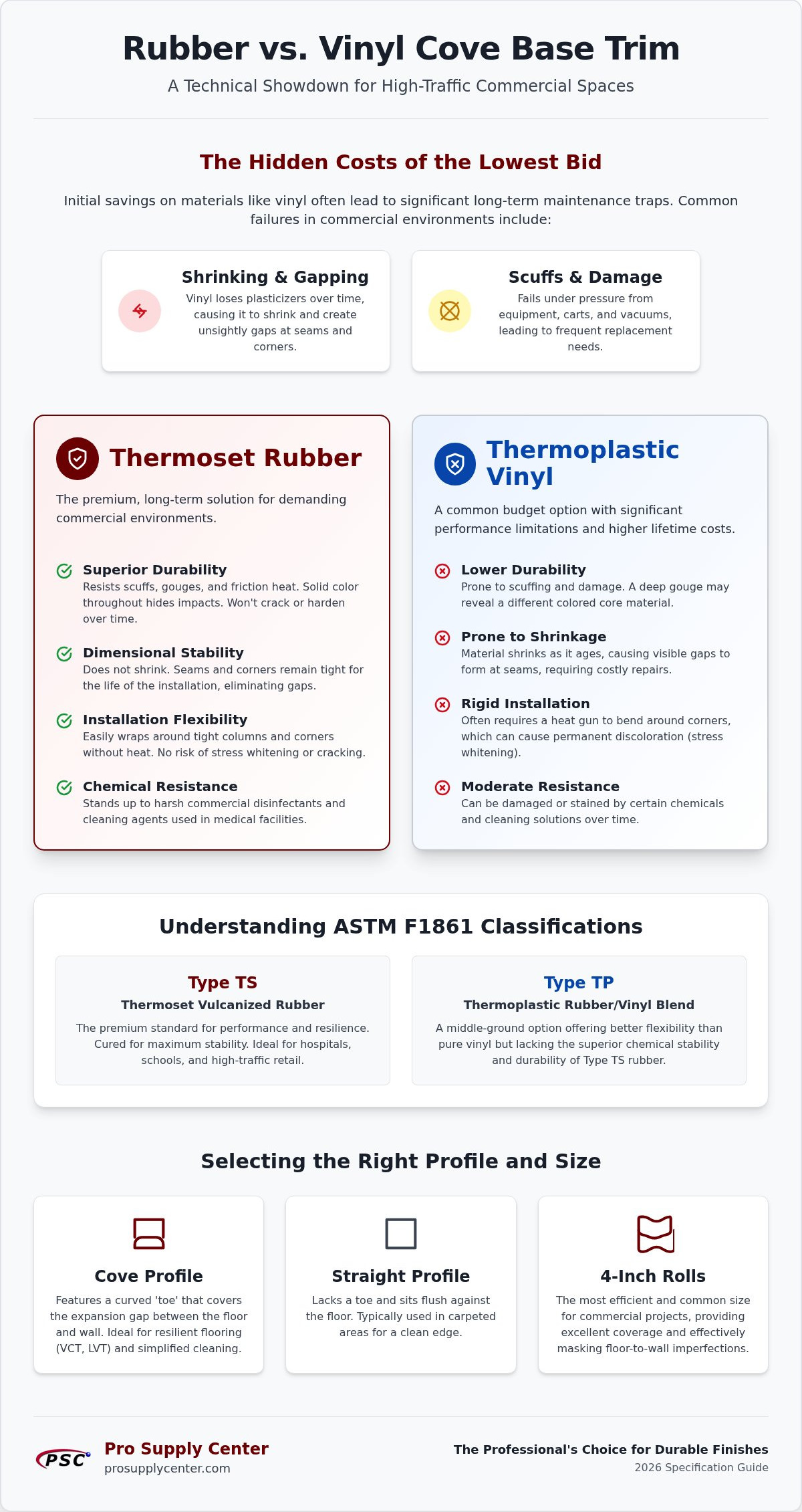
While vinyl and rubber may look identical on a pallet, their chemical behavior under stress is fundamentally different. This performance gap is most visible during installation and after years of heavy maintenance. For instance, rubber cove base trim offers superior flexibility. It allows installers to wrap the material around tight columns or outside corners without applying heat. In contrast, vinyl often requires a heat gun to prevent stress whitening, which is the permanent discoloration that occurs when thermoplastic materials are bent past their limit.
Durability in high-traffic corridors depends on scuff resistance and dimensional stability. Thermoset rubber is cured during manufacturing, making it highly resistant to the friction heat generated by vacuum bumpers or floor buffers. High-quality rubber also integrates pigments throughout the entire material. If a heavy cart gouges the surface, the color remains consistent; this is a major advantage over layered vinyl where a scratch might reveal a different colored core. It also maintains its size. One of the most common failures in commercial buildings is the appearance of gaps at the seams. This is almost always a result of vinyl shrinkage. Rubber doesn't lose its plasticizers over time, ensuring that the joints remain tight for the life of the installation.
Thermoset (TS) Rubber vs. Thermoplastic (TP) Blends
The industry standard ASTM F1861 categorizes these materials into three distinct types. Type TS (Thermoset Vulcanized Rubber) is the premium choice for hospitals and schools because it offers the highest level of resilience. When specifying rubber cove base trim, selecting Type TS ensures the material won't harden or crack under UV exposure. Type TP (Thermoplastic Rubber) provides a middle-ground solution; it's a blend that offers better flexibility than pure vinyl but doesn't quite match the chemical stability of thermoset options. Type TV (Vinyl) remains the budget-friendly selection for low-impact areas where cost is the primary driver.
Environmental and Maintenance Factors
Maintenance cycles also favor rubber. It resists the harsh chemicals found in heavy-duty floor strippers and degreasers that can make vinyl brittle or dull. Many modern rubber products also incorporate recycled content, aligning with LEED certification goals. When you calculate the long-term cost of ownership, the reduced need for repairs and replacements often makes rubber the more economical choice. If you're planning a large-scale project, you can find a wide selection of professional-grade trim options to meet these technical requirements.
Profiles and Dimensions: Selecting the Right 4 Inch Cove Base Roll
Commercial projects require a balance between functional protection and installation speed. The 4 inch cove base roll has become the industry standard because it provides sufficient wall coverage to hide typical construction irregularities while remaining cost-effective. Selecting the right profile depends entirely on the flooring material. A cove profile, characterized by its "toe" at the base, is the primary choice for resilient floors like VCT or LVT. This toe creates a tight seal that prevents moisture and debris from collecting in the expansion gap. Conversely, a straight or toeless profile is designed for carpeted rooms. It allows the trim to sit flush against the wall, providing a clean vertical line without the protrusion of a toe interfering with the carpet pile.
When planning high-traffic corridors, using a continuous roll is almost always superior to individual 4-foot strips. A 120-foot roll of rubber cove base trim allows for long, unbroken runs. This significantly reduces the number of vertical seams, which are often the first places where adhesive failure occurs or where dirt accumulates. Fewer seams also result in a more professional, uniform aesthetic across large floor plates.
Specifying Height for Wall Protection
The height of your wall base should reflect the expected activity level in the room. A 2.5-inch base is a subtle, minimalist option suitable for private offices or low-impact areas where heavy equipment isn't used. The 4-inch base is the workhorse of commercial design; it offers enough height to protect walls from vacuum bumpers and footwear scuffs. For environments like hospital corridors or school locker rooms, a 6-inch base is often specified. This extra height provides a larger vertical shield against the heavy impact of gurneys, carts, and frequent high-moisture cleaning.
Calculating Footage and Minimizing Waste
Accurate measurement is the first step in avoiding project delays. You should measure the linear footage of all walls, then add a waste factor of approximately 10 percent to account for corners and small off-cuts. Complex layouts with numerous columns or alcoves may require a higher waste allowance. Before installation, it is critical to allow the material to acclimate. Unroll the rubber cove base trim and let it sit in the room for at least 24 hours at a stable temperature. This process prevents the material from shrinking or expanding after it has been bonded to the substrate.
Installation Essentials: Adhesives and Corner Techniques
A successful project depends on the chemistry of the bond between the material and the substrate. Because rubber is a non-porous material, it requires specific mechanical and chemical conditions to remain secure over time. Utilizing professional cove base adhesive installation techniques ensures that the material doesn't pull away from the wall as the building settles. Contractors should prioritize adhesives that comply with South Coast AQMD Rule 1168, which limits VOC content for healthier indoor air quality in commercial environments.
Substrate preparation is a non-negotiable first step. Walls must be completely free of dust, old adhesive residue, and moisture. If the wall has been recently painted, you must wait until the paint is fully cured, as outgassing can cause bubbles to form behind the trim. For porous surfaces like drywall or masonry, a standard water-based acrylic adhesive is typically sufficient. However, if you're installing rubber cove base trim over non-porous surfaces like metal or plastic laminate, you'll need a premium contact cement to achieve an immediate, permanent grab.
Adhesive Types for Rubber and Vinyl
Acrylic-based adhesives are the workhorse of the industry for standard drywall applications. They offer a generous "open time," allowing installers to reposition the trim for a perfect fit before the bond sets. This is especially useful in long corridors where keeping a straight line is difficult. For high-traffic areas or areas subject to temperature fluctuations, specialized high-performance acrylics provide better moisture resistance. When working with non-porous substrates, managing tackiness is critical; the adhesive must be allowed to flash off until it's tacky to the touch but doesn't transfer to your finger before the trim is applied.
The Professional Finish: Corner Details
Corners are where most amateur installations fail. For inside corners, the most durable method is scribing. You'll cut the first piece of rubber cove base trim flush into the corner, then scribe the second piece to follow the profile of the first. This creates a tight, seamless look that resists dirt accumulation. Outside corners require a different approach. Instead of cutting the material, professional installers back-shave the rubber. By removing a thin vertical strip from the back of the trim where the bend occurs, you reduce the material's thickness. This allows the rubber to wrap tightly around the corner without the stress whitening or "gap creep" that occurs when the material is forced around a sharp 90-degree angle.
Once the trim is positioned, use a hand roller to apply firm, even pressure across the entire surface. This step is vital to eliminate air pockets and ensure 100 percent adhesive transfer. If you're ready to start your next commercial project, you can browse our full inventory of professional-grade installation accessories to ensure a lasting bond.
Final Selection Guide: Matching Trim to Your Project Goals
Selecting the right rubber cove base trim depends on balancing the upfront material cost against the projected maintenance cycle of the building. For high-traffic commercial environments like hospitals or public schools, specifying 1/8" thick Thermoset rubber is the only way to guarantee resistance to heavy equipment impact and frequent chemical cleaning. This material's vulcanized nature prevents it from becoming brittle or shrinking, which is a primary failure point in large-scale installations where dimensional stability is non-negotiable.
Budget-conscious projects, such as retail outlets or multi-family housing, often benefit from vinyl wall base molding. While it lacks the extreme resilience of thermoset rubber, it provides a clean, professional finish at a lower price point for areas where heavy impact from carts or gurneys is unlikely. If your project has an architectural focus, such as an executive suite or a high-end lobby, consider sculpted or high-profile rubber bases. These options mimic the look of traditional wood millwork while retaining the moisture resistance and durability of resilient materials.
In wet areas like commercial kitchens or locker rooms, the choice of profile is as important as the material itself. You must use a cove profile to ensure a sanitary, moisture-proof seal at the floor-to-wall junction. Pair this with a high-performance, moisture-resistant adhesive to prevent the bond from failing in high-humidity conditions or during frequent power-washing cycles.
Procurement Checklist for Contractors
A successful handover starts with accurate procurement. Use this checklist to verify your order before it arrives on the job site:
- Confirm color lot consistency: Large projects should be filled from the same production batch to avoid subtle shade variations between different rooms.
- Verify material compatibility: Ensure the selected adhesive is rated for both your specific wall substrate and the rubber cove base trim type (TS, TP, or TV).
- Order matching accessories: Factor in pre-molded corners if your crew isn't experienced with manual back-shaving or scribing techniques.
Why Source from Pro Supply Center?
Sourcing materials from a specialized trade partner ensures that you receive contractor-level utility rather than consumer-grade alternatives found in big-box stores. We provide technical support for complex projects, helping you integrate various finishing elements into a single, cohesive system. Whether you are installing the PSC Pro Gen II Waterproofing System in a commercial shower or applying the final wall trim in a high-traffic hallway, we offer the professional-grade supplies required for a successful build. Our focus remains on the physical integrity of the installation and the practical outcomes of the materials we supply.
Securing Long-Term Durability for Your Commercial Facility
Selecting a wall base involves more than matching a color palette; it requires an understanding of how thermoset materials resist the physical and chemical stresses of a high-traffic environment. By prioritizing rubber cove base trim over budget vinyl in critical zones, you eliminate the risks of shrinkage, scuffing, and adhesive failure that often plague inferior installations. This strategic choice ensures your facility maintains a professional appearance while reducing the long-term costs of frequent repairs.
Success on the job site comes down to the quality of your supplies and the precision of your corner techniques. From specialized adhesives to high-efficiency 4-inch rolls, having the right materials on hand is essential for contractor success. You can Shop Professional Rubber and Vinyl Cove Base at Pro Supply Center to access national distribution and expert technical guidance for your next project. We provide the professional-grade materials needed to ensure your building finishes won't fail under the pressure of daily operations. Build with confidence knowing your installation is supported by industry expertise.
Frequently Asked Questions
What is the difference between rubber and vinyl cove base?
The primary difference lies in the material's chemical structure. Rubber is a thermoset material that is vulcanized during manufacturing, meaning it retains its shape and resists scuffs under heat and friction. Vinyl is a thermoplastic material that is more rigid and prone to stress whitening when bent. While vinyl is more budget-friendly, rubber provides superior flexibility for wrapping around columns and curves without requiring a heat gun for installation.
Does rubber cove base shrink over time?
No, high-quality rubber cove base trim is dimensionally stable and won't shrink as it ages. This is a significant advantage over vinyl, which often loses plasticizers over time, leading to unsightly gaps at the vertical seams. Because rubber is cured, it maintains its original size even when exposed to the temperature fluctuations common in large commercial buildings, ensuring that corners and joints remain tight for the life of the product.
Can I install rubber cove base over existing baseboard?
You shouldn't install new trim over existing baseboards. For a professional bond, the old material and any wood or plastic molding must be completely removed. The wall substrate needs to be flat, dry, and smooth to ensure the new adhesive makes 100 percent contact with the surface. Installing over existing trim creates an uneven profile and a weak bond that will likely fail or peel away within a few months.
What height cove base is standard for commercial offices?
The 4-inch height is the industry standard for most commercial office environments. It provides a balanced aesthetic while offering enough vertical protection to shield walls from footwear scuffs and the impact of vacuum bumpers. While 2.5-inch options are available for a minimalist look, they offer less protection. In contrast, 6-inch bases are typically reserved for hospital corridors or schools where heavy equipment and high-impact traffic are expected daily.
Is a cove base required for commercial building codes?
While building codes vary by jurisdiction, cove base is often a requirement in environments that must meet strict health and sanitation standards. Commercial kitchens, laboratories, and medical facilities frequently mandate a coved profile with a toe. This design eliminates the 90-degree gap where the wall meets the floor, preventing the accumulation of bacteria and debris while making the junction easier to sanitize during deep cleaning cycles.
How do I remove old adhesive before installing new rubber trim?
Mechanical removal is the most effective method for preparing a wall. You should use a sharp scraper to remove the bulk of the old glue, followed by sanding with professional-grade abrasives to flatten the surface. If the adhesive is particularly stubborn, a specialized adhesive remover can be used, but you must ensure all chemical residue is cleaned off before applying new rubber cove base trim, or the new bond will be compromised.
What is the best way to clean and maintain rubber wall base?
Maintenance for rubber is straightforward and requires only a neutral pH cleaner and a soft cloth or sponge. You should avoid using harsh solvent-based cleaners or high-alkaline strippers, as these chemicals can dull the surface finish or cause the material to become brittle. For scuff marks, a gentle scrubbing with a damp cloth is usually sufficient. Regular dusting prevents dirt from building up along the top edge or in the cove toe.
Do I need a special tool to cut rubber cove base trim?
You don't need highly specialized machinery, but a sharp utility knife and a straight edge are essential. For the most professional results, many contractors use a miter box or specialized cove base cutters to ensure perfectly square vertical joints. When working with rubber cove base trim, a sharp blade is critical to prevent jagged edges. You may also find a hand roller useful for applying the necessary pressure to secure the bond after the cut is made.


