

You might assume that selecting vinyl wall base molding is a simple task of matching colors to your project's palette. In reality, the obvious choice for aesthetics often fails when it doesn't account for the technical requirements of the substrate or the foot traffic of the environment. It's common to feel overwhelmed by the choice between vinyl and rubber or to struggle with coverage calculations for large-scale rolls. A finish that looks great on day one shouldn't become a maintenance liability by month six because of adhesive failure or poor material selection.
We understand that a professional wall finish must be both scuff-resistant and cost-effective. This 2026 reference guide provides the technical expertise needed to master material specifications and installation standards for any commercial or residential project. You'll learn how to navigate ASTM F1861 classifications, identify the performance gaps between Type TV vinyl and rubber, and implement the high-performance adhesive systems required for a permanent bond. We're moving beyond simple trim to explore the engineering behind a durable, code-compliant perimeter that resists moisture and heavy cleaning.
Key Takeaways
- Identify the technical properties of thermoplastic PVC and its functional role in protecting wall bases within modern commercial environments.
- Differentiate between residential 0.080-inch and commercial 1/8-inch thickness standards to ensure long-term durability and code compliance.
- Evaluate the performance trade-offs between vinyl wall base molding and rubber options regarding scuff resistance and ease of installation.
- Implement professional installation standards, including substrate preparation and the mandatory 48-hour acclimation period for vinyl rolls.
- Learn to coordinate resilient base specifications with tiling and waterproofing systems to maintain structural integrity in high-traffic wet-room applications.
Understanding Vinyl Wall Base Molding in Modern Construction
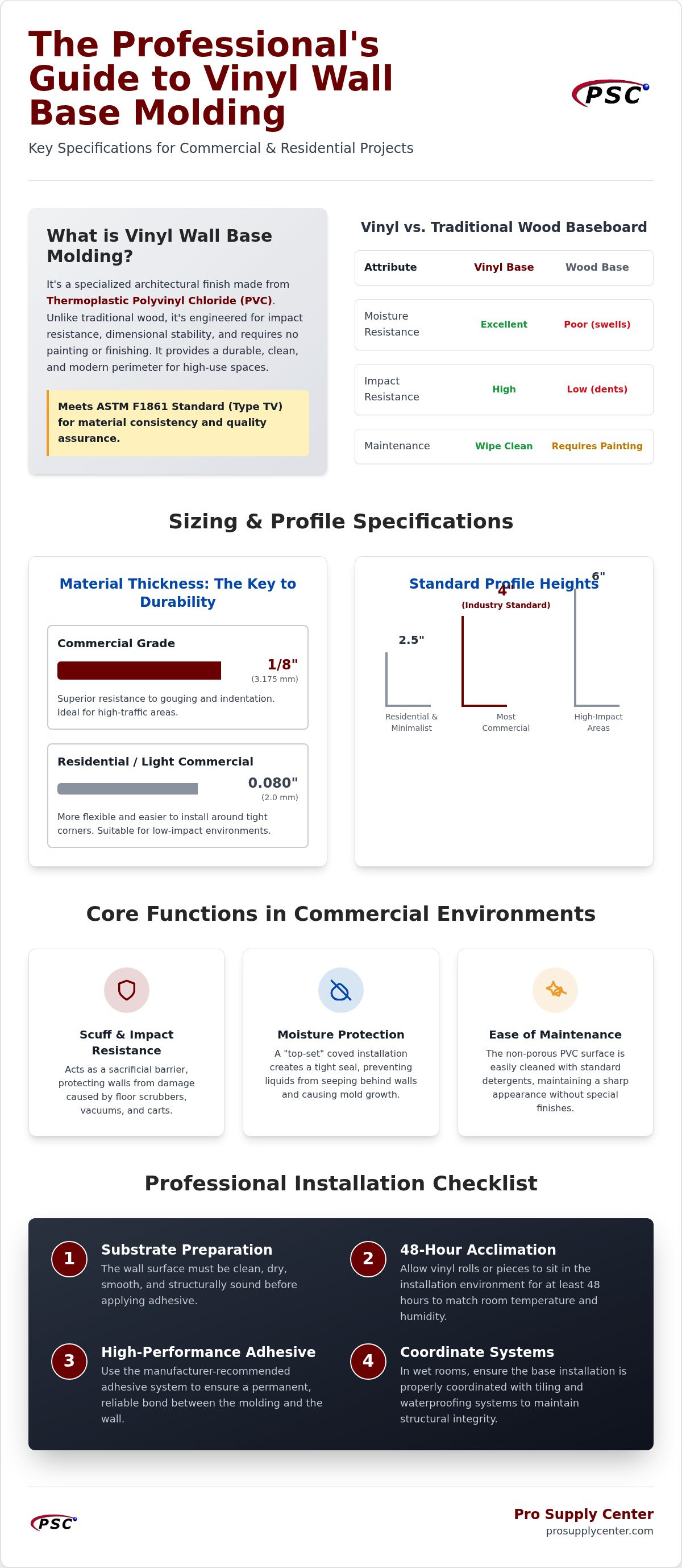
Vinyl wall base molding is a specialized architectural finish made from thermoplastic polyvinyl chloride (PVC). While traditional Baseboard molding was once primarily decorative wood or plaster, modern commercial construction requires materials that can withstand rigorous maintenance and constant foot traffic. This transition reflects a necessary shift toward functional reliability in high use spaces. Wood swells when exposed to moisture and dents easily under pressure. In contrast, thermoplastic vinyl is engineered for impact resistance and long term dimensional stability. It provides a clean, finished look that doesn't require the sanding, priming, or painting associated with traditional trim.
The Role of Resilient Base in Wall Protection
In busy facilities, walls face constant threats from floor scrubbers, vacuum cleaners, and rolling carts. Vinyl molding acts as a sacrificial barrier, absorbing these impacts to prevent structural damage to the drywall. A "top-set" installation is the industry standard for hygiene. It creates a tight seal against the floor, preventing liquid from seeping behind the wall where mold could grow. This makes it the preferred choice for moisture prone areas such as commercial kitchens or restrooms where frequent mopping is necessary. The material's flexibility also allows it to conform to slight irregularities in the wall or floor, ensuring a consistent seal that rigid materials can't achieve.
Material Composition and ASTM Standards
Professional specifications rely on the ASTM F1861 standard to ensure material consistency across different manufacturers. Under this classification, vinyl wall base molding is designated as Type TV (Thermoplastic Vinyl). This material is chosen for its specific chemical composition, which provides better scuff resistance than cheaper, non-standardized alternatives. Builders must also verify that the product meets specific flame spread and smoke development ratings. Most commercial building codes require a Class A fire rating, ensuring the material doesn't contribute significantly to fire hazards in egress corridors.
- Scuff Resistance: The dense PVC composition resists marks from rubber soles and equipment wheels.
- Moisture Protection: Non porous surfaces prevent water absorption during wet cleaning cycles.
- Ease of Maintenance: Simple wiping with standard detergents keeps the surface clean without specialized finishes.
You'll find these products most frequently in healthcare, education, and retail environments. In hospitals, the seamless transition provided by a coved vinyl base is vital for maintaining infection control standards. In schools, the durability of PVC handles the daily abuse of student activity and heavy equipment without needing frequent repainting or repair. Retail spaces benefit from the material's ability to maintain a sharp, clean appearance despite heavy customer volume and constant floor cleaning. It's a pragmatic solution that balances upfront material costs with significantly reduced lifecycle maintenance requirements.
Standard Sizing, Profiles, and Material Specifications
Selecting the correct dimensions for vinyl wall base molding is a matter of functional necessity, not just aesthetic preference. Standard heights are categorized into 2.5-inch, 4-inch, and 6-inch options. A 4-inch profile is the industry standard for most commercial interiors. It provides enough surface area to protect walls from typical equipment while maintaining a balanced visual scale. In contrast, 2.5-inch heights are reserved for minimalist designs or residential applications where impact risks are low. For high-traffic corridors in hospitals or warehouses, a 6-inch base is often specified to guard against heavy carts and floor scrubbers that might strike higher up the wall.
Material thickness is the primary indicator of durability. Commercial-grade vinyl wall base molding is typically 1/8-inch (3.175 mm) thick. This gauge offers superior resistance to gouging and indentation. Residential or light commercial projects often utilize 0.080-inch (2.0 mm) material. While thinner, it's more flexible and easier to manipulate around tight corners. Choosing the wrong thickness can lead to premature wear in environments where floor cleaning equipment is frequently used. It's vital to match the gauge to the expected mechanical stress of the room.
Cove Base vs. Straight (Toeless) Profiles
The profile you select depends entirely on the flooring material. Cove base features a "toe" at the bottom that curves outward. This toe serves a functional purpose by hiding gaps between the wall and the floor, creating a sanitary seal that prevents debris accumulation. It's the standard choice for resilient flooring like vinyl, VCT, or tile. Straight (toeless) profiles are designed to sit flush against the wall. These are used almost exclusively for carpeted areas. Because carpet has its own thickness and height, a toe would create an awkward protrusion that interferes with the carpet's edge.
Rolls vs. Strips: Planning Your Coverage
Project scale dictates whether you should order 4-foot sections or continuous rolls. For long, uninterrupted corridors, 4 inch cove base rolls are the most efficient choice. They minimize the number of vertical seams, which are often the first points of failure in an installation. Continuous rolls also reduce material waste on long runs. However, 4-foot strips are more practical for small rooms with multiple corners and doorways. They're easier to handle in tight spaces and allow for more precise cuts. When calculating your order, always include a waste factor of 5% to 10% to account for corners and off-cuts.
Finish options have expanded beyond basic colors. You can now select from matte or satin finishes to match the sheen of your flooring. Wood-grain patterns are also available for projects requiring a high-end look without the maintenance of real wood. If you're ready to start your next project, you can browse our full selection of professional trim to find the right material for your specific environment.
Vinyl vs. Rubber Cove Base: A Technical Comparison
Choosing the right vinyl wall base molding involves a direct evaluation of material chemistry against the specific demands of the job site. While vinyl and rubber look nearly identical once installed, their performance under mechanical stress varies significantly. Vinyl is a thermoplastic material (ASTM F1861 Type TV), meaning it is shaped by heat. Rubber, specifically vulcanized rubber (Type TS), is a thermoset material that maintains its shape regardless of temperature changes. This distinction dictates how the materials handle scuffs, gouges, and installation complexities. For the majority of commercial builds, standard vinyl wall base molding remains the most cost-effective choice, providing a balance of durability and low upfront material costs.
Flexibility is the primary functional difference during the installation phase. Vinyl is inherently more rigid than rubber. For contractors, this means wrapping tight outside corners usually requires a heat gun to soften the PVC, preventing the material from stressing or "whitening" at the bend. Rubber is naturally more pliable and can be wrapped around corners without supplemental heat, which can speed up installation on complex layouts. However, vinyl's rigidity provides better dimensional stability in environments with fluctuating temperatures, as it's less prone to shrinking or expanding after the adhesive has cured.
Performance Characteristics of Vinyl
When to Upgrade to Rubber or Blends
In high-impact zones like hospital gurney bays or loading areas, rubber's flexibility is a functional asset. It absorbs heavy shocks that might cause rigid vinyl to crack over time. If the project budget doesn't allow for 100% vulcanized rubber, consider a "Rubber-Vinyl Blend" (Type TP). This thermoplastic rubber bridges the gap, offering the scuff resistance of vinyl with the improved flexibility of rubber. It's a middle-ground solution that handles corners better than pure vinyl while remaining more affordable than vulcanized options. Evaluating the return on investment for these materials requires looking at the five-year maintenance cycle; rubber or blends often pay for themselves in healthcare settings by reducing the frequency of trim replacement in high-traffic corridors.
Professional Installation Standards and Substrate Preparation
Successful installation of vinyl wall base molding begins long before the first strip is glued to the wall. You must allow a 24 to 48 hour acclimation period for all materials. During this time, rolls should be uncoiled and stored flat at the room's normal operating temperature. This step is vital because it prevents the material from attempting to return to its coiled shape after the adhesive is applied, which often leads to end-curling. The substrate must be pristine. Any remnants of old adhesive, floor wax, or dust will compromise the bond. If you're working on new plaster or masonry, ensure the surface is fully cured and dry to avoid trapping moisture behind the PVC.
Adhesive Selection and Application
Choosing the right bonding agent is as critical as the trim itself. For most drywall and plaster applications, a standard water-based acrylic adhesive works best. However, professional cove base adhesive installation in wet areas like bathrooms or commercial kitchens requires moisture-resistant formulations. Use a 1/8-inch notched spreader for large runs to ensure 100% coverage on the back of the molding. For smaller repairs or complex details, a cartridge gun provides better precision. Avoid applying adhesive too close to the top edge. This prevents squeeze-out during the rolling process that can ruin the wall finish.
Mastering Inside and Outside Corners
Achieving a factory-look finish depends on your corner technique. For outside corners, the "V-Groove" method is superior to simple bending. By removing a small amount of material from the back of the vinyl with a gouging tool, you can wrap the corner without the vinyl turning white from stress. Inside corners require scribing. You'll overlap two pieces and cut through both to create a seamless, gap-free transition. While pre-molded corners are available, job-site fabrication allows for adjustments to walls that aren't perfectly square. This manual approach ensures a tighter fit that resists peeling over time.
Post-Installation Care and Maintenance
Once the installation is complete, follow the 72-hour "no-wash" rule. This allows the adhesive to reach its full shear strength before it's exposed to water or heavy cleaning equipment. Use pH-neutral cleaning agents to maintain the surface. Harsh solvents can degrade the PVC and cause the color to dull. If you notice minor scuffs, a soft cloth and a mild detergent usually suffice. For edge-peeling issues, a small amount of contact cement can provide a quick, permanent fix. If you need high-performance bonding agents for your project, you can buy professional-grade adhesives and installation tools here to ensure a long-lasting bond.
Specifying Vinyl Molding for Large-Scale Projects
Specifying vinyl wall base molding for large scale projects requires a transition from simple material selection to complex logistics management. Architects usually define these requirements in Section 09 65 13 of the project manual. You must verify that the specified material meets the required fire and safety codes for commercial occupancy. Most high occupancy buildings require a Class A fire rating under ASTM E84 testing. Beyond fire safety, coordination with other trades is essential. In wet room designs, the wall base serves as the final perimeter seal. It must work in tandem with advanced moisture barriers like PSC Pro Gen II Waterproofing Systems to ensure the structural integrity of the wall assembly.
Bulk procurement introduces unique challenges. When ordering thousands of feet, palletizing becomes a logistical necessity for site storage and movement. You should also account for lead times, which can vary based on color selection and profile height. Batch consistency is another critical factor. Always request that all rolls or strips come from the same production run or dye lot. Even minor variations in pigment can be visible when vinyl wall base molding is installed in a long, continuous corridor under bright LED lighting.
Inventory Planning and Waste Management
Procurement usually involves converting linear foot requirements into box counts. Most commercial molding is packaged in 100 foot or 120 foot boxes. It's standard practice to order a 10% overage. This surplus isn't just for installation errors or corner fabrication. It provides the facility manager with matching material for future repairs or maintenance. Without this "attic stock," matching the exact color and sheen years later can be nearly impossible due to production changes or sun aging.
Sourcing Professional-Grade Finishing Supplies
Relying on a centralized supplier simplifies the project lifecycle. Pro Supply Center supports contractors by providing everything from the base molding to the high performance adhesives and abrasives needed for a clean finish. This consolidated approach ensures that all materials are chemically compatible. A successful commercial hand-off requires a final inspection checklist:
- Verify all seams are tight and free of visible adhesive residue.
- Confirm all outside corners are wrapped correctly without whitening or stress marks.
- Ensure the material has fully cured for at least 72 hours before professional floor cleaning begins.
- Provide the client with the remaining attic stock and specific maintenance instructions for the PVC surface.
Following these standards ensures that the final result meets both the architectural intent and the long term durability requirements of the facility. By managing the logistics and material coordination effectively, you reduce the risk of delays and ensure a professional finish that lasts.
Mastering Your Next Wall Finish Project
Achieving a professional, scuff-resistant finish requires more than just picking a color. It demands an understanding of material chemistry and strict adherence to installation standards. By prioritizing substrate preparation and allowing for proper acclimation, you ensure a long-term bond that withstands heavy cleaning and high traffic. Whether you're specifying materials for a healthcare facility or a residential renovation, the right selection of vinyl wall base molding will dictate the lifecycle costs and performance of your space.
Reliable results depend on sourcing high-performance materials that meet modern building codes and fire safety standards. You can Browse Professional Vinyl and Rubber Cove Base at Pro Supply Center to access materials engineered for contractor-grade durability. We provide national shipping on all wall finishing supplies and offer trusted technical support for large-scale construction needs. Start your next installation with the right technical foundation and the best supplies for the job.
Frequently Asked Questions
What is the difference between vinyl and rubber wall base?
The primary difference lies in material chemistry and flexibility. Vinyl is a thermoplastic PVC (ASTM F1861 Type TV) that is harder and typically more scuff-resistant. Rubber is a thermoset vulcanized material (Type TS) that offers superior flexibility and dimensional stability in extreme temperature fluctuations. While vinyl is the industry standard for budget-conscious commercial builds, rubber is often specified for high-impact zones where its natural pliability prevents cracking and eases installation on irregular walls.
Can vinyl wall base be installed over existing baseboards?
No, you should never install vinyl wall base over existing wood or resilient baseboards. For a professional, long-term bond, the material must be applied directly to a clean, flat, and dry substrate like drywall or masonry. Installing over existing trim creates structural gaps where moisture can accumulate and prevents the adhesive from forming a permanent seal. Always remove old trim and scrape away residual adhesive or wax before starting a new installation.
Does vinyl wall base molding require a specific type of adhesive?
Yes, vinyl wall base molding requires specialized cove base adhesive, typically a water-based acrylic or a moisture-resistant formulation for wet environments. Standard construction adhesives or wood glues lack the initial "tack" required to hold the material in place while it cures. For commercial projects, using a cartridge gun or a notched spreader ensures 100% coverage, which is critical for preventing the edges from curling or pulling away from the wall over time.
What is the most common height for commercial vinyl wall base?
The 4-inch height is the industry standard for most commercial interiors. This dimension provides a balanced aesthetic while offering sufficient protection against foot traffic and floor cleaning equipment. While 2.5-inch options exist for minimalist residential designs and 6-inch profiles are specified for high-traffic corridors or hospitals, the 4-inch profile remains the most versatile choice across retail, office, and educational environments due to its functional coverage and visual scale.
How do you prevent vinyl wall base from peeling at the corners?
Prevention starts with proper substrate preparation and using the "V-Groove" technique for outside corners. By removing a small amount of material from the back of the vinyl with a gouging tool, you reduce the tension that causes the material to pull away. Additionally, ensuring the wall is free of dust and old adhesive allows the bond to reach full strength. Always use a hand roller after installation to press the molding firmly into the adhesive.
Is vinyl wall base waterproof and suitable for bathrooms?
Yes, vinyl is a non-porous thermoplastic that is inherently waterproof and highly suitable for bathrooms. However, the integrity of the seal depends on using a moisture-resistant adhesive and ensuring a tight cove transition at the floor-to-wall joint. In these environments, vinyl wall base molding prevents water from seeping into the wall cavity during wet cleaning cycles, making it a sanitary choice for commercial restrooms, kitchens, and other high-moisture zones.
How many linear feet are typically in a standard cove base roll?
Standard commercial rolls are typically manufactured in 100-foot or 120-foot lengths. These continuous rolls are preferred for large-scale projects because they significantly reduce the number of vertical seams in long corridors, which are common points of failure. When planning your procurement, convert your total linear footage into box counts based on these standard lengths. Always include a 10% waste factor to account for corner fabrication and off-cuts during the installation process.
Can I paint vinyl wall base molding if the color doesn’t match?
While you can technically paint vinyl using specialized 100% acrylic latex primers, it is not recommended for high-traffic areas. The inherent flexibility of the vinyl often causes paint to crack or peel when the material is bumped or cleaned. It is more effective to select a product from the wide range of factory-integrated colors. This ensures the color remains consistent even if the surface is scuffed or gouged during the facility's normal lifecycle.


