

Could the traditional "snap-off" clip be the most inefficient tool on your job site? While disposable systems are common, they frequently leave behind broken plastic shards that ruin grout lines and force you into a cycle of constant repurchasing. As large-format porcelain panels dominate the market in 2026, the technical limitations of cheap plastic are harder to ignore. We know that achieving a perfectly flat surface on 24x48 tiles requires consistent mechanical tension that a reusable tile leveling system provides more reliably.
By switching to professional-grade hardware like the Ceramic Tiles Leveling System, you don't just reduce waste; you eliminate the recurring expense of single-use plastics and ensure a cleaner finish without plastic remnants. This guide provides a technical comparison of the latest hardware to help you reduce per-job material costs. You'll learn how to master lippage-free installations through a detailed look at mechanical advantages and the professional maintenance routines required to keep your equipment in peak condition.
Key Takeaways
- Learn how a reusable tile leveling system locks large-format tiles into a single flat plane to eliminate lippage and ensure professional results.
- Understand the technical differences between T-pin and Cap-and-Strap hardware to choose the most efficient mechanical tension for your specific installation.
- Discover the long-term ROI of professional-grade kits, which significantly reduce material costs and storage requirements compared to single-use plastic clips.
- Master the critical timing for tool removal and the cleaning protocols necessary to maintain the functional reliability of your Ceramic Tiles Leveling System.
- Identify how to select the right hardware for specific tile thicknesses while integrating these tools with the PSC Pro Gen II Waterproofing System for a high-performance build.
Understanding the Shift to Reusable Tile Leveling Systems
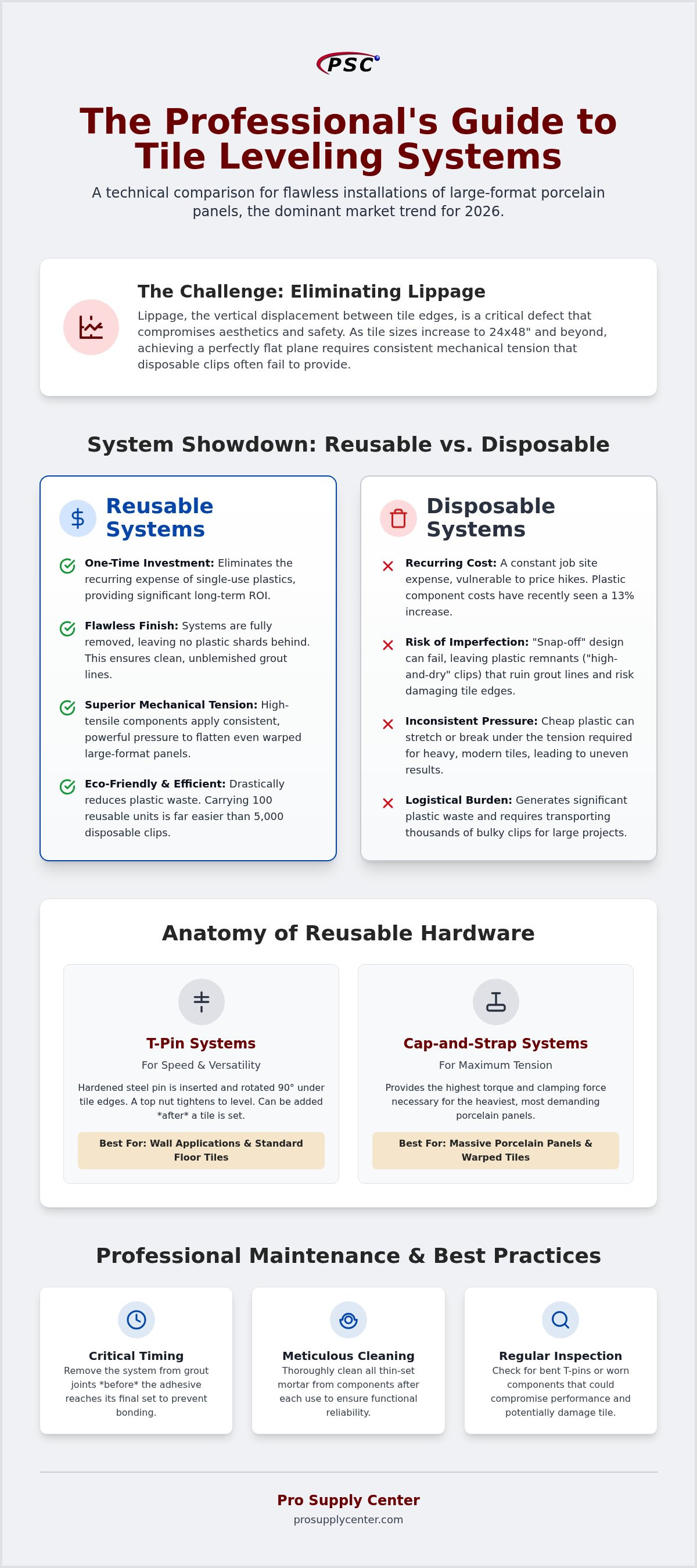
A reusable tile leveling system is a mechanical toolset engineered to maintain a perfectly flat installation surface across multiple projects. Unlike traditional plastic clips that are snapped off and discarded, these systems utilize high-tensile components designed for retrieval and repeated use. As the industry moves toward larger, heavier porcelain panels in 2026, the need for precise calibration has shifted from a luxury to a technical requirement. Professionals are increasingly moving away from single-use plastics due to both environmental concerns and logistical headaches. Logistically, carrying 100 reusable units is far more efficient than transporting 5,000 disposable clips. Furthermore, with the 13% increase in plastic component costs reported in recent years, the economic argument for a permanent toolset is now a priority for any high-volume contractor.
The Mechanics of Lippage Control
Lippage is defined as the vertical displacement between the edges of two adjacent tiles, a defect that creates tripping hazards and compromises the floor's long-term durability. To combat this, a reusable tile leveling system applies consistent vertical pressure to force adjacent tile edges into a single, unified plane. This pressure is essential when working with modern porcelain panels, which often exhibit subtle warpage due to the cooling stages of production. Installers must account for these physical properties to achieve a professional finish. Understanding the evolution of tile manufacturing and materials helps professionals realize why modern ceramics require higher mechanical tension than older, smaller formats. Without this sustained pressure, even a slight bow in the tile can lead to significant lippage that ruins the aesthetic and structural integrity of the build.
Disposable vs. Reusable: The Core Differences
The primary distinction between these two systems lies in their removal process and mechanical longevity. Disposable systems rely on a "snap-off" design where a plastic bridge is broken at the base after the thin-set hardens. This creates a recurring risk of "high-and-dry" clips, where the plastic breaks incorrectly and leaves a shard protruding above the grout line. These remnants are difficult to remove without damaging the tile edge. In contrast, a reusable system is designed to be fully removed from the grout joint before the adhesive reaches its final set. This eliminates the presence of plastic remnants entirely, ensuring cleaner grout lines and a more reliable finish. For the serious trade professional, investing in a Ceramic Tiles Leveling System represents a shift toward tools that offer functional reliability rather than consumable waste. This mechanical approach ensures that the tension used to level the tile is consistent from the first room to the last.
Anatomy of Reusable Systems: T-Pins vs. Cap-and-Strap Designs
Choosing the right hardware depends on the specific mechanical demands of your project. A professional reusable tile leveling system generally falls into two categories: T-pin designs and cap-and-strap systems. Each utilizes different physics to achieve the same goal of zero lippage. T-pin systems are often favored for their speed and ability to be retrofitted into a joint, while cap-and-strap systems are known for providing the high torque necessary for the heaviest porcelain panels. Understanding the material composition of these tools is just as vital as understanding their shape. You'll typically find components made from hardened steel or high-impact reinforced polymers, both of which are selected for their ability to withstand repeated tension cycles without deforming.
T-Pin Systems: Speed and Simplicity
T-pin systems prioritize efficiency on the job site. The installation process is straightforward: you insert the steel pin into the grout joint, rotate it 90 degrees to hook under the tile edges, and tighten the top nut to pull the tiles into alignment. This design is particularly useful because you can add a leveler after the tile is already set in the mortar, a feature that disposable clips don't offer. To ensure functional reliability, these systems rely on high-quality hardened steel pins. Lower-grade metals can bend or "fish-hook" under pressure, making them difficult to remove and potentially damaging the tile edges. For installers focusing on wall applications or standard floor tiles, the T-pin is often the most practical choice due to its rapid deployment and retrieval.
Cap-and-Strap Systems: Maximum Tension
When working with massive porcelain panels, you need granular control over leveling pressure. Cap-and-strap systems, often referred to as "Spin Doctor" style tools, use a reusable threaded cap that screws onto a vertical strap. This threading allows for precise tensioning that wedge-based systems can't always match. While the straps are sometimes disposable, the caps are built for longevity and can be used across hundreds of installations. This setup is frequently the preferred tile leveling system for large format tile because it can exert the significant force required to flatten warped panels. Adhering to industry installation standards ensures that these high-tension tools are used correctly to prevent "tenting" or adhesive failure.
Material durability remains the deciding factor for professional longevity. Heavy floor installations require the reinforced polymers found in a premium Ceramic Tiles Leveling System to prevent the caps from cracking under high torque. If you're managing a high-volume project, these robust systems offer a better return on investment by maintaining their structural integrity over dozens of uses. Whether you choose the agility of the T-pin or the power of the cap-and-strap, the goal is a flat, durable surface that stands up to 2026's rigorous building requirements.
Economic and Performance Analysis: The ROI of Reusable Kits
Calculating the true value of professional equipment requires looking past the initial receipt. While a bag of 500 disposable clips might seem inexpensive, the cumulative cost over a year of high-volume work is staggering. A reusable tile leveling system changes the financial math by shifting the expense from a recurring consumable to a durable capital asset. In 2026, where material costs for plastic components have risen by 13%, the economic argument for permanent hardware is a priority for any professional contractor. You're no longer just buying plastic; you're investing in a mechanical toolset that maintains its value across dozens of job sites.
Initial Investment vs. Long-Term Savings
If you calculate the cost-per-tile-set for a reusable system over 50 projects, the savings become undeniable. A standard 1,000-square-foot floor might require 4,000 to 5,000 disposable clips. Over 50 jobs, that's a quarter-million pieces of plastic destined for the landfill. In contrast, 100 to 200 units from a professional Ceramic Tiles Leveling System can handle that same volume with zero additional material purchases. Logistics also improve significantly. 100 reusable units fit in a single tool bag, whereas 5,000 clips require significant van space and constant inventory management. Premium materials pay for themselves within the first five large-scale jobs simply by eliminating the "plastic tax" on every invoice.
Performance on the Job Site
Beyond the balance sheet, the performance of these tools reduces the "callback" factor. Superior leveling prevents the expensive repairs and client complaints associated with lippage. Adhering to professional installation standards means recognizing that leveling clips aren't a crutch; they're essential equipment for modern tile. Some critics point to "cleaning time" as a drawback, but they often ignore the hours saved during grout preparation. You don't have to spend your morning digging out broken plastic remnants with a utility knife. Instead, you get clean grout joints every time. In 2026, the typical lifespan of a professional T-pin system is estimated at 50 or more uses per pin. This reliability ensures that the tension remains consistent over the full 24-hour thin-set cure period, preventing the "tile creep" that occurs as moisture evaporates from the adhesive.
Professional Best Practices for Reusable System Maintenance
The long-term value of a reusable tile leveling system depends entirely on your maintenance discipline. While these tools are built for durability, they are not indestructible. The most critical rule for any installer is the removal window. You must extract the leveling hardware before the thin-set adhesive reaches its final set. Typically, this window is between four and six hours, depending on the ambient temperature and the specific mortar used. If the adhesive hardens completely, the steel pin becomes bonded to the substrate. Forcing a stuck pin can chip the tile edge or snap the metal, leaving a permanent obstruction in your grout joint.
Cleaning and Storage Protocols
Clean tools work better. It's that simple. To maintain functional reliability, implement a "set-and-bucket" workflow on every job site. Keep a five-gallon bucket of clean water nearby. As you remove each unit, drop it immediately into the water to prevent the mortar from skinning over. Once the job is finished, use a soft-bristle brush to scrub away any remaining residue from the threads and pins. Pay close attention to the internal threads of the caps; dried mortar in these areas acts as an abrasive that will eventually strip the polymer. After scrubbing, dry the components thoroughly. Even high-grade steel can suffer from surface oxidation if stored in a damp bag, which increases friction and makes future installations more difficult.
Applying a dry lubricant to the threads can significantly extend the life of your hardware. Avoid oil-based lubricants that might stain the tile or grout. Instead, a quick spray of PTFE or silicone-based dry lubricant keeps the mechanical action smooth and prevents mortar from sticking to the moving parts. This small step ensures that you can achieve maximum tension with minimal effort on your next project.
Troubleshooting Common Issues
Regular inspection is the best way to prevent tool failure during a live set. Before every project, check your T-pins for "necking" or slight bends. A deformed pin will not rotate properly and can get snagged under the tile. If a pin does become stuck in partially hardened mortar, do not use pliers to force it. Instead, gently wiggle the pin back and forth to break the bond. For complex areas like integrated shower niches or tight corners, you may need to use a smaller profile leveler to avoid crowding the joint. If you notice the threads on a cap starting to jump or slip, it has reached the end of its functional life. In the 2026 market, professional T-pins are rated for approximately 50 uses, but only if they are kept clean and straight.
Maintaining your equipment ensures that every installation meets the high standards of a master tradesman. To upgrade your kit with professional-grade hardware, browse our selection of the Ceramic Tiles Leveling System and ensure your next project is lippage-free.
Selecting the Right Leveling System for Your Next Project
Selecting a reusable tile leveling system is the final technical decision in a chain that begins with substrate preparation. You can't rely on a mechanical leveler to fix a subfloor that is significantly out of spec. Substrate prep is mandatory. Industry standards generally require a surface to be flat within 1/8 inch over a 10-foot span for large-format installations. Once the foundation is verified, the choice of hardware depends on the physical properties of the tile and the intended aesthetic of the grout joint.
Matching Tools to Tile Types
Different materials impose different mechanical demands on your leveling hardware. Gauged porcelain panels are particularly sensitive to uneven tension. Because these panels are thinner and larger than standard tiles, they require a system that distributes pressure without creating stress points that could cause cracking. In contrast, heavy natural stone needs high-torque cap systems to move the significant mass of the slab. Consider these common requirements:
- Gauged Porcelain Panels: Require consistent, low-profile tension to avoid stress fractures.
- Heavy Natural Stone: Needs high-torque cap systems to handle the weight of the material.
- Standard Ceramic: Well-suited for rapid-deployment T-pin systems that prioritize speed.
It is also vital to check the minimum joint width of your chosen hardware. Most T-pin systems require at least a 1.5mm gap. If your design calls for a wider joint, you should use traditional spacers in conjunction with the levelers to maintain perfect lines while the mechanical system handles the vertical alignment.
The Complete Installation Ecosystem
A successful build relies on the synergy between different professional-grade components. For example, achieving a perfectly flat floor is essential when installing the PSC Pro Gen II Waterproofing System. In wet areas like showers, even minor lippage can disrupt the intended slope toward the drain. This leads to standing water, which eventually compromises the grout and creates maintenance headaches for the client. By eliminating these vertical offsets, you ensure that the waterproofing membrane and the surface finish work together as a single, high-performance unit.
Long-term grout integrity also depends on this stability. When tiles are locked into a single plane, the grout is less likely to crack or debond due to point-load pressure. Pro Supply Center’s curated selection of tiling accessories is designed to meet these rigorous trade standards. Whether you are managing a residential renovation or a large-scale commercial project, the Ceramic Tiles Leveling System provides the functional reliability required for a lippage-free finish. Investing in the right tools today prevents the costly remediation work of tomorrow.
Mastering the Standard for 2026 Installations
Transitioning to a reusable tile leveling system is no longer just about reducing plastic waste; it's a strategic move to ensure mechanical consistency and long-term profitability. By selecting hardware that matches your specific tile format and committing to a disciplined cleaning protocol, you eliminate the frustration of broken plastic remnants and protect the integrity of your grout lines. These tools provide the sustained tension required for modern porcelain panels, ensuring that your finish remains flat throughout the curing process.
Pro Supply Center offers a curated Ceramic Tiles Leveling System specifically engineered for professional contractor durability. Our team provides expert technical support for complex large-format installations and offers national shipping on our full range of tiling accessories. Shop Professional Ceramic Tile Leveling Systems at Pro Supply Center to upgrade your toolkit with equipment that performs under pressure. Achieving a lippage-free surface is the hallmark of a master tradesman. With the right hardware and a methodical approach, you'll deliver flawless, high-performance results on every project.
Frequently Asked Questions
How many times can I actually reuse a T-pin leveling system?
Professional-grade T-pins are typically rated for 50 or more uses if you maintain them correctly. This lifespan depends on immediate cleaning and avoiding high-torque stress that can bend the metal. Inspecting for deformation before each project ensures functional reliability. If a pin becomes bent or the metal shows fatigue, you should replace it to prevent it from snapping inside a live grout joint.
Do reusable tile leveling systems work on wall tiles as well as floors?
These systems are highly effective for vertical applications where gravity can cause tile slippage. A reusable tile leveling system provides the mechanical tension needed to keep large-format wall tiles perfectly aligned while the mortar sets. This is especially useful for high-end shower builds. It prevents the "stair-stepping" effect that often occurs on vertical surfaces when you use standard spacers alone.
Will a steel T-pin scratch the surface of my porcelain or marble tiles?
Steel pins won't scratch the surface if you insert and rotate them correctly within the grout joint. The pin's "T" section sits beneath the tile, while the tightening cap applies pressure to the top surface. Most professional caps feature a smooth, non-marring base to protect delicate finishes like polished marble. Ensure the tiles are clean and free of abrasive grit before tightening the system.
At what point in the drying process should I remove the reusable levelers?
You should remove the levelers once the thin-set has reached an initial set but before it hardens completely. This window is typically between four and six hours after installation. Removing them too early can allow the tiles to shift. Waiting too long risks bonding the steel pin to the substrate. Checking the mortar's consistency in a scrap joint is a reliable way to gauge timing.
Can I use a reusable system with very thin grout lines like 1/16 inch?
Most T-pin systems are designed for grout joints of 1.5mm, which is roughly 1/16 inch, or wider. If you're aiming for an ultra-thin joint, you must verify the specific pin thickness of your reusable tile leveling system. For joints narrower than the pin width, you'll need a different leveling method. Always use traditional spacers alongside the levelers to ensure the joint width remains consistent.
What is the best way to remove hardened mortar from a reusable cap?
The most efficient method is a warm water soak followed by scrubbing with a soft-bristle brush. Avoid using metal scrapers or harsh chemicals that can degrade the high-impact reinforced polymers of the cap. If mortar has dried inside the internal threads, a quick rinse in a bucket immediately after removal is the best preventative measure. For stubborn residue, a stiff nylon brush will clear the threads.
Are reusable systems compatible with all types of thin-set and mortar?
Reusable systems are compatible with standard and large-format tile mortars, including polymer-modified thin-sets. However, rapid-setting mortars significantly shorten your removal window. If you're using a fast-cure adhesive, you may only have 60 to 90 minutes before the pin becomes difficult to extract. Coordinate your installation pace with the open time and setting speed of the specific mortar you've selected for the project.
Do I still need to use traditional spacers if I have a leveling system?
Traditional spacers are still necessary to maintain horizontal alignment and consistent joint widths. While a leveling system manages the vertical plane to eliminate lippage, it isn't designed to keep tiles perfectly spaced. Using the Ceramic Tiles Leveling System in conjunction with standard spacers ensures that your grout lines are straight and your tile edges are flush. This results in a professional, high-performance installation.


