

The wrong deck tile spacer clips can create neat-looking joints while still being the wrong fit for the deck assembly. A spacer may set the gap between tiles, but it doesn’t necessarily level them or support the deck surface. Those functions may belong to separate components in a pedestal decking system.
To identify which parts your project needs, start with the tile or paver and the support method. Joint spacing, drainage paths, compatibility, and room for movement all affect the choice. A component that works in one assembly may not suit another, so check the system details before selecting clips or spacers.
This guide compares deck tile spacer clips and related components by installation method, drainage needs, tile compatibility, and project conditions. You’ll learn how to distinguish joint-spacing parts from pedestal decking components, and when both may be needed. It also explains how to plan consistent joints without obstructing drainage or restricting movement, so you can choose a compatible setup for stable alignment.
Key Takeaways
- Identify how the outdoor tiles or pavers are supported before choosing components.
- Use deck tile spacer clips only for the function their specifications confirm. Indoor tile-leveling accessories serve a different purpose.
- Check the tile or paver format and planned joint layout against the component details before purchasing.
- Plan drainage and movement as part of the full assembly. Don’t assume a spacer handles either one.
- Compare simple paver spacers with system-specific decking components to determine what the installation requires.
What Deck Tile Spacer Clips Do and What They Do Not Do
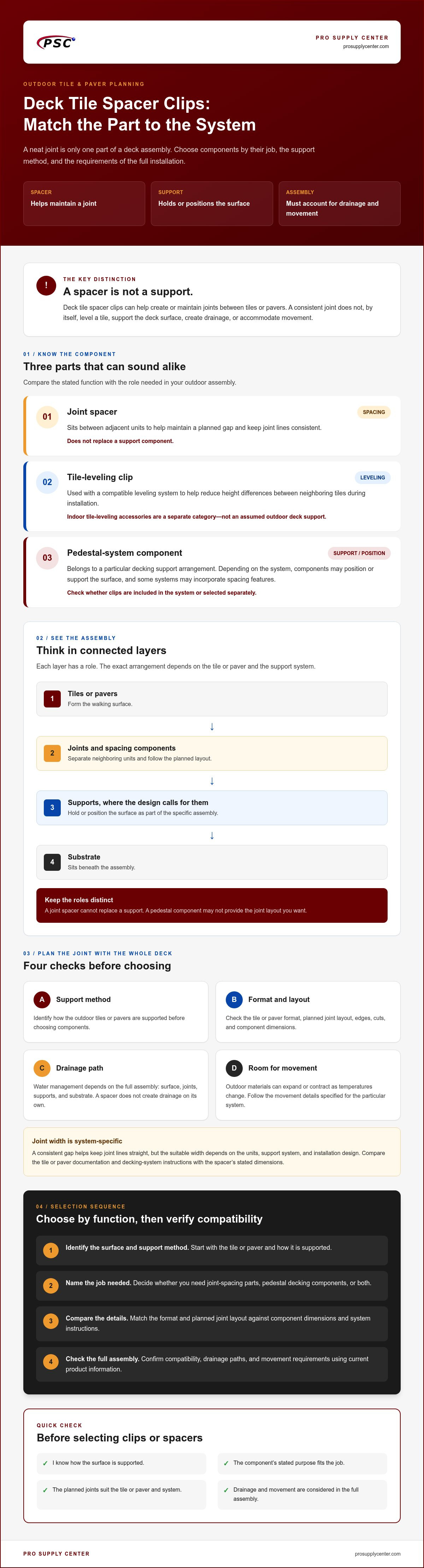
Deck tile spacer clips help create or maintain joints between tiles or pavers. Support components carry and position the deck surface as part of a specific assembly. The terms can sound interchangeable, but the parts may have different jobs. A consistent joint can help keep a layout aligned. It doesn’t, by itself, level a tile or provide structural support.
The right component depends on how the outdoor surface is built. A tile or paver may sit on supports above a substrate or form part of another assembly. Each layer has a role, so accessories should match the design rather than being selected by appearance alone.
Spacer, leveling clip, or pedestal component?
A joint spacer sits between adjacent units to help maintain a planned gap. For example, a paver spacer may help keep joints visually consistent as pavers are placed. Its job is spacing, not supporting the assembly.
A tile-leveling clip is used with a compatible leveling system to help reduce height differences between neighboring tiles during installation. Ceramic tile leveling systems are a distinct accessory category. Don’t assume an indoor leveling clip will work as an outdoor deck support.
A pedestal-system component belongs to a particular decking support arrangement. Depending on the system, parts may position or support the surface, and some systems may incorporate spacing features. Check the product information to see whether clips are part of the pedestal system or need to be selected separately.
Where deck tile spacer clips fit in an outdoor assembly
Think of the assembly as connected layers: tiles or pavers form the walking surface, joints separate neighboring units, supports hold the surface where the design calls for them, and the substrate sits beneath the assembly. The required accessories depend on how those layers are intended to work together. A joint spacer cannot replace a support, and a pedestal component may not provide the joint layout you want.
This distinction matters in raised flooring systems, where the walking surface is elevated above the underlying floor and components serve different roles. For outdoor decks, don’t assume every assembly uses the same joint arrangement, edge details, or support method. Confirm those requirements for the specific tile or paver and support system.
Before choosing deck tile spacer clips, decide whether you need joint-spacing components, pedestal decking components, or both. Compare each component’s stated purpose with your assembly, then verify dimensions and compatibility against current product information. Pro Supply Center carries paver spacers and decking-system supplies, as well as ceramic tile leveling systems for a separate application category.
How Deck Tile Spacer Clips Affect Joint Spacing, Drainage, and Movement
Spacer dimensions influence the width of the joints between tiles or pavers. A consistent gap helps keep joint lines straight across a layout, but the suitable width depends on the units, support system, and installation design. A clip that creates a uniform gap doesn’t automatically create the right gap for every project.
Joint design needs to work with the complete deck assembly, not just the spacer. Consider the tile or paver format, support method, drainage paths, and surface edges together.
Joint width and layout consistency
Evenly spaced joints make it easier to maintain a grid as you set each unit. Tiles and pavers can vary in dimensions, however, and the layout may include cuts or edges where a standard spacing component doesn’t fit as intended. These details can affect the joint’s appearance and whether the spacer suits the installation.
Before selecting deck tile spacer clips, check the recommended joint width in the tile or paver documentation and the decking-system instructions. Compare that guidance with the spacer’s stated dimensions. Don’t assume a size used for one material or system is suitable for another. For background on wood deck construction, consult the American Wood Council’s deck construction standards. Keep in mind that wood decking guidance isn’t a specification for every tile or pedestal assembly.
Drainage and outdoor movement considerations
Clips don’t create drainage on their own. Water management depends on the full assembly, including the surface, joints, supports, and substrate. Some assemblies are designed to let water pass through joints; others direct it along or away from the surface. The spacing component must suit that design, not substitute for it.
Outdoor materials can expand or contract as temperatures change. The assembly needs to accommodate movement through details specified for the particular system. Don’t guess at expansion gaps or assume a spacer’s joint width also handles movement. Check manufacturer instructions for drainage paths, perimeter details, and movement provisions before installation.
A practical review should confirm three points: the intended joint width, how water is meant to move, and how the surface handles movement at its boundaries. If you’re comparing paver spacers and decking-system supplies, verify current product dimensions and compatibility against the product information before choosing components.
Deck Tile Spacer Clips Compared: Match the Component to the System
Choose an accessory by its job in the assembly, not just by a label such as “clip” or “spacer.” A joint spacer sets distance between neighboring units. A tile-leveling clip helps manage height differences during a compatible tile installation. Pedestal-system accessories belong to a support arrangement and may help position or adjust its components. These functions can overlap in some systems, but don’t assume they do.
The comparison below is a starting point. Product names alone don’t confirm compatibility. Check the product details and the instructions for the tile, paver, or support system before combining parts.
| Component category | Intended function | Typical assembly | Adjustment needs | Installation context |
|---|---|---|---|---|
| Joint spacer | Helps maintain a planned gap between adjacent units | Pavers or tiles where the assembly calls for separate spacing pieces | Usually sets spacing rather than surface height; confirm the specified dimensions | Placed between units as the layout is established |
| Tile-leveling clip | Helps reduce lippage, or height variation, between neighboring tiles | A tile installation using a compatible leveling system | Used to bring adjacent tile edges into alignment during installation | Fitted according to the leveling system’s instructions |
| Pedestal-system accessory | Works with the support arrangement to position or adjust the deck surface | A compatible pedestal decking system | Depends on the system and accessory design | Installed as part of the specified support assembly |
Joint spacers versus tile-leveling clips
Spacing and lippage control solve different layout problems. A spacer can help keep the gaps in a paver grid consistent, while a leveling clip is intended to align adjacent tile edges within its compatible installation system. One doesn’t automatically perform the other’s job. Confirm the intended surface, installation stage, and permitted use in the relevant tile and system instructions. Pro Supply Center carries paver spacers and ceramic tile leveling systems as distinct accessory categories.
Spacer clips versus pedestal decking components
Pedestal assemblies may require parts designed for that specific support system. A fixed spacer addresses joint layout; an adjustable system component addresses positioning or support according to the system design. Don’t substitute one for the other based on appearance. If your goal is uniform paver joints, consult an adjustable paver spacer guide alongside the pedestal decking instructions. For broader context, compare outdoor leveling guidance with the documentation for the exact decking system. Deck tile spacer clips are suitable only when their stated function and compatibility match the assembly you’re building.
How to Select and Install Deck Tile Spacer Clips
A compatibility check before purchase can help prevent a mismatch between the tile, spacer, and support system. Use this workflow to narrow the options, then follow the manufacturer’s instructions for the assembly and installation sequence.
- Identify the assembly. Determine whether the surface uses pavers or tiles on a pedestal decking system, or another support method. Identify what holds and positions the surface before choosing an accessory.
- Record the unit details. Note the tile or paver dimensions, thickness, and edge profile. Check the product documentation for requirements relevant to the chosen assembly.
- Define the joint layout. Establish the intended pattern and joint width, including how the layout meets perimeters, walls, and transitions. Use the tile or paver and system instructions to guide these decisions.
- Verify component compatibility. Compare the spacer’s dimensions, material, intended application, and connection method with the system requirements. Confirm whether spacing parts are separate or integrated into a pedestal component.
- Dry-fit before proceeding. Test representative tiles or pavers with the selected components. Check that the parts fit as intended and that the proposed layout works at edges and transitions before proceeding across the full surface.
Pre-purchase compatibility checklist
Keep the product information for the surface and support system together while comparing options. Check details against the actual assembly, not just the product name or a general description. A clip labeled for tile may not be intended for an outdoor pedestal deck, and a spacer’s dimensions alone don’t establish compatibility.
- Tile or paver dimensions, thickness, and edge profile
- Support type and any system-specific component requirements
- Spacer dimensions, material, intended application, and connection method
- Perimeter, wall, and transition details required by the assembly instructions
Installation checks for consistent alignment
Before laying out the full surface, establish a reference line and dry-fit a representative section to check the planned joint pattern. As installation progresses, review alignment and confirm that the assembly’s intended drainage paths remain clear. If a component doesn’t fit, pause and recheck the specifications rather than forcing it into place.
Manufacturer instructions govern assembly details and installation sequence. Don’t substitute accessories or combine components from different systems unless the manufacturer confirms they’re suitable for that use. For project supplies, review Pro Supply Center’s paver spacers and decking systems and verify current product details before selecting components.
Choose Deck Tile Spacer Clips and Decking Supplies with Confidence
Make the selection in order: identify the deck assembly, decide what the component must do, then verify that it fits the tile or paver and support system. A simple spacer may be enough when the need is to keep joints consistent. A system-specific adjustable component may be appropriate when the assembly requires support or positioning features. These options aren’t interchangeable, and a more complex part isn’t automatically the better choice.
A final checklist before selecting components
Before ordering, use this quick decision path:
- What supports the surface? Identify the support type and any components specified for that decking system.
- What job needs doing? Choose a joint spacer for spacing, a leveling accessory for its intended tile application, or a system component for its specified role in the deck assembly.
- Does it match the materials and layout? Check the component specifications against the selected tile or paver, joint plan, and support arrangement.
- Are the details confirmed? Review current product information and installation instructions, including perimeter and transition requirements.
Don’t rely on the phrase “spacer clip” alone. Similar-sounding accessories may have different purposes, dimensions, or connection methods. Verify compatibility before purchase rather than assuming a component fits because it looks similar or shares a general product label.
Find the right outdoor leveling supplies
Pro Supply Center offers paver spacers and decking-system supplies as relevant categories for outdoor assemblies. They’re options to assess, not guaranteed matches for every tile, paver, or pedestal arrangement. Compare product details with the intended use, and consult a heavy-duty paver spacer guide when evaluating more demanding project applications. Confirm the guide’s recommendations against the product and system manufacturers’ instructions.
The final choice should suit the assembly, not just the desired joint appearance. A fixed spacer keeps the decision focused on spacing; system-specific adjustable components may address additional needs defined by the support system, but require careful compatibility checks. To compare options, explore Pro Supply Center’s decking and paver supplies, then confirm current specifications and installation requirements before ordering.
Choose Components That Fit Your Deck Assembly
Start with the support system, then choose accessories by function. Joint spacers help maintain a planned gap, while leveling clips and pedestal-system components serve different roles. Confirm dimensions and compatibility against the tile or paver details and the manufacturer’s installation instructions before ordering.
Deck tile spacer clips can help create consistent joints, but the complete assembly determines how spacing, drainage, and movement are handled. Treat these as connected design considerations, not jobs a spacer automatically performs. Pro Supply Center’s catalog includes paver spacers and decking systems, with ceramic tile leveling systems offered as a separate category.
Ready to compare supplies for your project? Explore Pro Supply Center’s decking and paver supplies, and check current product specifications to confirm they suit your assembly. Match each component to its intended job before ordering.
Frequently Asked Questions
What are deck tile spacer clips used for?
Deck tile spacer clips help position adjacent tiles or pavers with a planned, consistent joint, or work as part of a specific decking support system. Their exact role depends on the assembly. A joint-spacing piece doesn’t automatically level the surface or support the deck. Check the component’s stated purpose and the system instructions before using it, especially if the clip is designed to connect with a particular pedestal.
Are deck tile spacer clips the same as tile leveling clips?
No. A joint spacer maintains a gap between neighboring units, while a tile-leveling clip is designed for use with a compatible leveling system to help align tile edges and manage lippage during installation. They address different tasks and aren’t automatically interchangeable. Check whether each accessory is intended for your tile, installation method, and outdoor assembly. Pro Supply Center lists paver spacers and ceramic tile leveling systems as separate accessory categories.
Can I use regular tile spacers on an outdoor deck?
Only if the spacer is suitable for the specific outdoor assembly and its instructions allow that use. “Regular tile spacer” can refer to accessories intended for indoor tile work, which may not fit a deck’s paver or pedestal system. Confirm the spacer’s material, dimensions, and application in current product information. Also check that it won’t interfere with the assembly’s planned drainage, movement, or edge details.
How do I choose the right spacer size for deck tiles?
Choose a size that matches the tile or paver documentation and the decking-system instructions, rather than relying on a commonly used gap. Tile dimensions, edge profile, layout, and the assembly all affect the joint decision. Compare the spacer’s stated dimensions with the recommended joint width, then dry-fit representative units to check the result. If the instructions don’t establish a suitable size, confirm requirements with the relevant manufacturer before proceeding.
Do deck tile spacer clips allow water to drain?
Not by themselves. Drainage depends on the design of the whole assembly, including the surface, joints, support arrangement, and substrate. Some systems direct water through joints or away from the surface; others use a different approach. Choose spacers that are compatible with the specified drainage design, and keep required drainage paths clear during installation. Don’t assume that adding clips creates drainage or makes an assembly suitable for outdoor exposure.
Do I need a pedestal system for deck tiles?
Not necessarily. Whether you need a pedestal system depends on the deck design, the tile or paver, and how the surface is intended to be supported. Some assemblies use pedestals; others may call for a different support method. Follow the tile and system instructions rather than selecting pedestals by default. If your project uses a pedestal arrangement, confirm that its components are intended to work with the chosen surface units.
Can I use indoor tile leveling clips for outdoor deck tiles?
Don’t assume indoor tile-leveling clips are suitable for outdoor deck tiles. They’re designed for use with a compatible tile-leveling system, and that doesn’t make them deck supports or pedestal accessories. Check the product instructions for permitted materials and applications, then verify the outdoor assembly’s requirements separately. Pro Supply Center carries ceramic tile leveling systems as a distinct category from its paver spacers and decking systems.


