

What if the soap dish you choose disrupts the tile layout you’ve already planned? Consider the PSC Soap Dish alongside tile size, placement, and the shower’s overall finish, not as a last-minute accessory. Appearance matters, but dimensions and how the dish integrates with the wall matter just as much once the surrounding tile is set.
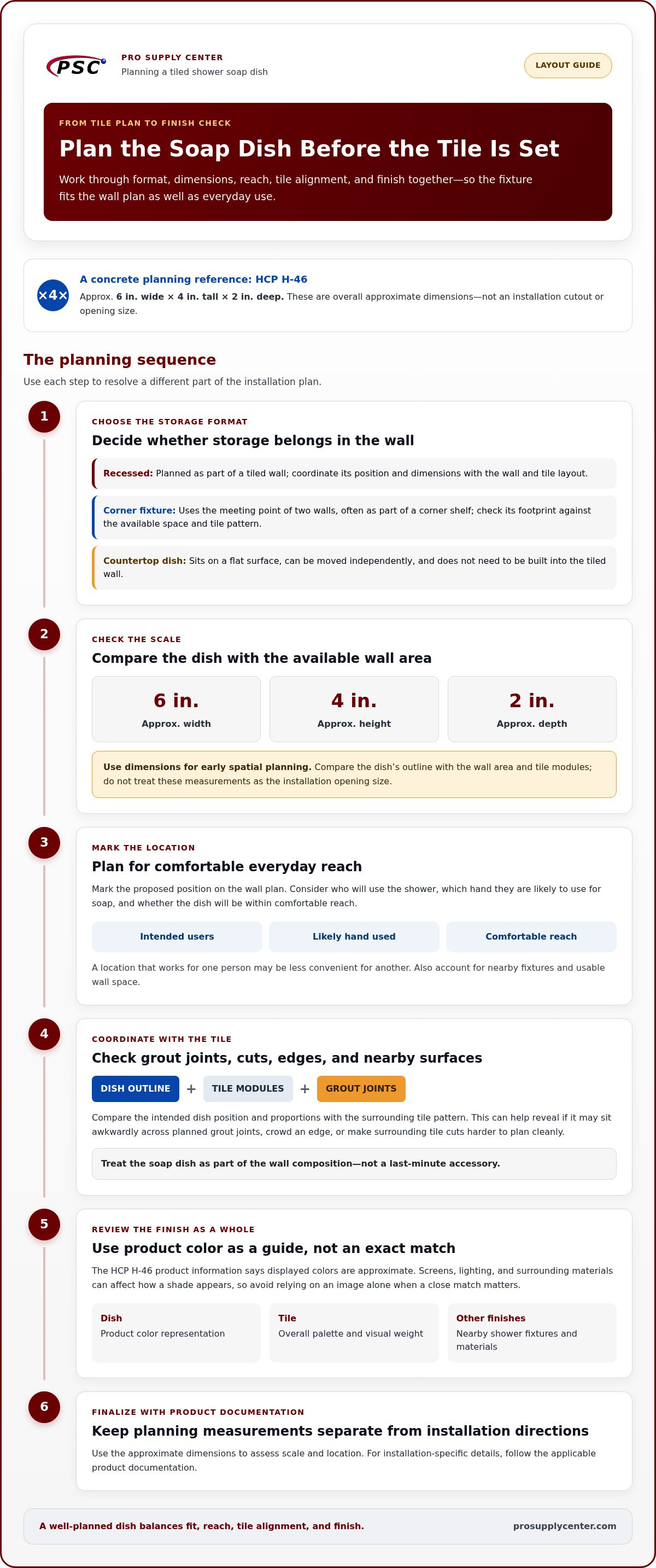
This guide explains how to assess soap-storage formats, choose a practical location, and coordinate the dish with the tile. It also covers what to consider when reviewing dimensions and color. For example, the HCP H-46 ceramic soap dish is approximately 6 inches wide, 4 inches tall, and 2 inches deep. Those measurements offer a useful starting point for layout planning. Product images show approximate colors, so use them as a guide rather than an exact match.
We’ll walk through the decisions in order, from placement and tile integration to finish coordination with other shower fixtures, so you can choose a ceramic dish that works with the installation as well as the design.
Key Takeaways
- Choose between recessed storage, a corner fixture, and a movable countertop dish based on your shower layout and installation context.
- Use the HCP H-46’s approximate dimensions of 6 inches wide, 4 inches tall, and 2 inches deep as a starting point for tile planning.
- Coordinate the PSC Soap Dish with grout lines, surrounding tile, and nearby shower fixtures before settling on its position.
- Treat product color images as approximate when coordinating finishes, especially when a close visual match matters.
- Use these planning steps to guide selection, then follow the product documentation for installation-specific directions.
What to Look for in a Ceramic Shower Soap Dish
A ceramic soap dish provides a designated place for bar soap in a shower or bath. In a tiled room, the format affects more than storage: a built-in fixture becomes part of the wall layout, while a countertop dish remains a separate object. Choose based on where the soap will be used, how the tile is arranged, and whether the fixture should be fixed or movable. For background on materials and form, see this overview of the history and design of soap dishes.
Recessed, corner, or countertop: which soap dish format fits?
A recessed soap dish is planned as part of a tiled wall. Consider its position and dimensions while laying out the wall and tile so the fixture can be coordinated with the surrounding surface. This format suits projects where soap storage is intended to be integrated into the shower or bath wall.
A corner fixture places storage where two walls meet, often as part of a corner shelf. It may suit a layout where that location is convenient, but its shape and footprint still need to work with the available space and tile pattern. A countertop dish, by contrast, sits on a flat surface and can be moved independently. It’s an accessory, not a built-in shower fixture, so it doesn’t need to be incorporated into the tiled wall.
Think about how the shower or bath will be used before choosing. A location that’s easy for one person to reach may be less convenient for another. Select a PSC Soap Dish to suit the room’s actual use and planned surfaces, rather than appearance alone.
Which details matter before selecting a ceramic dish?
Start with the product’s listed dimensions and compare them with the intended wall area. The HCP H-46’s approximate measurements, for example, help establish how much space to allow for the fixture. Consider how its outline will sit against the tile modules and grout joints, and whether the surrounding cuts and edges can be planned cleanly. Use the measurements as a planning reference, not as a substitute for product-specific installation directions.
Then check the position. Mark the proposed location on a layout or wall plan and consider who will use the shower, which hand they’re likely to use for soap, and whether the dish will be within comfortable reach. Account for nearby fixtures and usable wall area instead of choosing a spot simply because it looks open on the plan.
- Wall space: Compare the dish’s approximate width and height with the tile pattern and available surface.
- Use: Place soap storage where the intended users can reach it comfortably.
- Finish: Treat product images as a visual reference when displayed color is approximate.
Color deserves a practical check. Screen settings and lighting can affect how a shade appears, and the HCP H-46 product information states that displayed colors are approximate. Use images to narrow your preference, but don’t treat them as an exact match when coordinating ceramic with tile or other finishes. These checks help you choose a dish that fits both the wall plan and everyday use.
How the HCP H-46 Ceramic Soap Dish Fits a Tiled Shower
The HCP H-46 is a ceramic soap dish described for tiled showers and baths. Its product details give you a concrete starting point for planning: compare its approximate size with the wall area and tile arrangement before finalizing the fixture’s location. The product page also states that it is made in the USA.
Think of the dish as one element in a larger wall composition. Its position can affect which tile pieces surround it and where grout joints fall. Review the product’s proportions against the intended layout rather than treating it as an afterthought. General references to ceramic tile industry standards can help orient a project, but they don’t replace product-specific installation directions.
What do the HCP H-46 dimensions tell you?
The listed approximate dimensions are 6 inches wide, 4 inches tall, and 2 inches deep. Use them to judge the fixture’s overall scale and how it may sit among adjacent tiles. They are not specified as an installation cutout or opening size.
On a layout, mark the intended location and compare the dish’s approximate width and height with the surrounding tile pattern. This can reveal whether the fixture may sit awkwardly across planned grout joints or crowd a nearby edge. Keep the measurements in their proper role: they support early spatial planning, while product documentation governs installation details.
How should you think about ceramic color and finish?
The HCP H-46 product page states that displayed colors are approximate. Treat the product image and listed color as a visual reference, not a promise that the ceramic will match a particular tile exactly. Lighting, screens, and surrounding materials can all affect how a color appears in the finished room.
Compare the product representation with the overall tile palette, including the tones and visual weight of nearby surfaces. If you’re coordinating several materials, consider them together rather than judging the dish in isolation. Avoid making a close-match decision based on an image alone.
For a coordinated selection, weigh scale, placement, and color together. The H-46’s stated dimensions let you assess its footprint against the tile plan, while the approximate-color notice sets a realistic expectation for visual matching. Use those details to decide whether this ceramic fixture suits the shower or bath design, then follow its applicable product documentation for installation instructions. Review the HCP H-46 ceramic soap dish while planning a PSC Soap Dish selection for a tiled project.
Ceramic Soap Dish or Other Soap Storage: Compare by Project Need
The right soap-storage format depends on the available surfaces and how much of the fixture you want incorporated into the room. A recessed ceramic dish is planned with a tiled wall. A corner fixture uses the corner area for storage, while a countertop dish stays separate from the wall. Compare the options by installation context and whether the storage will remain in place or can be moved.
| Format | Project fit | Installation context | Fixed or movable |
|---|---|---|---|
| Recessed ceramic dish | A tiled wall with a planned soap-storage location | Coordinated with the wall and tile layout | Fixed as part of the tiled installation |
| Corner fixture | A layout where corner storage suits the available space | Selected for the corner and installed according to its product requirements | Typically fixed in place |
| Countertop dish | A bath or vanity surface with room for a separate accessory | Placed on a flat surface, outside the tiled wall | Movable |
When does a recessed ceramic soap dish make sense?
Choose a recessed dish when the project calls for a built-in soap location within a tiled wall. Establish its position while planning the wall, before settling the tile placement. That gives you a chance to consider the fixture’s dimensions alongside the tile arrangement and nearby surfaces. The specific wall and the product’s directions determine whether this format suits the project.
This approach is most relevant when the soap dish is intended as a permanent part of the shower or bath design. For broader context on how soap storage relates to other fixtures, the professional shower hardware guide discusses components within a tiled installation. A recessed dish has a distinct role: it provides a designated place for soap while being coordinated with the wall finish.
When might a different soap-storage format suit the project?
A corner fixture may be appropriate when the room’s layout makes a corner the intended storage area. Its shape and position should fit the available space and surrounding tile. A countertop dish works differently. It can be placed or moved on a suitable flat surface, making it an accessory rather than a built-in wall fixture.
For projects comparing built-in storage beyond a soap dish, a PSC shower niche offers a separate point of comparison. A niche and a soap dish serve different storage purposes, so choose based on what needs to be stored and where. The PSC Soap Dish is a relevant option when the plan calls for ceramic soap storage coordinated with tiled walls; other formats suit different placement needs.
Plan Soap Dish Placement Before Tile Installation
A built-in soap dish is easier to coordinate when its location is decided before the tile layout is fixed. Early planning lets you consider how the fixture will be used, how it fits on the wall, and how its outline relates to the surrounding tile. This section offers selection and layout guidance, not a substitute for product-specific installation directions or a full tile and waterproofing procedure.
How do you choose a practical location?
Start with the people using the shower and the way they move through the space. Consider reach, the usual bathing position, nearby fixtures, and the amount of tiled wall area available. A spot that looks convenient on a drawing may be awkward once the shower is in use, so assess the proposed location in relation to the actual layout.
There’s no universal mounting height that suits every user and shower. Instead, mark a proposed location on the plan or wall, then check that it’s accessible without conflicting with adjacent fixtures or the intended tile arrangement. Make this decision before tile work fixes the visible pattern and makes the fixture’s position harder to adjust.
How should the dish coordinate with tile and waterproofing?
Use the fixture’s approximate dimensions to assess its footprint against the tiled area. For example, the HCP H-46 is listed at approximately 6 inches wide, 4 inches tall, and 2 inches deep. These measurements can inform early planning, but they aren’t a cutout specification or a complete set of installation instructions. Use the applicable product documentation for installation details.
Consider the dish and the tile grid together. Look at where the fixture will sit relative to tile edges, grout joints, and nearby transitions. Resolve placement and visual alignment during planning rather than assuming that a particular tile arrangement or installation method will suit every wall.
Plan a soap dish’s location with the tile layout so its placement, surrounding cuts, and finished wall can be considered as one assembly.
Waterproofing details at the wall and fixture interface must follow the instructions for the applicable waterproofing system and fixture. Don’t infer a sealing method or change the wall assembly based on general selection advice. Product-specific directions govern those details; this article doesn’t replace them or explain how to install tile or waterproof a shower.
- Choose the location: Account for reach, shower use, adjacent fixtures, and available wall area.
- Review the dimensions: Use approximate measurements to understand the fixture’s scale, not to determine an opening.
- Coordinate the tile layout: Check the proposed position against the tile pattern and surrounding edges.
- Follow product documentation: Use the fixture and waterproofing system instructions for installation and wall-interface requirements.
These planning checks connect fixture selection to the realities of the tiled wall without assuming installation specifics. Review the PSC Soap Dish options as you settle on a fixture, then use the relevant product instructions to guide installation planning.
Choose the PSC Soap Dish for a Coordinated Tile Project
A well-chosen soap dish fits the project in practical ways: its format suits the intended storage location, its size works with the wall plan, and its appearance complements the tile without relying on an assumed exact color match. Review those factors together before making a selection. The HCP H-46 is a ceramic option described for tiled showers and baths.
Is the HCP H-46 a fit for your project?
The product page identifies the HCP H-46 as a ceramic soap dish for tiled showers and baths and states that it is made in the USA. Its listed approximate dimensions are 6 inches wide, 4 inches tall, and 2 inches deep. Use these figures to assess the dish’s overall scale against the planned wall area and tile arrangement.
These are approximate product dimensions, not cutout or installation measurements. The product page also states that displayed colors are approximate, so use its color representation as a guide rather than an exact promise of how the ceramic will look beside a particular tile. If the project depends on a close visual match, factor that limitation into your decision.
Suitability also depends on the intended fixture format and its installation requirements. Decide whether the project calls for a soap dish integrated with the tiled wall, then consult the applicable product documentation for installation-specific details. Don’t infer a mounting method or wall opening from the product’s general dimensions.
What should you review before making a selection?
Before settling on a ceramic dish, compare its approximate size with the planned tile layout. Consider the visible wall area, the position of surrounding grout joints, and whether the fixture’s outline will fit the composition. Then consider how the soap-storage location will work in daily use and whether a fixed fixture suits the project better than a movable dish.
A short review can keep the decision focused:
- Format: Decide whether a built-in fixture matches the planned storage location.
- Dimensions: Use the listed approximate measurements to assess scale, not to determine installation openings.
- Tile coordination: Consider the dish’s placement with the wall layout and surrounding surfaces.
- Color expectations: Treat displayed colors as approximate when comparing finishes.
- Installation details: Follow the applicable product documentation for specific requirements.
These checks bring the main decisions into one sequence: choose the fixture format, compare dimensions with the tile plan, and assess color realistically. This connects selection to the actual room instead of treating the soap dish as a separate finishing choice. The HCP H-46 offers a ceramic option for tiled showers and baths, with stated approximate dimensions and country of manufacture.
Explore the PSC Soap Dish and shower supplies as you finalize the fixtures for your tile project.
Move Your Tile Plan Toward a Confident Fixture Choice
Before finalizing the wall plan, decide what role soap storage should play in the finished shower or bath. A built-in fixture is part of the tiled composition, so its position deserves attention alongside the broader design choices. The HCP H-46 product information identifies it as a ceramic dish for tiled showers and baths, made in the USA. Use those stated details as a starting point while keeping the project’s layout and applicable product directions in view.
A considered PSC Soap Dish selection can bring practical use and tile design into alignment. Take the next step by reviewing the ceramic dish and related shower components together: Explore the PSC Soap Dish and shower supplies. With the fixture choice connected to the plan, you can move forward with greater clarity.
Frequently Asked Questions
Can you add a recessed soap dish to an already tiled shower?
Sometimes, but the work depends on the existing wall assembly, tile, and waterproofing system. Adding a recessed fixture may require opening the tiled wall, so it’s more involved than attaching a surface accessory. Before changing the wall, review the instructions for both the fixture and waterproofing system. There isn’t one universal retrofit method; the existing construction determines the appropriate approach.
Is a ceramic soap dish suitable for a bathtub surround?
The HCP H-46 product page describes the ceramic dish for tiled showers and baths, including a tiled bathtub surround. The project still needs to account for the wall assembly and how the fixture fits into the tile layout. Review the applicable fixture instructions before planning the installation, since product use information alone doesn’t establish how it should be integrated into every surround.
How do you clean a ceramic shower soap dish?
Remove soap residue regularly with a non-abrasive cloth and a suitable mild cleaner. Apply the cleaner according to its label, then rinse or wipe the surface as directed. Avoid abrasive tools and harsh chemicals unless the cleaner and product instructions allow them, since care requirements can vary. These are general precautions, not specific cleaning instructions from the HCP H-46 product page.
What should you do if a recessed soap dish becomes loose?
Stop using a loose recessed dish until its condition has been assessed. Movement may point to an issue with the fixture’s attachment or the surrounding wall, and continued handling could affect the area around it. The appropriate response depends on how the dish and wall were installed, so don’t assume a particular repair method. Follow the applicable fixture and wall-system instructions when determining next steps.
What does nominal size mean for a ceramic soap dish?
A nominal size is a rounded designation, so it may not match a product’s exact measured dimensions. The HCP H-46 page gives approximate dimensions of 6 inches wide, 4 inches tall, and 2 inches deep. Treat those figures as product-size guidance, not as the opening or cutout required for installation. Use the applicable product documentation for installation measurements and requirements.
Are the colors shown for the HCP H-46 exact?
No. The HCP H-46 product page states that displayed colors are approximate. Screens, lighting, and nearby tile can influence how a color appears, so an online image shouldn’t be treated as an exact match. Compare the product representation with the project’s overall palette as a visual reference, while allowing for differences in how the color looks in the finished space.


